EN


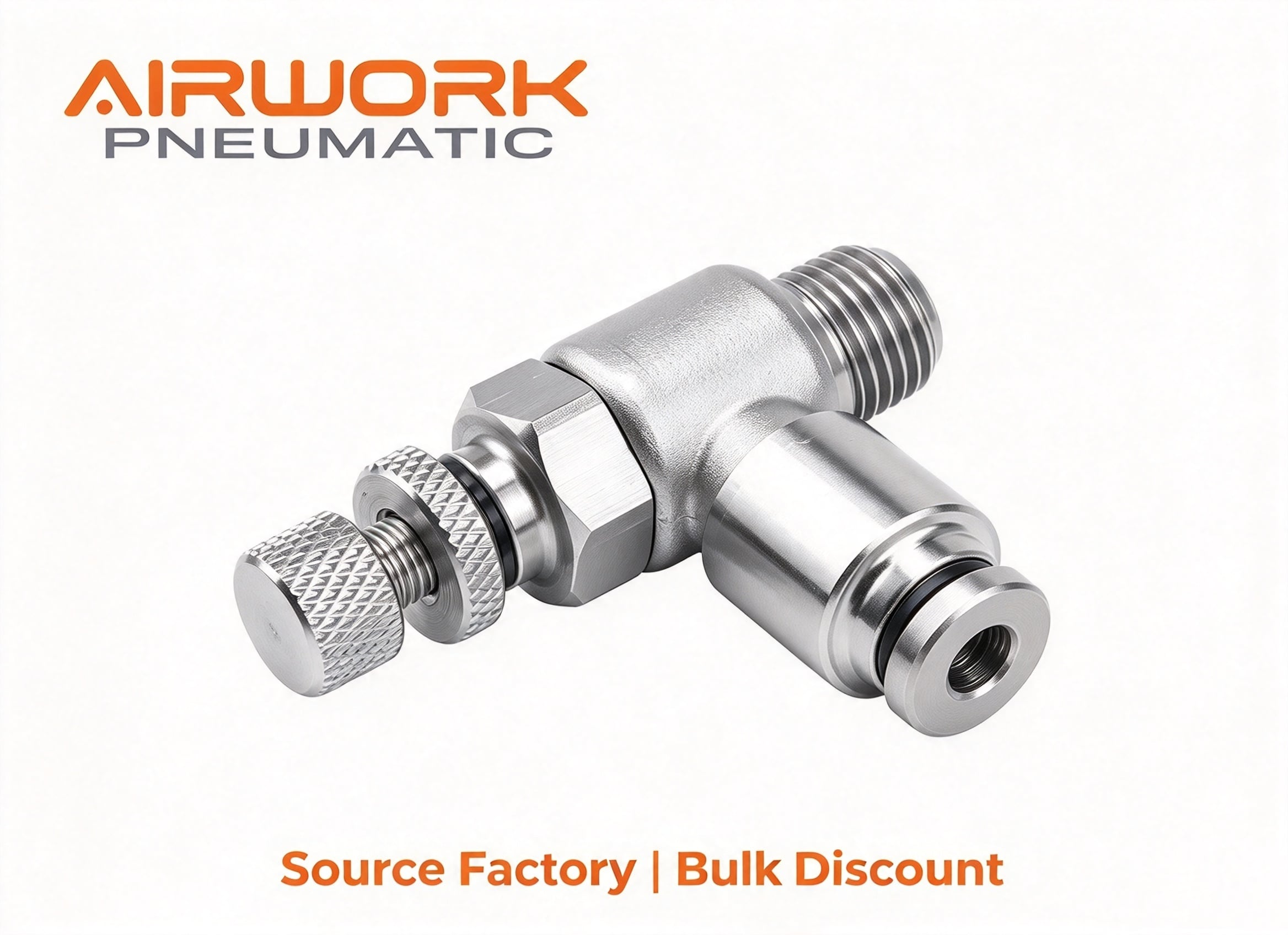
Stainless Steel Elbow Speed Controller Pneumatic Flow Control Valve One Touch Push In Fitting Meter Out Cylinder M G PT Thread
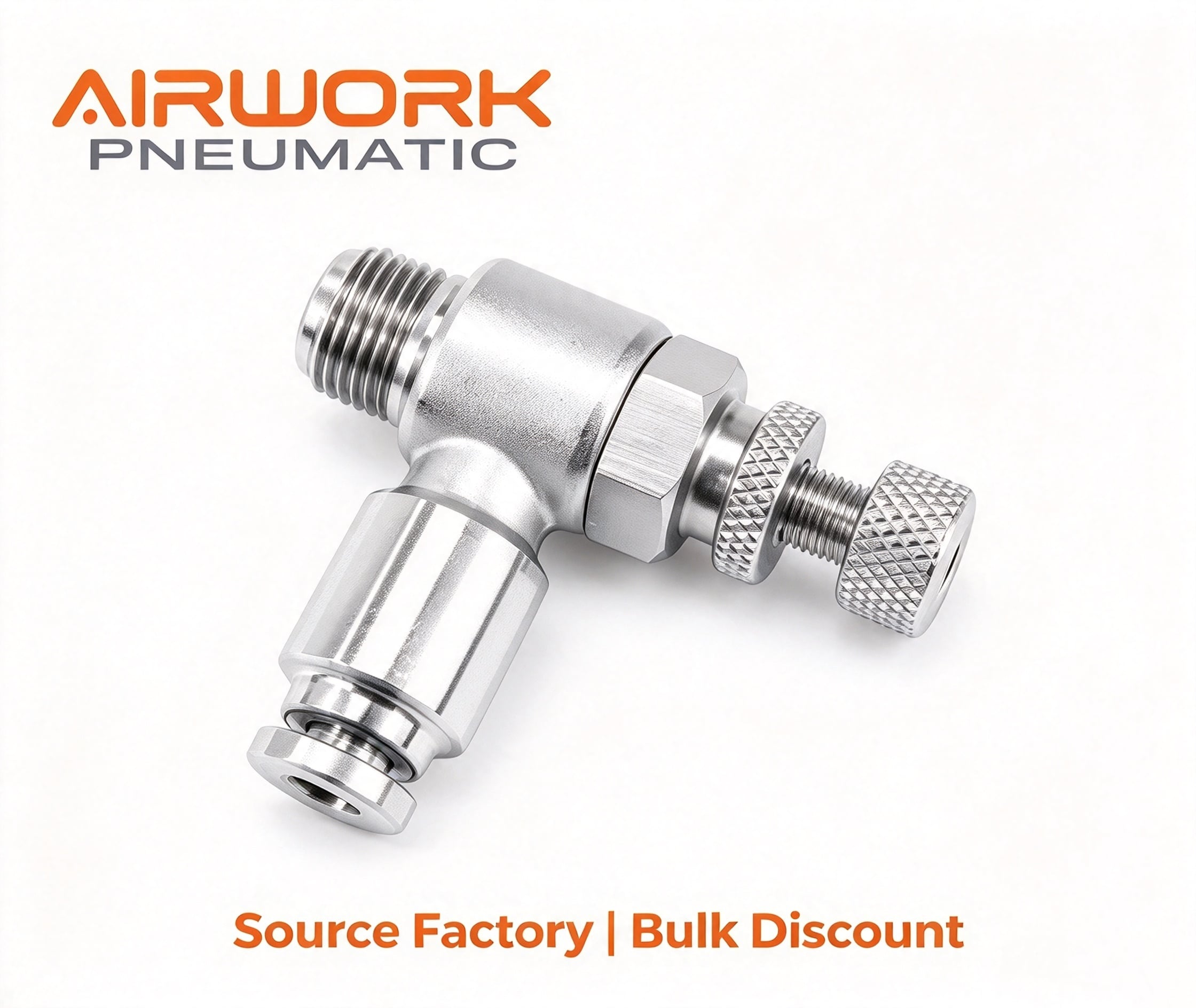
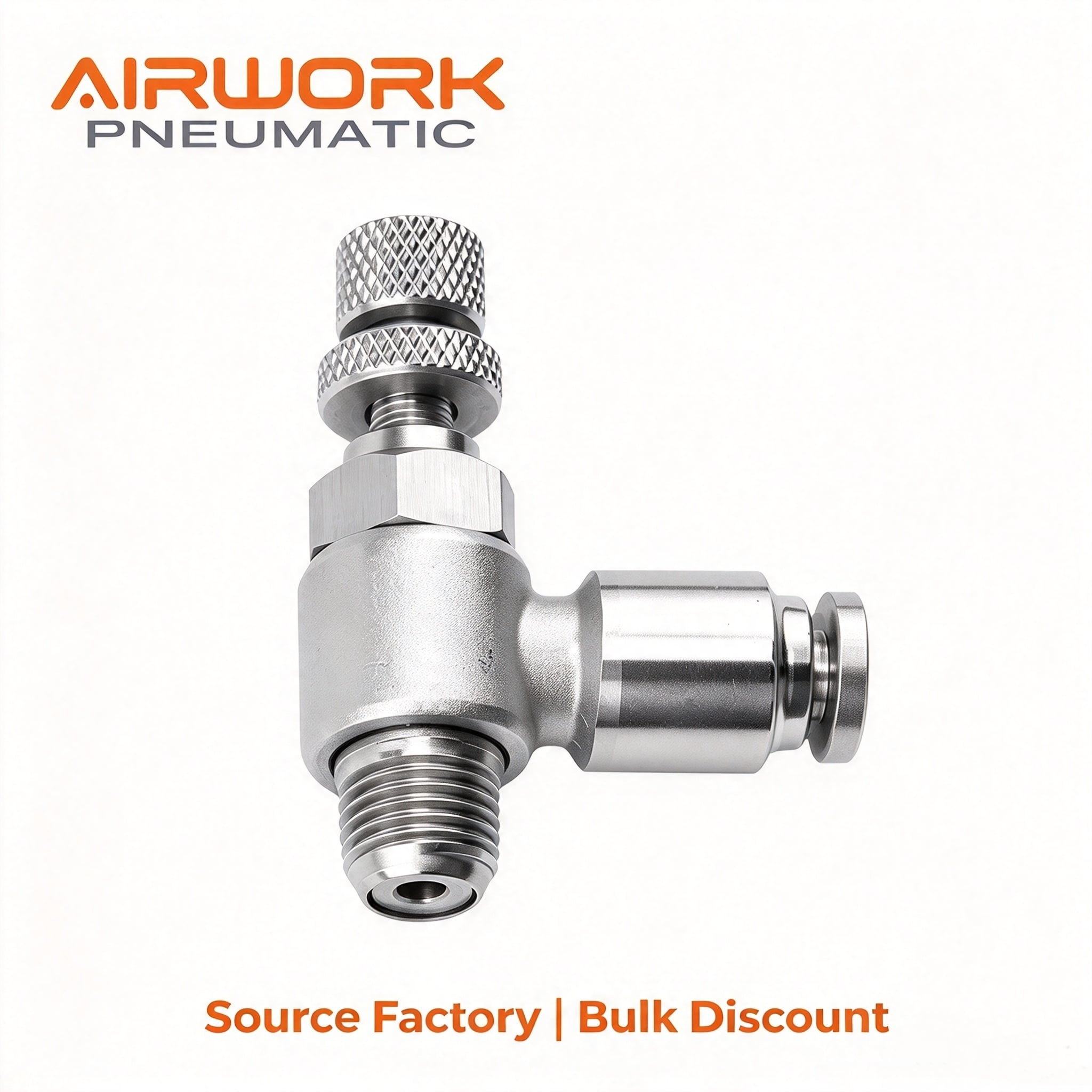
A stainless steel elbow speed controller that screws into a cylinder port and sets how fast the rod moves by throttling the air leaving the cylinder. One end is a male thread, the other is a one touch push in collet for the tube, and the body turns through 90 degrees so the air line leaves the port along the machine frame instead of standing out from it. The needle is adjusted by hand and locked with a nut, so a setting survives vibration once it has been made.
- Overview
- Recommended Products
Product Detailed Description:
The BKC-SL is an elbow speed controller, which means the body turns the air line through a right angle and the needle sits in the path of that flow. The threaded end screws into the cylinder port, the tube pushes into the collet, and the knob on top of the body sets how far the needle lifts off its seat. Turning the knob changes the open area, and the open area changes the rod speed; there is nothing else to adjust on the cylinder itself.
The standard version throttles the exhaust side, not the supply side. On a double acting cylinder the air that has to leave the rod end is what limits the rod speed, and controlling that escape gives a stiffer, more predictable stroke than choking the supply: the piston is pushed against a controlled back pressure instead of being starved of air. This is why a meter out speed controller is fitted to the port the air leaves, and why the same valve fitted on the wrong port will still adjust speed but will feel spongy under load.
The body is stainless rather than plated brass so that the same fitting can be used where the machine is washed down, where salt or chemical vapour reaches the panel, or where an outdoor cabinet collects condensation. Threads are available in M, G and PT, with custom threads on request, and the thread system is quoted together with the tube size because the three seal differently: M and G are parallel and seal on a washer or an O ring, PT is tapered and seals on the thread flank with a sealant.
Product Feature:
- Elbow body, 90 degree turn: the tube leaves the cylinder port along the frame rather than straight out of it, which keeps the line inside the machine envelope and out of the way of moving parts.
- Meter out throttling: the needle controls the air leaving the cylinder, so the rod is held against a controlled back pressure and the stroke stays steady when the load changes.
- Needle with lock nut: the setting is made by hand and locked, so it does not drift with vibration or with the tube being moved during maintenance.
- Stainless steel body: chosen for washdown bays, coastal plants and chemical atmospheres where a plated body pits at the thread and at the collet window.
- Push in collet, tool free: the tube goes in by hand and is released by pressing the ring, so a line can be re-routed without cutting a new length.
- Three thread systems, one body range: M, G and PT cover metric ports, European parallel ports and tapered pipe ports, with custom threads on request.
- Adjustment without dismantling: the knob is reachable with the tube in place, so a speed change during commissioning does not mean pulling the line apart.
Application Industries:
- Packaging machinery – carton erecting, sealing heads, pushers and diverters where a fast approach has to end softly
- Food and beverage processing – washdown areas, filling heads, conveyor transfers
- Assembly and automation cells – pick and place, clamping, pressing and ejector strokes
- Automotive and paint shops – jig clamping, booth surrounds, corrosive atmosphere
- Water treatment and chemical dosing – actuator pilot lines on panels and skids
- Marine, offshore and shipboard – deck machinery, hatch and door actuation
- Medical device and laboratory – slow, repeatable actuator movement in humid rooms
- Textile, printing and woodworking – traverse and feed units that need a set speed
- General pneumatic automation – any double acting cylinder that has to arrive without slamming
Specification:
Item |
Detai |
Series |
BKC-SL elbow speed controller |
Type |
Elbow body, 90 degree, meter out throttling |
End 1 |
Push in collet for tube |
End 2 |
Male thread, M / G / PT, custom thread on request |
Tube outside diameter |
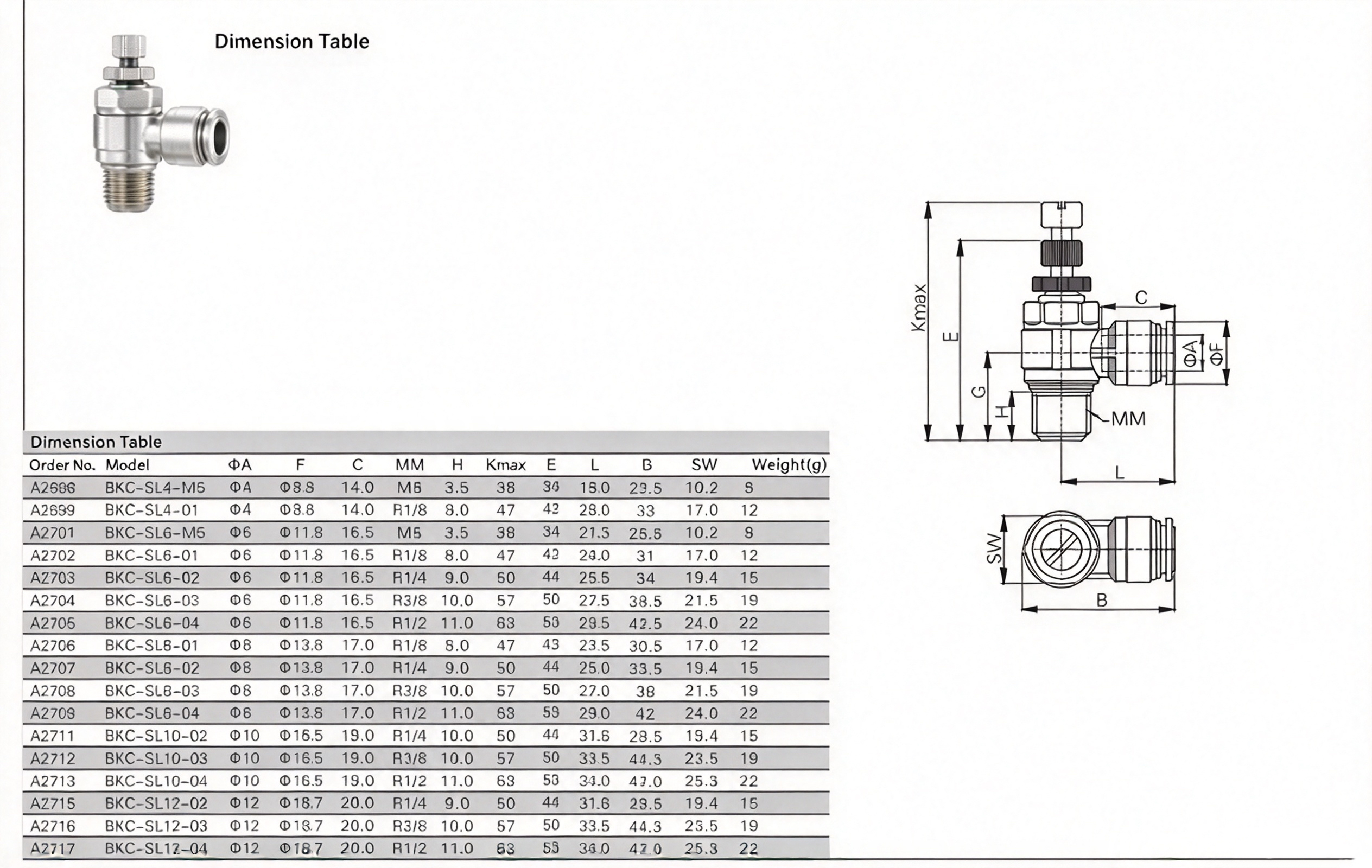
4 / 6 / 8 / 10 / 12 mm (per model) |
Body material |
Stainless steel |
Adjustment |
Needle with lock nut, hand adjusted |
Seal |
Confirmed per model |
Fluid |
Compressed air and inert gas; other media confirmed against the seal |
Thread sealing |
M and G seal on a washer or O ring, PT seals on the thread flank with a sealant |
Typical pairings |
4 mm tube with M5 or M6, 6 mm and 8 mm tube with G1/8 or PT1/8, 10 mm and 12 mm tube with G1/4 or PT1/4 |
MOQ |
50 pcs |
Customization Options:
Customization Item |
Options |
Tube size |
4 / 6 / 8 / 10 / 12 mm OD, other sizes on request |
Thread system |
M metric, G parallel, PT tapered |
Thread size |
Matched to the cylinder port on the drawing, quoted per size |
Custom thread |
Non standard pitch or diameter, made to drawing |
Body material grade |
Stainless grade confirmed with the order |
OEM marking |
Laser marking on the body, neutral bag and label |
Application:
1.Carton erecting head (packaging):
A sealing head is driven down by a cylinder and has to arrive on the flap without bouncing. The speed controller sits on the rod end port and throttles the air leaving it, so the head decelerates into the stop instead of hitting it at full speed. The elbow body keeps the tube running along the frame, which matters on a head that moves several hundred millimetres per cycle and would otherwise drag a loop of tube into the guard.
2.Ejector stroke on a clamping fixture (assembly line):
An ejector pushes a finished part off a nest and has to do it in one steady movement, whatever the weight of the part. Because the valve holds a back pressure on the exhaust side, the stroke stays close to the set speed from an empty nest to a full one, and the lock nut keeps that setting through a shift of vibration. A meter in valve in the same position would let the rod run away on a light part.
3.Washdown transfer on a food line (corrosive environment):
On a conveyor transfer the cylinders sit under a frame that is hosed down at the end of each shift. Plated bodies at the port show a white bloom within a season and the needle starts to seize; a stainless body keeps the adjustment free, which is the whole reason for specifying it here rather than in the dry part of the plant.
Installation and Usage:
- Fit it on the exhaust side: on a double acting cylinder the speed controller goes on the port the air leaves during the stroke being controlled. Putting it on the supply side still changes speed but loses the stiffness that a meter out setting gives.
- Set it under the real load: adjust with the machine running its normal cycle and the normal workpiece in place. A setting made with the fixture empty will run faster once there is a load on the rod.
- Lock the nut after setting: the needle is held by a lock nut. A setting that is not locked will move with vibration and the fault will be read as a sticking cylinder.
- Cut the tube square: use a tube cutter and check for burrs. A slanted end seats on one side only and will leak at the collet.
- Do not use it as a shut off valve: the needle is an adjusting device, not a seal. A cylinder that has to be isolated needs a proper valve in the line.
- Keep the air clean: filtration ahead of the valve keeps the needle seat clear; debris on the seat turns a fine adjustment into a two position switch.
- Leave access to the knob: mount so the knob can be reached with the tube connected, otherwise every speed change becomes a dismantling job.
FAQ:
Q1. What is the difference between a speed controller and a flow control valve?
A1. They are the same family of adjustable valve; the name changes with how it is used. A speed controller is fitted at a cylinder port to set rod speed, while a flow control valve may sit anywhere in a line. This body is built for the cylinder port, with a push in tube end and a male thread.
Q2. How do I read the model code?
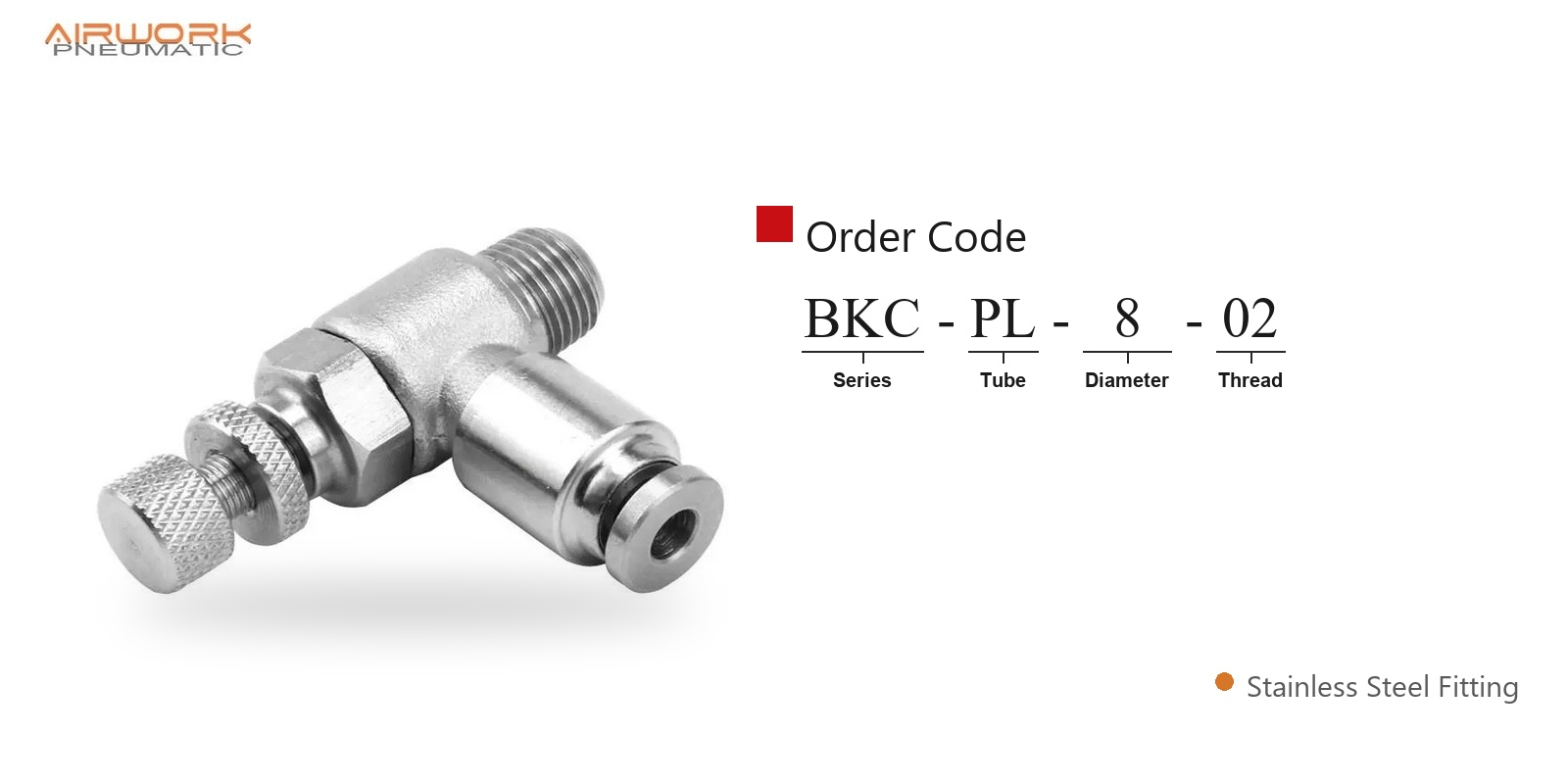
A2. BKC-SL is the series, followed by the tube outside diameter and then the thread. A 6 mm tube with a 1/8 thread reads as the 6 by 1/8 size. State tube OD and thread system together, because M, G and PT of the same nominal size are different fittings.
Q3. What does meter out mean and why is it the standard?
A3. Meter out throttles the air leaving the cylinder. The piston is pushed against a controlled back pressure, which gives a stiffer stroke and a speed that holds when the load changes. Meter in throttles the supply instead and is used where the load is steady and the exhaust is restricted for other reasons.
Q4. Can I use it to hold a load or as a shut off?
A4. No. The needle adjusts flow, it does not seal. A vertical load that must be held needs a pilot check valve or a mechanical brake, and a line that must be isolated needs a proper valve, not a speed controller screwed shut.
Q5. Why stainless instead of plated brass?
A5. The function is the same; the body is the difference. Plated brass is the economical choice in dry indoor air. Stainless is chosen where washdown, salt or chemical vapour attacks the plating at the thread and seizes the needle, which is the failure that takes a machine out of service.
Q6. What are the working pressure and temperature?
A6. They are stated per size and per seal on the quotation rather than as one figure for the range, because the tube size and the seal set the limit. Tell us the line pressure, the temperature and the tube material, and the model is matched to it.
Q7. How many turns of adjustment do I get?
A7. The adjustment range is set by the needle and seat of the model rather than quoted as a turn count, because the useful range depends on the cylinder volume and the load. Set it on the machine; if the working point ends up at the very end of the travel, the next tube size is usually the better answer.
Q8. Can it be used with the tube already fitted?
A8. Yes. The knob is reached with the tube connected, so a speed change during commissioning does not mean pulling the line apart. Release the lock nut, adjust, then lock it again before the machine goes back into cycle.
Q9. What is the MOQ and can you mark the body?
A9. MOQ is 50 pcs. Laser marking on the body and neutral bag and label are available on request, which suits a distributor who sells under their own part number.
Factory Advantages and Certifications:
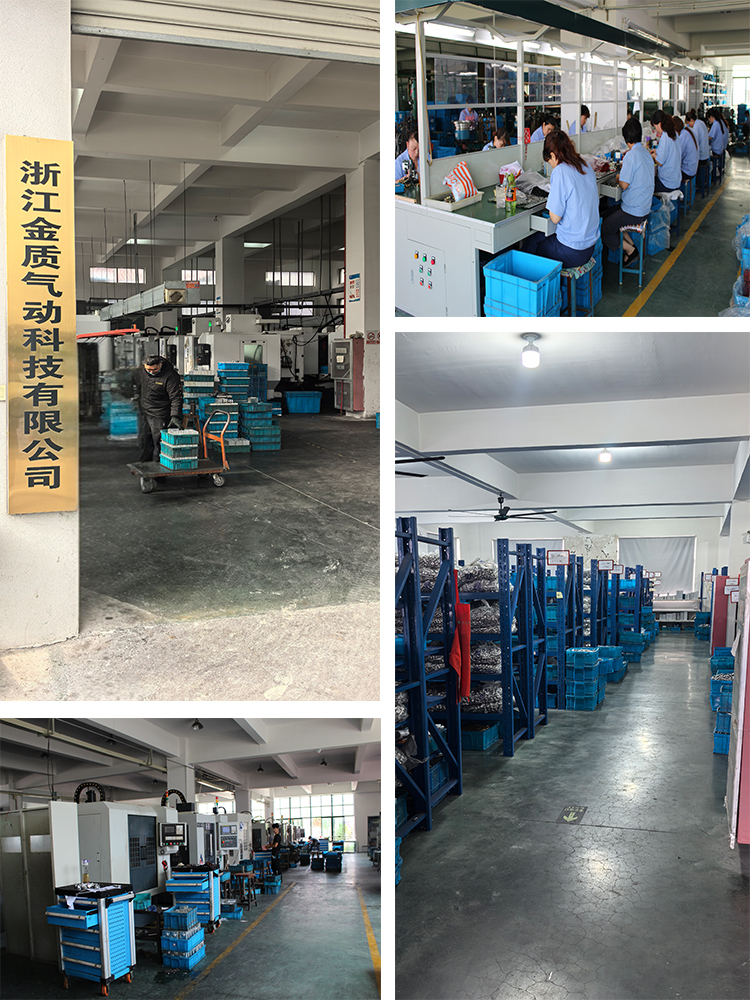
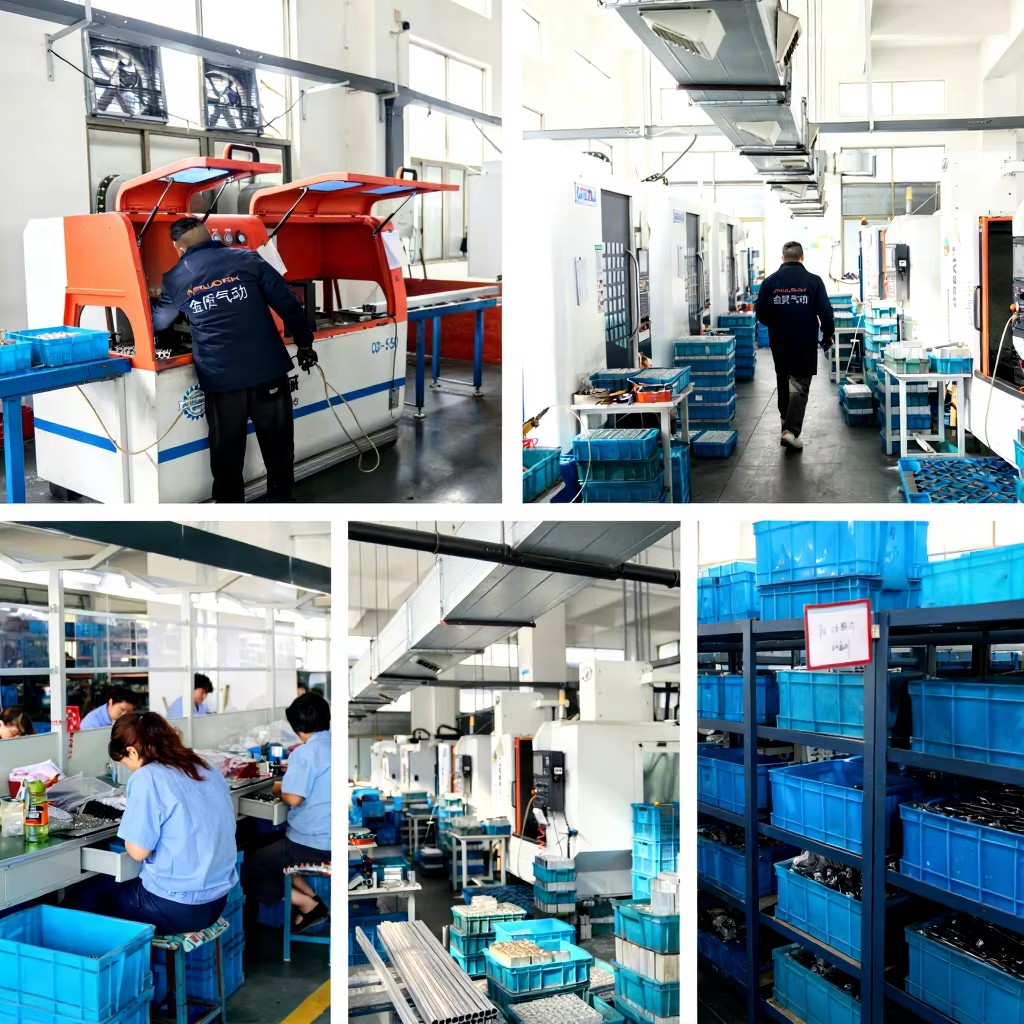
The BKC-SL is machined and assembled as one family rather than as separate sizes bought in, which is what keeps the needle seat and the thread depth consistent from one tube size to the next. Bodies are checked at the thread, at the collet bore and at the needle seat before assembly, and each batch carries a batch number on the bag so a complaint can be traced to a run rather than to a guess. OEM marking and neutral packaging are handled in house.
Certification