 EN
EN

Q: What are ATEX Zone 1 and Zone 21 classifications, and why are they critical for industrial plant safety?
In chemical processing plants, petrochemical refineries, pharmaceutical facilities, and grain silos, the presence of flammable gases, liquids, vapors, or combustible dusts is a constant operational reality. To ensure worker safety and prevent catastrophic explosions, the European Union enforces the ATEX directive (2014/34/EU), which is the global standard for regulating equipment used in explosive atmospheres. Sourcing managers and R&D engineers must understand these classifications when designing or upgrading plant automation.
Hazardous areas are divided into different zones based on the frequency and duration of the explosive atmosphere:
- Zone 1 (Gas/Vapor/Mist): A place in which an explosive atmosphere consisting of a mixture of air and flammable substances in the form of gas, vapor, or mist is likely to occur occasionally in normal operation. Typical locations include the vicinity of loading docks, chemical reaction vessels, and paint-spraying booths.
- Zone 21 (Combustible Dust): A place in which an explosive atmosphere in the form of a cloud of combustible dust in air is likely to occur occasionally in normal operation. Typical locations include coal handling facilities, flour mills, and pharmaceutical powder-blending areas.
In these environments, any electrical or mechanical component can act as an ignition source. Sourcing managers must buy ATEX-certified pneumatic components that are specifically classified under Category 2 (suitable for Zone 1 and Zone 21). Using uncertified equipment in these areas is a severe regulatory violation and a massive safety hazard, as standard pneumatic components can generate static electricity, sparks from mechanical impact, or excessive surface heat that can ignite the surrounding atmosphere.
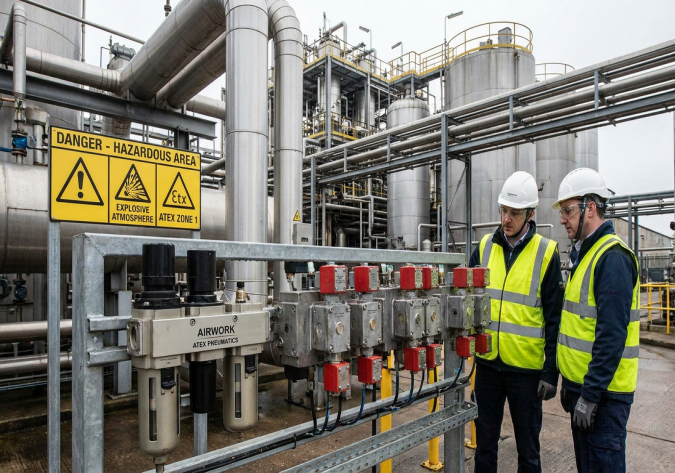
Q: What are the primary ignition risks in standard pneumatic components, and how does ATEX certification address them?
A common misconception in B2B procurement is that pneumatics are inherently safe because they run on compressed air rather than electricity. While compressed air itself does not burn, standard pneumatic components present several hidden ignition risks that must be engineered out to receive ATEX certification:
- Electrostatic Discharge (ESD): As dry compressed air flows through polyurethane tubing or across plastic silencers, it generates static electricity. This electrical charge can build up on non-conductive plastic surfaces. If a worker touches the part or if it comes near a grounded metal pipe, the static charge can release a high-energy spark, which is more than enough to ignite flammable gases or fine organic dust.
- Mechanical Impact Sparks: If a pneumatic cylinder's piston rod or mounting bracket experiences heavy shock or lateral loads, metal-on-metal contact can occur. For example, a steel piston rod striking a steel guide can generate mechanical friction sparks. If the cylinder is made of certain aluminum alloys, striking it with rust-covered tools can trigger a thermite reaction, creating highly energetic sparks.
- Solenoid Coil Overheating: Solenoid valves use electrical currents to move the internal spool. Standard solenoid coils can run extremely hot under continuous operation. If the surface temperature of the coil exceeds the ignition temperature of the surrounding gas or dust (the Temperature Class, e.g., T4 or T6), the coil will ignite the atmosphere directly.
- Friction Heat in Dynamic Seals: At high speeds, the dynamic rubber seals inside a pneumatic cylinder or valve spool generate heat due to friction. If the lubrication dryout occurs, this local heating can raise the component's surface temperature above safe levels.
ATEX certification requires manufacturers to design out these risks. Pneumatic components must use anti-static, conductive polymers to bleed off static charges to the ground. Cylinder rods must incorporate non-sparking materials, and solenoid coils must be encapsulated in flame-proof, sand-filled, or intrinsically safe housings that prevent any internal spark or heat from escaping into the environment.
Q: What technical markings and specifications should a procurement manager verify when sourcing ATEX pneumatic components?
Sourcing ATEX components requires a meticulous review of product markings. Procurement managers should look for the official hexagonal Ex logo and verify the alphanumeric ATEX coding. A typical marking for Zone 1 and Zone 21 compliance looks like this:
Ex h IIB T4 Gb / Ex h IIIC T135C Db
Here is how to decode these critical specifications:
- Ex h: Indicates that the component uses mechanical protection standards (such as constructional safety 'c' or control of ignition sources 'b') rather than purely electrical protection.
- IIB (Gas Group): Suitable for environments containing gases like ethylene, ether, or propane. Group IIC is the most stringent (hydrogen, acetylene), while IIA is the least. IIB is the standard for most chemical and industrial process plants.
- IIIC (Dust Group): Suitable for environments with conductive dusts (such as graphite or metal powders). IIIB covers non-conductive dusts (grain, starch), and IIIA covers flyings.
- T4 / T135C (Temperature Class): For gases, T4 means the maximum surface temperature of the component will never exceed 135 degrees Celsius under any operating or fault condition. For dust, T135C indicates the maximum surface temperature is capped at 135 degrees Celsius. Sourcing managers must ensure this temperature is safely below the minimum ignition temperature of the chemicals and dust present in their specific plant.
- Gb / Db (Equipment Protection Level): Gb denotes high protection for gas (Zone 1), and Db denotes high protection for dust (Zone 21).
Q: What dedicated ATEX-certified pneumatic solutions does AIRWORK provide for hazardous zone safety?
AIRWORK has built a global reputation for manufacturing high-reliability ATEX-certified pneumatic components that comply fully with the European Directive 2014/34/EU. Our range includes:
- ATEX Certified Cylinders: AIRWORK offers ISO 15552 and ISO 6432 cylinders certified for Category 2G (Zone 1) and 2D (Zone 21). These cylinders are constructed with high-durability anodized aluminum or SUS316 stainless steel, fitted with specialized metallic scraper rings, and incorporate dedicated grounding terminals to ensure all static charges are safely discharged.
- ATEX Solenoid Valves: Our control valves are equipped with flame-proof (Ex d) or encapsulated (Ex m) solenoid coils. They feature IP67 sealing to prevent dust and moisture ingress and are rated for 100% continuous duty cycles, ensuring safe, cool operation in high-risk zones.
- ATEX Air Preparation (FRL) Units: Clean air is vital. AIRWORK's ATEX-certified filters, regulators, and lubricators utilize anti-static technopolymer bowls and metallic housings, ensuring that the air preparation process does not build up dangerous electrostatic charges.
By partnering with AIRWORK, procurement managers can source fully documented, certified ATEX packages. Every shipment is accompanied by an official Declaration of Conformity and an operations manual outlining correct installation and grounding procedures. This comprehensive documentation simplifies plant safety audits, ensures immediate insurance approval, and protects your capital equipment and human workforce from explosive hazards.
Table of Contents
- Q: What are ATEX Zone 1 and Zone 21 classifications, and why are they critical for industrial plant safety?
- Q: What are the primary ignition risks in standard pneumatic components, and how does ATEX certification address them?
- Q: What technical markings and specifications should a procurement manager verify when sourcing ATEX pneumatic components?
- Q: What dedicated ATEX-certified pneumatic solutions does AIRWORK provide for hazardous zone safety?