 EN
EN

Q: Why is compressed air consumption in packaging machinery such a major concern for manufacturing plants, and where is the energy being wasted?
Compressed air is often called the 'fourth utility' in modern manufacturing, alongside electricity, gas, and water. However, it is by far the most expensive utility to produce. A staggering 85% to 90% of the electrical energy used to power an air compressor is lost as heat. Only 10% to 15% is converted into usable pneumatic energy. In high-volume packaging plants, where thousands of pneumatic cylinders cycle continuously, day and night, compressed air consumption represents a massive operational expense and a significant source of carbon emissions.
Packaging machinery, including cartoners, bagging machines, tray sealers, pick-and-place systems, and palletizers, is heavily reliant on pneumatic systems. Pneumatics are chosen because they are fast, reliable, clean, and offer high power density. However, because pneumatic systems are simple to install, they are often poorly optimized. This leads to massive energy waste across several areas:
- Uniform Pressure on Non-Work Strokes: A standard pneumatic cylinder is designed to perform its primary work (such as clamping, pressing, or pushing a heavy box) on its forward stroke. This requires high pressure, typically 6 bar. However, on the return stroke, the cylinder is merely returning to its starting position, moving no load. Despite this, standard setups supply the same 6 bar of compressed air to both ends of the cylinder, wasting energy on the return stroke.
- High Air Pressure Over-Specification: Machinery designers often specify a higher operating pressure than necessary to ensure a margin of safety. If a machine can operate perfectly at 4 bar, but the plant supplies 6 bar, the system wastes a massive amount of compressed air on every single cycle.
- Excessive Dead Volume: The volume of air contained within the tubing between the control valve and the cylinder is called 'dead volume.' On every cycle, this air is pressurized and then exhausted into the atmosphere without doing any useful work. If the tubing is excessively long or has a larger diameter than necessary, this dead volume wastes a significant amount of air.
- Continuous Exhaust Waste: During normal valve switching, standard solenoid valves exhaust pressurized air directly into the atmosphere, throwing away valuable pressure energy that could be recycled.
For B2B manufacturing plants and packaging OEMs, these inefficiencies add up to thousands of dollars in wasted electricity bills annually. Optimizing pneumatic energy is no longer just an environmental goal; it is a critical requirement for maintaining cost competitiveness.
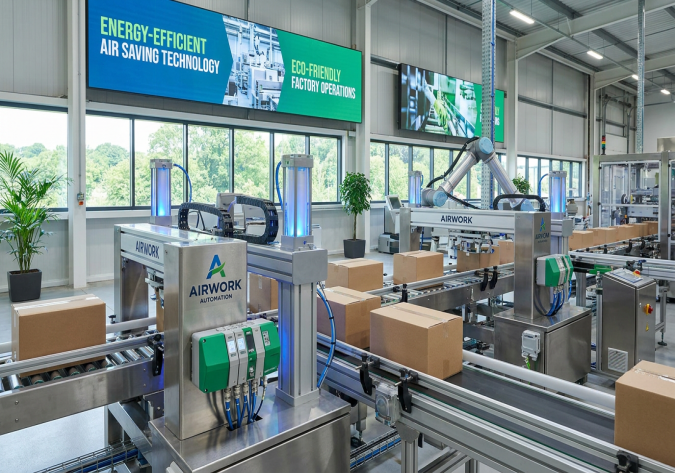
Q: How do air-saving valves and dual-pressure pneumatic circuits optimize energy consumption in packaging applications?
The most effective way to reduce compressed air waste in packaging machinery is by implementing advanced air-saving valves and dual-pressure circuits. These technologies target the core source of pneumatic waste: the non-work stroke.
AIRWORK has developed specialized air-saving valve solutions that operate on the principle of pressure optimization and air recycling:
- Dual-Pressure Circuits: An air-saving valve can be configured to supply high pressure (such as 6 bar) to the cylinder's forward stroke and low pressure (such as 2 or 3 bar) to the return stroke. By reducing the return pressure to the minimum level required to retract the piston, the cylinder consumes up to 50% less air on its return stroke. Over millions of cycles, this translates to an overall reduction in air consumption of 25% to 35% for that actuator.
- Built-In Pressure Regulators: AIRWORK's energy-saving manifolds incorporate compact, high-precision regulators directly on the valve body. This allows engineers to tune the operating pressure of individual cylinders to match their exact load requirements, preventing overall machine over-pressurization.
- Exhaust Air Recycling: Some of AIRWORK's advanced air-saving valves incorporate an internal bypass circuit. When the cylinder completes its high-pressure forward stroke, instead of exhausting all the pressurized air into the atmosphere, the valve redirects a portion of this air to pressurize the opposite end of the cylinder for the return stroke. This recycling mechanism allows the return stroke to be completed using 'free' waste air, further reducing the load on the air compressor.
- Low-Power Solenoid Technology: Solenoid valves themselves consume electrical energy. AIRWORK's energy-saving coils consume only 0.5 to 1.5 Watts of electricity, compared to standard 4 to 5 Watt coils. This reduces the heat generation in electrical cabinets and lowers overall electrical consumption.
Q: What design practices should R&D engineers adopt to minimize pneumatic dead volume in packaging machinery?
While air-saving valves provide immediate results, R&D engineers can achieve further energy optimization by adopting smart pneumatic design practices. Minimizing dead volume is a key strategy:
- Mount Valves Close to Cylinders: Traditionally, solenoid valves are grouped together in a central cabinet for easy maintenance. While convenient, this requires long tubing runs to the cylinders, creating massive dead volume. Engineers should utilize decentralized valve manifolds, such as AIRWORK's compact series, mounting them directly onto the machine frame near the actuators to keep tubing lengths under 500mm.
- Optimize Tubing Diameter: Sizing tubing is a delicate balance. Tubing that is too narrow restricts flow and slows down machine operation. However, tubing that is too wide increases dead volume. R&D engineers should use AIRWORK's flow calculation software to select the minimum tubing diameter that satisfies the cylinder's speed requirements.
- Select Compact and Integrated Actuators: Modern packaging machines benefit from integrated cylinder-valve units. By combining the control valve and the cylinder into a single physical unit, the connecting tubing is completely eliminated, reducing dead volume to zero.
Q: What is the Total Cost of Ownership (TCO) and ROI of upgrading to AIRWORK's air-saving pneumatic systems?
For B2B procurement managers, evaluating the financial viability of upgrading to energy-efficient pneumatics is essential. Upgrading standard valves to AIRWORK's air-saving systems represents a minor initial capital expenditure, but it delivers an exceptionally fast payback period:
- Rapid ROI (Return on Investment): In a typical packaging facility operating 24/7, upgrading a single high-cycle packaging line with AIRWORK air-saving valves can reduce electricity bills by $500 to $1,500 per machine per year. The payback period for the replacement valves is often less than 6 months.
- Reduced Compressor Maintenance: Lowering air consumption reduces the load on the plant's air compressors. Compressors run cooler, wear out slower, and require fewer expensive maintenance overhauls, extending their overall service life.
- Carbon Footprint Reduction: Minimizing electricity consumption directly lowers the plant's greenhouse gas emissions. Sourcing from AIRWORK allows manufacturing companies to document concrete energy-saving data, helping them achieve corporate sustainability goals and comply with international environmental standards like ISO 50001.
By partnering with AIRWORK, packaging OEMs and manufacturing plants can transform their pneumatic systems from expensive energy drains into highly optimized, sustainable, and cost-effective automation assets.
Table of Contents
- Q: Why is compressed air consumption in packaging machinery such a major concern for manufacturing plants, and where is the energy being wasted?
- Q: How do air-saving valves and dual-pressure pneumatic circuits optimize energy consumption in packaging applications?
- Q: What design practices should R&D engineers adopt to minimize pneumatic dead volume in packaging machinery?
- Q: What is the Total Cost of Ownership (TCO) and ROI of upgrading to AIRWORK's air-saving pneumatic systems?