 EN
EN

Q: What are high-frequency response failures in SMT pneumatic systems, and how do they manifest in electronic assembly lines?
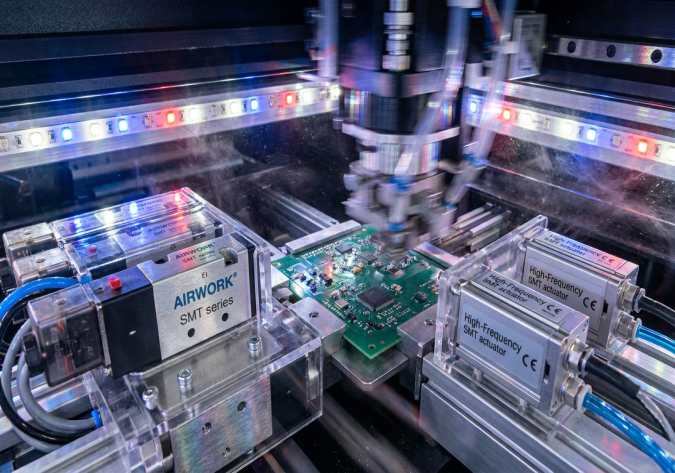
In Surface Mount Technology (SMT) electronics assembly, speed and precision are the primary metrics of production efficiency. Modern pick-and-place machines, automated component feeders, and pneumatic vacuum nozzles operate at staggering speeds, placing tens of thousands of microscopic components (such as capacitors, resistors, and microchips) onto printed circuit boards (PCBs) every hour. To sustain these speeds, the pneumatic solenoid valves controlling these actuators must cycle at high frequencies, often ranging from 30 to 60 Hertz (cycles per second), with response times measured in single-digit milliseconds.
A high-frequency response failure occurs when a pneumatic solenoid valve can no longer complete its open-and-close cycle within the designated time frame. Instead of a crisp, instantaneous switch, the valve's response becomes sluggish, erratic, or completely out of sync with the machine's electronic controller. This mechanical lag can cause several severe quality and operational problems on the production line:
- Component Misplacement and Tombstoning: If the pneumatic valve controlling the vacuum nozzle does not release the suction at the exact millisecond the placement head reaches the PCB, the component may be placed slightly off-target, dropped prematurely, or stand upright on one end (a defect known as tombstoning).
- Increased Scrap Rates: slowness in valve switching leads to components being dropped inside the machine or misaligned on the solder paste, resulting in immediate board rejection and expensive component waste.
- System Synchronization Faults: SMT machines utilize continuous optical and mechanical sensors to verify component placement. A delay of just 5 milliseconds in pneumatic actuation can trigger an automatic machine emergency stop, interrupting the entire production line.
- Vacuum Blow-Off Failures: During component release, a quick pulse of positive pressure (blow-off air) is injected to overcome residual vacuum and adhesion forces. If the high-speed blow-off valve fails to respond fast enough, the component remains stuck to the nozzle, resulting in a pick-up error on the next cycle.
Q: What are the root causes of high-frequency response failures in SMT pneumatic solenoid valves?
When a high-frequency pneumatic valve begins to fail, the issue is rarely a simple electrical malfunction. Instead, it is typically a complex interaction between mechanical wear, air quality, pneumatic design, and thermal stress. R&D engineers and maintenance teams must investigate several common root causes during troubleshooting:
- Compressed Air Contamination: SMT machines require extremely clean and dry air. If the main filtration system fails, microscopic particles of dust, compressor oil, or water vapor can enter the valve. At high speeds, this mixture creates a sticky sludge inside the valve, increasing the mechanical resistance on the internal spool and slowing its movement.
- Solenoid Coil Overheating: Running a solenoid coil at high frequencies (especially with continuous duty cycles) generates significant heat. As the temperature of the copper coil rises, its electrical resistance increases, which reduces the magnetic force exerted on the valve spool. This weak magnetic pull slows down the valve opening time and can prevent complete actuation.
- Spool and Seal Wear: Standard rubber or polyurethane seals experience rapid frictional wear and heat generation when cycled millions of times at high speeds. The resulting friction increases the response time and can cause the seal material to degrade, causing internal air leaks that further reduce actuation speed.
- Back-Pressure and Exhaust Flow Restrictions: In compact SMT machines, many valves are mounted close together on a single manifold. If the exhaust ports or silencers are restricted, back-pressure can build up in the manifold. This residual pressure acts against the valve spool, hindering its return spring and delaying the valve's closing cycle.
- Excessive Tubing Length: The physical distance between the pneumatic valve and the actuator represents a column of air that must be pressurized and depressurized on every cycle. If the connecting polyurethane tubing is too long, the pneumatic signal is delayed, which mimics a valve response failure.
Q: How can maintenance teams systematically troubleshoot and resolve these high-frequency failures?
Resolving high-frequency pneumatic failures in SMT environments requires a systematic diagnostic approach. Maintenance engineers should follow these technical troubleshooting steps:
- Diagnose the Compressed Air Quality: Check the machine's localized Filter-Regulator-Lubricator (FRL) unit. Ensure the coalescing filter is actively removing oil mist down to 0.01 microns and that the membrane dryer is keeping the dew point at or below 3 degrees Celsius. Clean the air lines to remove any accumulated liquid or sludge.
- Measure the Electrical Control Signal: Use an oscilloscope to verify that the 24V DC signal reaching the solenoid coil is a clean, sharp square wave. Any voltage drops or slow rise times from the PLC or machine controller can cause corresponding mechanical delays in the valve.
- Verify Thermal and Magnetic Performance: Measure the temperature of the solenoid coils during peak operation. If the coils are running extremely hot (above 80 degrees Celsius), verify that they are rated for 100% continuous duty and check if the driving circuit can utilize energy-saving peak-and-hold voltage reduction.
- Minimize Pneumatic Dead Volume: Inspect the tubing layout. Tubing should be kept as short as possible (ideally under 300mm) and have the minimum internal diameter necessary to supply the required flow. This reduces the volume of air that must be pressurized, ensuring instantaneous mechanical response at the nozzle.
- Inspect Exhaust Paths and Silencers: Remove the manifold silencers and test the machine's speed. If the response improves significantly, the silencers are clogged with oil residue and must be replaced to prevent back-pressure accumulation.
Q: What advanced valve technologies has AIRWORK developed to eliminate high-frequency failures in SMT automation?
To prevent the high-frequency response failures that plague standard industrial valves, AIRWORK has engineered a dedicated series of high-speed micro solenoid valves designed specifically for SMT and semiconductor assembly lines:
- Low-Friction Spool Technology: AIRWORK utilizes lightweight, hard-anodized aluminum spools with specialized low-friction coatings. This reduces the moving mass and eliminates the stick-slip effect, allowing the valve to transition between states in less than 4 milliseconds.
- High-Durability HNBR Seals: Our SMT valves feature high-performance Hydrogenated Nitrile Butadiene Rubber (HNBR) seals that offer exceptional wear resistance and thermal stability. These seals are designed to withstand over 100 million cycles without degradation, maintaining a perfect seal and low friction.
- Optimized Heat Dissipation Coils: AIRWORK coils are wound with high-grade wire and encapsulated in thermally conductive polymers. They are engineered to dissipate heat quickly, keeping operating temperatures low even during continuous high-frequency switching.
- Integrated Power-Saving Circuitry: Our advanced high-speed solenoid valves can be supplied with integrated energy-saving circuits. These circuits deliver a high-voltage pulse (24V DC) for a fraction of a millisecond to initiate rapid spool movement, then immediately drop to a lower holding voltage (typically 5V DC). This reduces heat generation by up to 70%, preventing coil degradation and maintaining ultra-fast response times over long operating shifts.
By upgrading SMT pick-and-place systems and automated feeders to AIRWORK's high-frequency pneumatic solutions, B2B electronic manufacturers can minimize component placement errors, reduce scrap rates, and maintain continuous, high-yield production runs.
Table of Contents
- Q: What are high-frequency response failures in SMT pneumatic systems, and how do they manifest in electronic assembly lines?
- Q: What are the root causes of high-frequency response failures in SMT pneumatic solenoid valves?
- Q: How can maintenance teams systematically troubleshoot and resolve these high-frequency failures?
- Q: What advanced valve technologies has AIRWORK developed to eliminate high-frequency failures in SMT automation?