 EN


Inside the Coil: How AIRWORK Winds, Assembles and Tests a Solenoid Valve
Inside the Coil: How AIRWORK Winds,Assembles and Tests a Solenoid Valve
Copper, armature, seal: three stages on one floor, and the reason the coil is the part that decides whether the valve works.
Every solenoid valve is an argument between electricity and air, and the coil is where that argument is settled. Apply 24 volts and the coil pulls an armature; the armature moves a seal; the valve opens. Remove the current and a spring puts everything back. Nothing in the assembly matters more than the winding at its centre, and at AIRWORK that winding happens on the same floor as the assembly and the test bench that follow it.
Winding: the coil starts as wire
Coil production begins with copper wire and a plastic bobbin. The bobbins are loaded into racks in rows, and the wire is laid down by machine — spindle after spindle, bobbin after bobbin, with no hand on the wire between them. Automated winding is not faster in a way a visitor can see; it is more repeatable. The wire path, the tension it is pulled at and the point where the winding stops are set by the machine rather than by the operator's hand, so the first coil of a shift and the last one are made the same way.
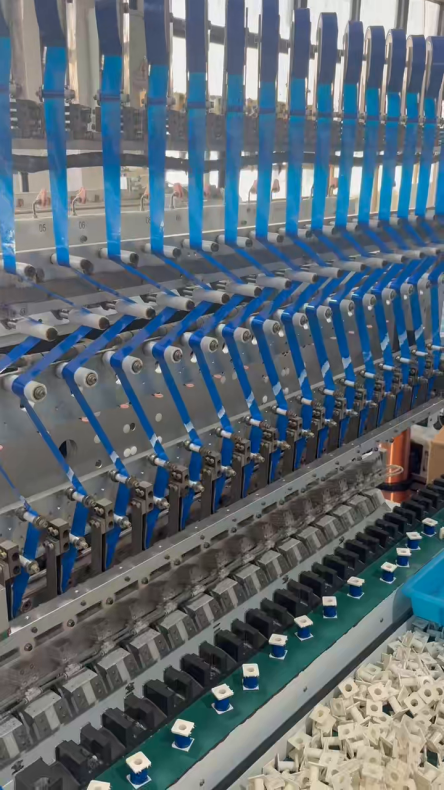
The winding line. Bobbins travel in racks; the wire is guided by machine.
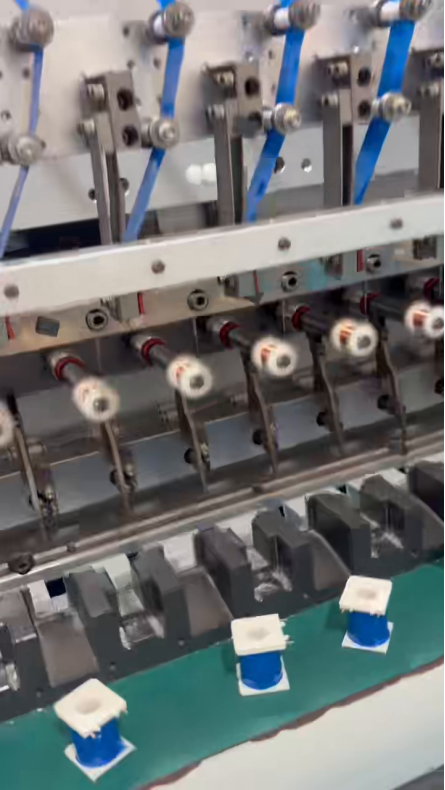
At the winding head, bobbins index under the spindle and the wire is laid down in the same path every cycle.
Assembly: the coil becomes a valve
From winding, the coils move to assembly. Each one is fitted with its armature and sleeve, then seated into the valve body together with the seal that will do the actual sealing. On the line, pick-and-place heads lift the parts into fixtures and the stations repeat the same motion in the same order — lift, orient, seat, press — so that the valve body that leaves the last station was built by the same sequence as the one before it.
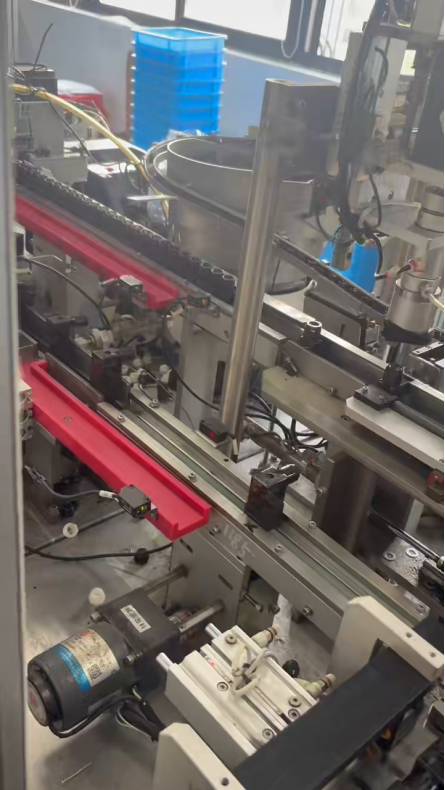
The assembly line. Coils enter from winding and leave as seated valve bodies.
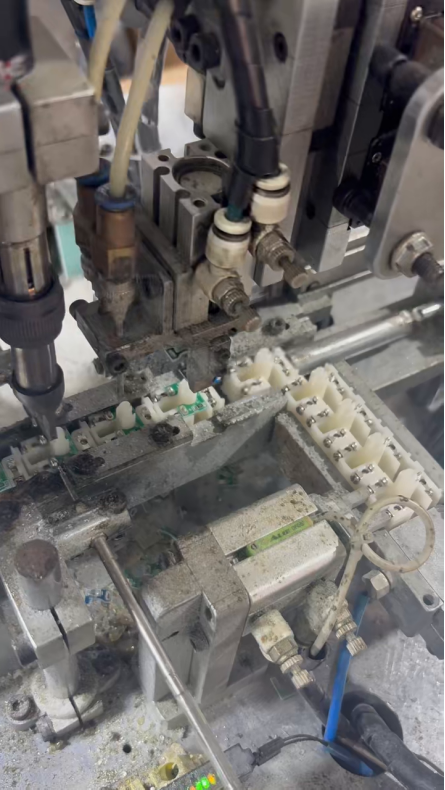
A pick-and-place head over a coil fixture. The station repeats one motion, thousands of times a shift.
Test: nothing leaves without a reading
Testing is the step that decides whether a coil leaves the building. Finished coils arrive at the bench in trays, leads already fitted, and each one is connected to a meter. The reading on that meter is what the operator checks before the coil goes into a carton. It is a slow step compared with winding, and it is deliberately kept that way.
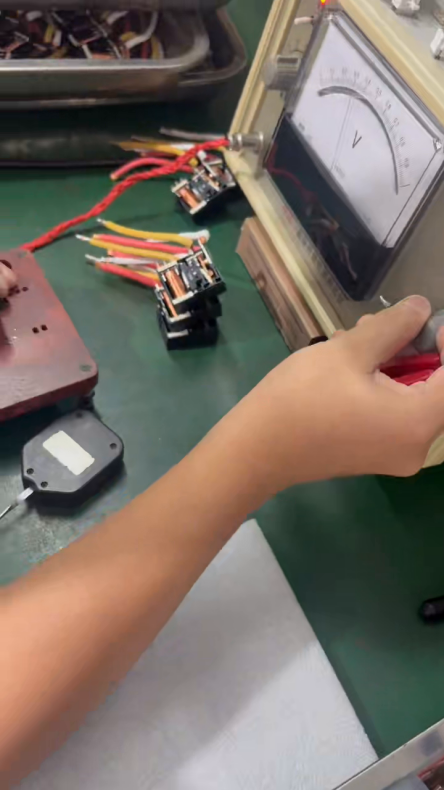
A finished coil connected to the test meter. Every coil is measured, not sampled.
The part, as marked
The valve shown here carries its ratings on the body: DC24V, 7W, an operating voltage range of DC21.4V–26.4V, a 100% duty rating (100%ED) and an IP65 enclosure rating, with the CE mark. 100%ED means the coil is rated to stay energised continuously rather than intermittently — the difference between a coil that is switched a few times an hour and one that is held on all day.
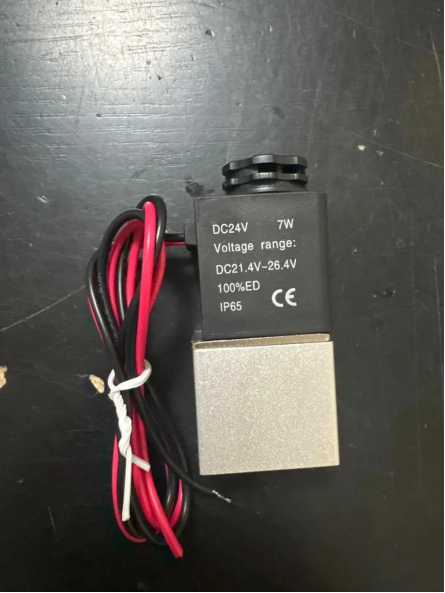
DC24V, 7W, 100%ED, IP65, CE: the ratings are moulded into the coil body, not added to a datasheet.
Supply
Standard voltages ship from stock; coils wound to a customer's specification are quoted individually.
Watch the process
A 72-second film of the winding, assembly and test stages described above accompanies this note.