EN
EN


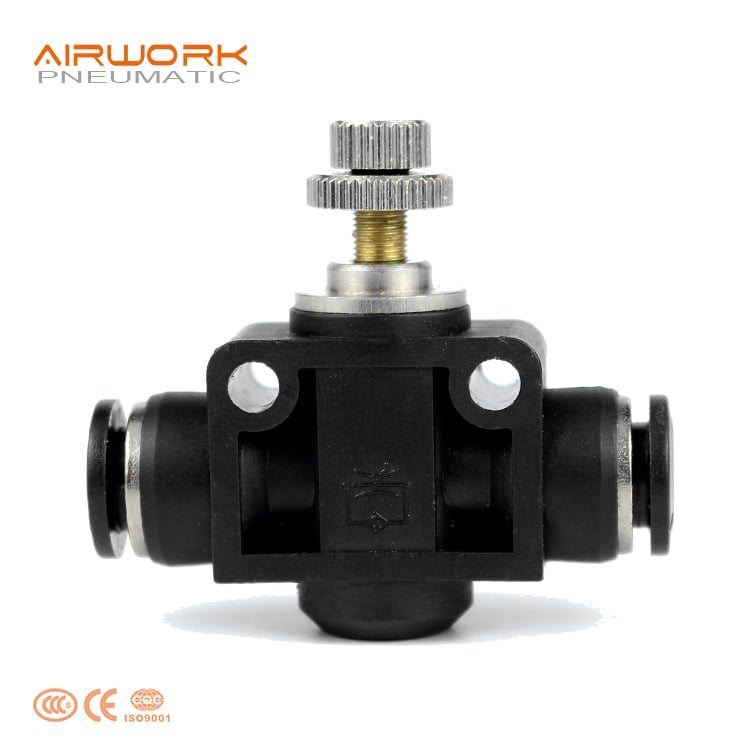
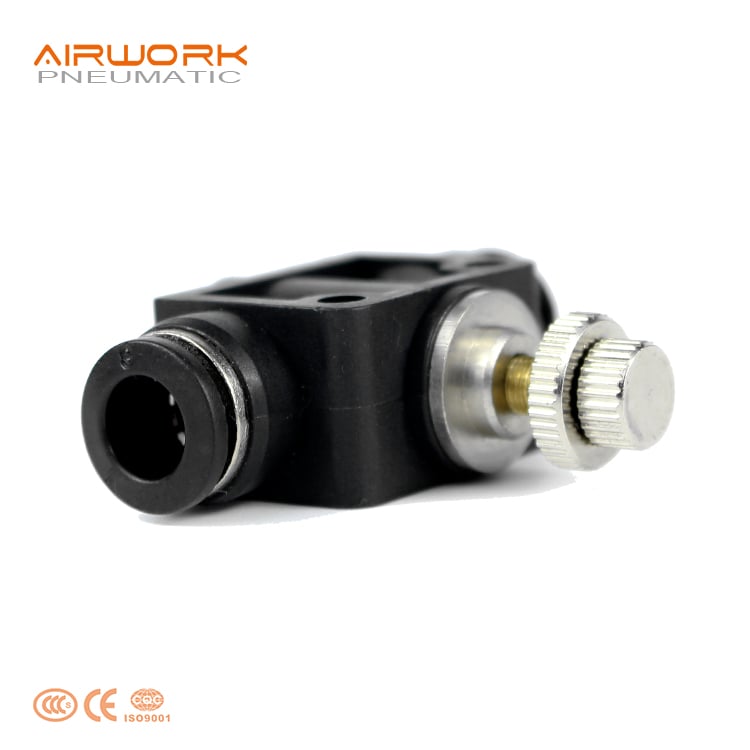
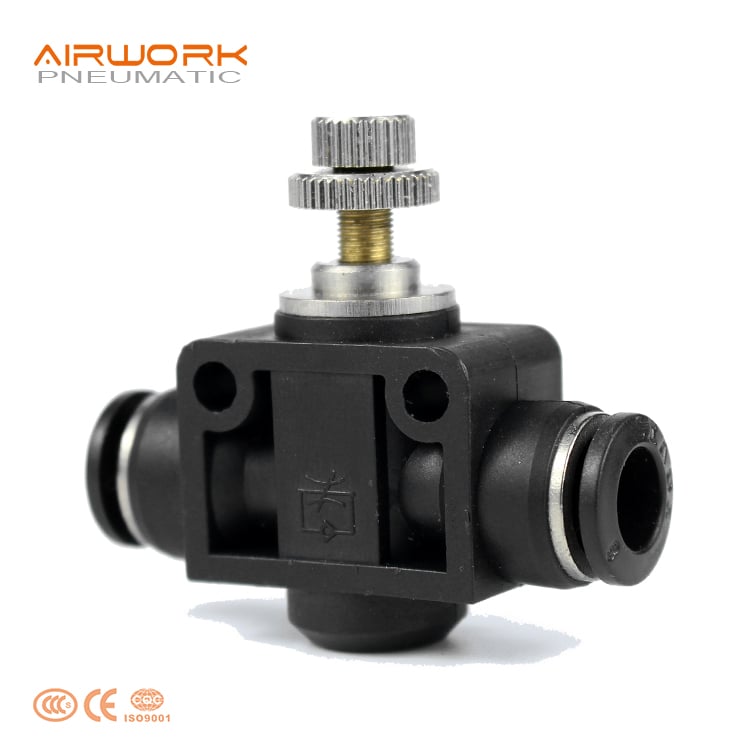
OEM Factory Direct SA Series Pneumatic Air Flow Control Valve Manufacturer Plastic Push-in Fittings Speed Controller Compatible With SMC Festo Airtac
The shape and structure of the plastic air line flow control valve are not different from that of the globe valve, but the shape of its opening and closing parts is different. The opening and closing parts of throttle valves are mostly conical streamlined, through which the flow and pressure can be regulated by changing the cross-section area of the passage. Throttle valves are used to reduce medium pressure in the case of great pressure drop.
- Overview
- Recommended Products
- Integrated push-to-connect ports — one component replaces three. The valve body incorporates push-to-connect ports directly. Tubing plugs in instantly — no separate fittings, no adapters, no thread sealant. This eliminates two potential leak points and reduces component count per cylinder from three (valve + two fittings) to one.
- Meter-out control — the industry standard for stability. The valve restricts exhaust flow from the cylinder while allowing unrestricted supply flow. This meter-out configuration creates back-pressure on the exhausting cylinder side, preventing the stick-slip and erratic motion associated with meter-in control. Smooth, predictable deceleration is achieved across the full speed range.
- Brass needle valve with fine adjustment resolution. A machined brass needle provides precise, linear flow adjustment across the entire range — not just near the fully closed position. The fine thread pitch allows small, repeatable speed changes, particularly valuable when matching cylinder speeds in multi-axis synchronized systems.
- Vibration-resistant lock nut. The knurled lock nut mechanically locks the adjustment setting against vibration-induced drift. Set the speed once during commissioning and it remains stable through millions of cycles — eliminating the periodic readjustment common with un-locked speed controllers.
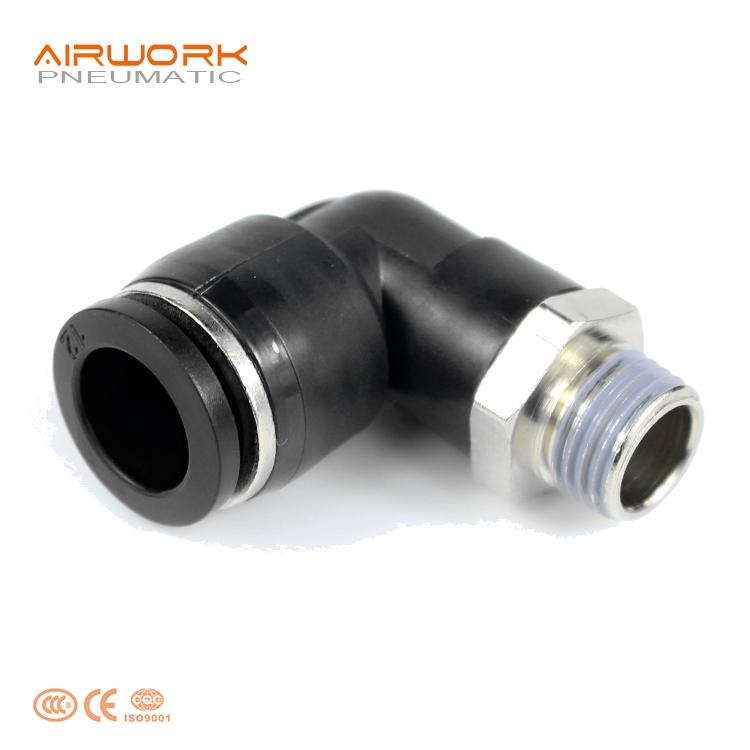
- Three body styles — optimized for any installation. In-line straight for mid-line tube connections. Elbow (90° L-shape) for cylinder port installation where clearance behind the port is minimal — the most commonly used configuration. T-shape for branching circuits with independent speed control on one branch.
- Lightweight — minimal stress on small fittings. The plastic body weighs only a few grams, imposing negligible mechanical load on small-diameter push-in fittings and cylinder ports. This is critical in robotic end-effectors and reciprocating assemblies where every gram of moving mass affects cycle speed and energy consumption.
- Universal tube compatibility. The push-to-connect collet grips PU, nylon (PA), FEP, and most other standard pneumatic tubing with equal sealing reliability. Mixed-material circuits can use a single flow control valve series throughout.
- Cylinder speed control — adjustable needle valve regulates exhaust flow for smooth, stable motion
- Direct cylinder port mounting — compact body fits tight spaces without interfering with adjacent ports
- One-way throttle function — full flow in one direction, metered flow in the reverse direction
- Vertical lift and hoist speed control — prevents load from dropping too fast on descent
- Multi-actuator synchronization — independent speed tuning per actuator on shared air supply
- Soft stop at end-of-stroke — gradual deceleration protects seals and reduces noise
- Delicate part handling — slow, controlled motion for fragile or precision components
- Vacuum circuit flow limiting — fine-tune suction strength without changing vacuum source
- Light automation and robotics — compact plastic body adds minimal weight to end-effectors
- Maintenance and retrofit — easily added to existing cylinder ports for instant speed control
- Installation location: Install the valve directly at the cylinder port for best control. One valve on the extend port controls extension speed; one valve on the retract port controls retraction speed. This provides independent, adjustable speed for each direction.
- Flow direction: The arrow on the valve body indicates the controlled (restricted) flow path. For meter-out cylinder speed control, install with the arrow pointing away from the cylinder — toward the exhaust. Free flow enters the cylinder unrestricted through the internal check valve.
- Tube connection: Push the tube firmly into the push-to-connect port until it bottoms out. Pull back gently to confirm the collet has gripped. No tools or sealant needed. For removal, depress the release collar fully while pulling the tube out.
- Speed adjustment: Loosen the lock nut. Turn the knob clockwise (restrict) for slower speed, counterclockwise for faster speed. Start fully closed, cycle the cylinder, then gradually open to the desired speed. Tighten the lock nut to lock the setting against vibration.
- Fine-tuning: Adjust in small increments (1/8 to 1/4 turn at a time). Cycle the cylinder after each change. Large sudden adjustments cause overshoot and make it difficult to find the optimal speed.
- Dual valve setup: For independent extend and retract speed control, install one valve at each cylinder port. Adjust each independently. This is the standard configuration for precision pneumatic motion control.
- Maintenance: Minimal — verify lock nut tightness periodically. Replace the valve if the adjustment range changes (needle wear) or if clogged and blowing through in the free-flow direction does not clear the restriction. Vacuum-rated — suitable for vacuum circuit speed control.
Product Detailed Description:
The SA Series plastic in-line flow control valve is a compact pneumatic speed controller with integrated push-to-connect ports, engineered for direct installation at cylinder ports or valve manifolds. It provides precise one-way air flow regulation to control pneumatic actuator speed with smooth, stable motion and independent adjustment for extend and retract strokes.
The valve body is injection-molded from high-strength engineering plastic (PBT) with a precision brass needle valve, stainless steel spring, and internal check valve. The check valve permits unrestricted free flow in one direction while the adjustable needle meters flow in the opposite direction. This meter-out configuration — restricting exhaust air from the cylinder — is the universally recommended method for stable, judder-free cylinder speed control.
Instant tube connection is achieved via push-to-connect ports on both ends. The knurled adjustment knob with lock nut enables tool-free speed setting that stays locked against vibration. Available in tube OD sizes from 4 mm to 12 mm and three body styles — in-line straight, elbow (90° L-shape), and T-shape — the SA series covers the full range of pneumatic speed control requirements from miniature pilot circuits to large-bore actuator exhaust control.
Application Industries:
SA plastic flow control valves are deployed wherever pneumatic cylinder speed must be precisely regulated. In general automation and assembly systems, they control extend and retract speed on pick-and-place actuators, clamping cylinders, pressing stations, and transfer mechanisms. Packaging machinery uses them to tune carton erector cylinder speed, seal jaw closing rate, and label applicator approach velocity.
Machine tool and CNC equipment employ flow control valves to set tool changer actuation speed, safety door cylinder motion, and pneumatic clamping release rate — preventing slamming that accelerates mechanical wear and generates noise. Textile machinery regulates thread cutter actuation and presser-foot lift speed in high-cycle sewing and loom operations.
Electronics assembly, medical device manufacturing, woodworking, printing machinery, and automotive sub-assembly stations all depend on flow control valves to match cylinder speed to each application's specific mass, stroke, and timing requirements.
Product Feature :
The flow regulation range is large, and the flow-pressure difference changes smoothly. The internal leakage is small, and if there is an external leakage, the external leakage is also small. The adjusting moment is small and the action is sensitive. The medium flows very fast between the Plastic air line flow control valve and the valve seat, so that the surface of these parts is damaged quickly, which is called cavitation phenomenon. In order to minimize the effect of cavitation, the valve disc is made of corrosion resistant material (alloy steel) and a streamlined cone with a tip angle of 140-180, which can also make the valve disc have a larger opening height. Throttling under a small gap is generally not recommended.
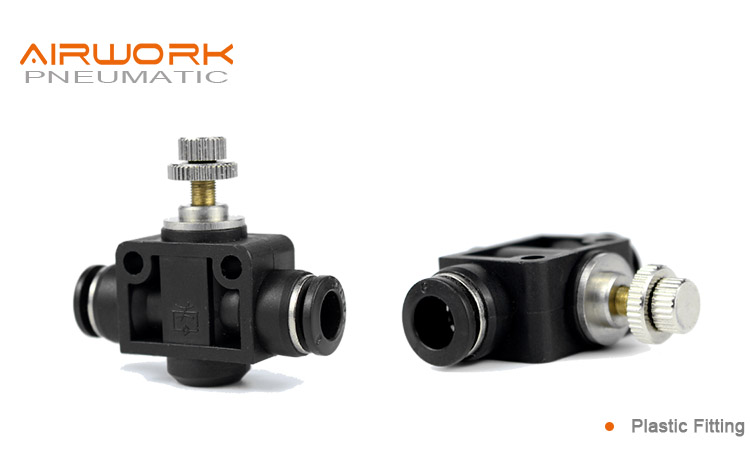
Specification:
Model Number |
SA |
Product Name |
Throttle Valve |
Material |
Brass with nickle plated; Plastic |
Power |
Pneumatic |
Port size |
4,6,8,10,12,14,16 |
Color |
Black |
Working Medium |
Air |
Certificate |
CE/ISO9001 |
Working Temperature |
0~60°C |
Working Pressure |
0~0.9MPa |
Proof pressure |
1.32MPa |
Proof Vacuum pressure |
-100Kpa(10Torr) |
Tube Diameter |
Ф4 Ф6 Ф8 Ф10 Ф12Ф14Ф16 |
MOQ |
10 |
Lead Time |
5-7 Days |
Warranty |
1 year |
Pattern of Payment |
Paypal ;T/T;L/C;D/P |
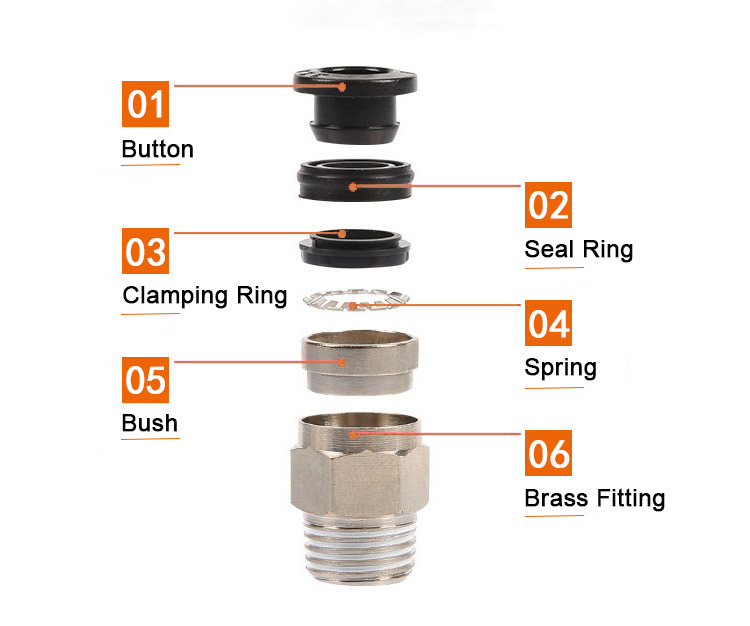
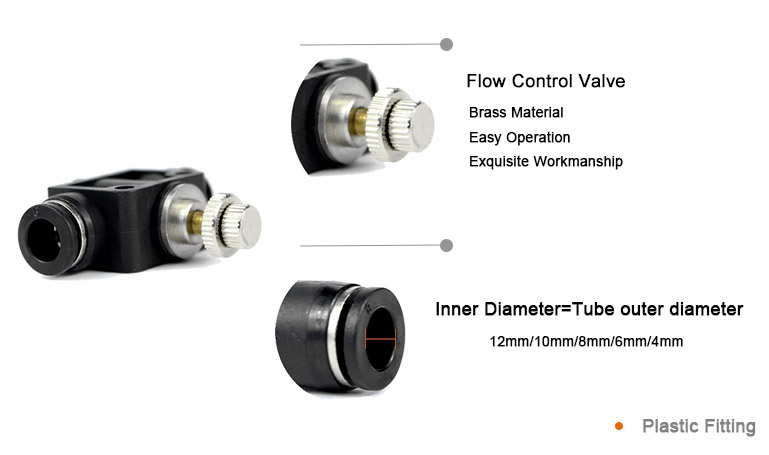
Customization Options
Customization Item |
Options & Details |
Lead Time |
Tube OD Size |
4 mm, 6 mm, 8 mm, 10 mm, 12 mm |
3–5 days |
Body Style |
In-line straight, elbow (90° L-shape), T-shape (3-way) |
3–5 days |
Control Type |
Meter-out (standard — restrict exhaust). Meter-in option upon request |
3–5 days |
Body Material |
PBT plastic (standard), nylon, or polypropylene. Metal body (brass, aluminum) available |
5–7 days |
Needle Material |
Brass (standard). Options: stainless steel (corrosion-resistant), plastic needle (economy grade) |
5–7 days |
Adjustment Type |
Knurled knob with lock nut (standard). Options: slotted screw (tamper-proof), wing knob (glove-friendly), digital micrometer dial (high-precision) |
5–7 days |
Seal Material |
NBR 0–60°C (standard). Options: Viton/FKM to 150°C, EPDM food-grade |
5–7 days |
Port Configuration |
Push-to-connect both ends (standard). Options: threaded port (M5, G1/8", G1/4", NPT) one or both ends, or mixed push-in/threaded |
3–5 days |
Color |
Standard: black, blue, gray. Custom color available on bulk orders |
7–10 days |
Flow Adjustment Range |
Standard needle. Option: fine-adjustment extended-range needle for precision low-speed applications |
5–7 days |
OEM Branding |
Custom laser marking on body; neutral packaging for distribution partners |
3–5 days |
Product Advantages
Application:
Installation and Usage:
FAQ
Q1.Meter-out or meter-in — which one?
A1.Meter-out for all double-acting cylinders — restricts exhaust, provides back-pressure for smooth stable motion. Meter-in only for single-acting spring-return cylinders. The arrow on the body shows the controlled flow direction.
Q2. How many valves per cylinder?
A2. Two for full control — one on the extend port, one on the retract port. One valve if controlling only one direction. One valve at the exhaust port if controlling multiple cylinders together.
Q3.Straight, elbow, or T-shape?
A3. Straight: mid-line segment connections. Elbow: cylinder ports with limited rear clearance — most common. T-shape: splitting one supply to two devices with speed control on one branch.
Q4. Compatible with nylon tube?
A4. Yes. The push-to-connect collet grips PU, nylon (PA), and most standard pneumatic tubing equally reliably
Q5. How to adjust speed?
A5.Loosen lock nut, turn clockwise to slow, counterclockwise to speed up. Start fully closed, cycle cylinder, gradually open to desired speed. Tighten lock nut.
Q6.Valve is clogged — how to clean?
A6. Disconnect tube, blow compressed air through the valve in the free-flow direction (opposite the arrow). If still restricted, replace the valve
Q7.What maintenance is needed?
A7.Very little. Verify lock nut tightness periodically. Replace every 2–3 years in high-cycle applications as preventive maintenance.
Q8. Compatible with all fitting and tube brands?
A8. Yes. Standard OD tolerances ensure compatibility with SMC, Festo, Airtac, Parker, Norgren, and all major brands.
Q9.What warranty?
A9.12–18 months against manufacturing defects. Normal needle/seat wear is consumable — not covered. Low-cost replacement valves stocked. Samples available for evaluation.
Factory Advantages and Certifications
Company Introduction 1
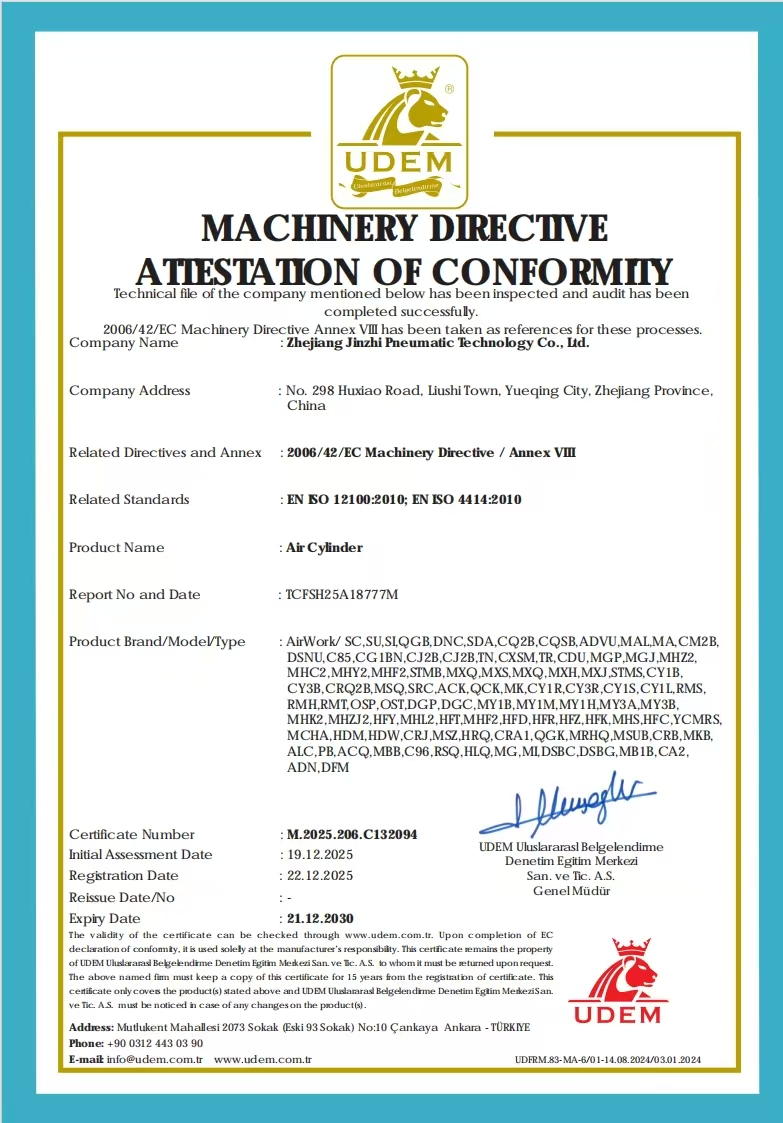
Certification