 EN
EN

Q: Troubleshooting 'Oil Carryover' in oil-free pneumatic systems: Selecting high-efficiency mist separators.
In high-purity B2B sectors such as food packaging, pharmaceutical processing, medical device assembly, printing, and high-end electronics manufacturing, oil contamination in compressed air lines is absolutely unacceptable. These industries rely on oil-free pneumatic systems to ensure that no mineral oil or synthetic lubricant comes into contact with the product. Even a trace amount of oil can spoil thousands of units of food, contaminate drug batches, or ruin high-resolution print runs.
To prevent this, factories install oil-free air compressors. However, many maintenance engineers are shocked to find liquid oil or greasy residues pooling inside their pneumatic valves and exhausts, even when operating an oil-free compressor. This phenomenon, known as oil carryover, is a major threat to sterile production. This technical guide analyzes why oil carryover occurs in theoretically oil-free systems, and how to troubleshoot and eliminate it by selecting the right high-efficiency mist separators and filtration systems.
The Paradox: Why Oil Carryover Occurs in Oil-Free Systems
To troubleshoot oil carryover, we must first dispel a common industry myth: using an oil-free compressor does not guarantee oil-free air at your machine drops. There are two primary avenues through which oil can invade a high-purity system:
1. Ingestion of Atmospheric Hydrocarbons
An air compressor is a giant vacuum, drawing in massive volumes of ambient air. In an industrial zone, this ambient air is heavily contaminated with gaseous hydrocarbons, volatile organic compounds (VOCs), vehicle exhaust fumes, and vaporized oil from nearby machinery.
When the oil-free compressor compresses this contaminated ambient air, these airborne gaseous hydrocarbons are concentrated by a factor of eight or more. As the hot compressed air cools downstream, these gaseous hydrocarbon vapors condense into liquid oil aerosols and liquid droplets. Thus, despite using an oil-free compressor, your pipelines are flooded with environmental oil.
2. Upstream Lubrication Carryover
In many facilities, a standard oil-lubricated compressor is used for main operations, while a specific branch of the piping is designated for oil-free processes. Over years of operation, oil aerosols from the main compressor can migrate backward through the piping network, or travel down cross-connected lines, contaminating the oil-free branch. Additionally, if the main compressor's internal dynamic seals fail, substantial quantities of crankshaft lubricant can blow by into the main header line.
The Solution: Staging High-Efficiency Mist Separators
Standard particulate filters (which catch dust and water) are useless against sub-micron oil aerosols and vapors. To capture these contaminants and guarantee pure air, engineers must implement a multi-stage separation strategy utilizing specialized high-efficiency mist separators.
These separators are categorized based on their filtration efficiency and the physical size of the oil droplets they can capture:
1. Standard Mist Separators (Coarse Coalescing)
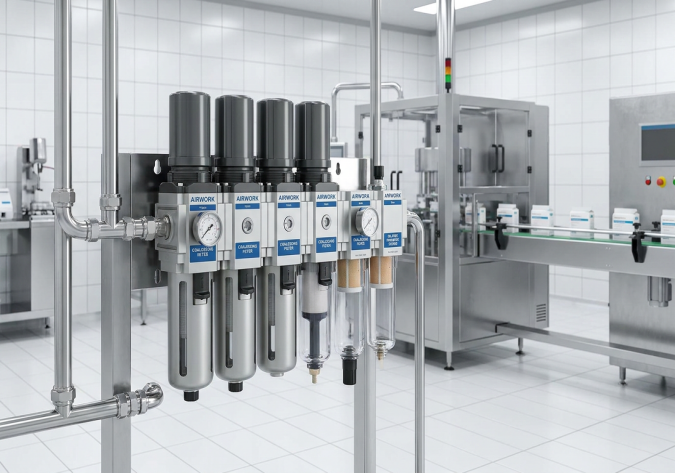
Standard mist separators, such as those in the AIRWORK series, are designed to capture oil droplets down to 0.3 microns with an efficiency of 99 percent or higher.
- Operating Principle: These units utilize a medium-density microfiber element to force microscopic oil aerosols to coalesce into larger, heavy droplets. These droplets slide down the element surface and pool in the filter bowl, where they are evacuated by an automatic drain.
- Primary Use: Installed as a pre-filter immediately upstream of the ultra-high efficiency coalescing filters to remove the bulk of the oil loading.
2. Micro-Mist Separators (High-Efficiency Coalescing)
For applications requiring near-absolute oil removal, a micro-mist separator is essential. These units filter down to 0.01 microns, achieving an oil removal efficiency of 99.999 percent, leaving a maximum remaining oil content of just 0.01 milligrams per cubic meter.
- Operating Principle: They utilize a highly dense, borosilicate glass microfiber matrix. The ultra-fine fibers capture the smallest sub-micron aerosols through Brownian diffusion and electrostatic attraction.
- Primary Use: Installed directly at the point of use for paint booths, packaging machinery, or cleanroom inlets.
3. Activated Carbon Odor Filters (Adsorption)
Even after passing through a 0.01-micron micro-mist separator, gaseous oil vapors (which carry smells and taste) can still pass through. In food processing and pharmaceutical manufacturing, these vapors must be removed.
- Operating Principle: Gaseous vapor removal cannot be achieved via coalescing filters. Instead, an activated carbon adsorber is used. The carbon element features a highly porous surface area that chemically adsorbs gaseous oil molecules, completely neutralizing odors and organic vapors.
- Primary Use: Positioned as the absolute final stage of treatment, directly before the point of application.
Dynamic Troubleshooting Sequence for Maintenance Teams
If you discover oil in your clean lines, follow this technical troubleshooting protocol:
- Step 1: Identify the source. Test the air quality immediately at the compressor outlet. If liquid oil is present there on an oil-free compressor, the compressor's internal dry-running seals are damaged and must be serviced.
- Step 2: Check for upstream cross-connections. Ensure that no standard oil-lubricated lines are tied into the high-purity lines without a backflow check valve.
- Step 3: Verify filter staging. Ensure that your 0.01-micron micro-mist separator is protected by a 5-micron particulate filter and a 0.3-micron mist separator upstream. If you run raw air directly into a 0.01-micron filter, the oil will saturate the dense microfiber element in hours, causing a massive pressure drop and oil blow-by.
- Step 4: Monitor the pressure differential. Coalescing elements act like sponges; once they are completely saturated with oil (known as wet saturation), they can no longer merge and separate incoming aerosols. If the pressure drop across the filter exceeds 0.5 bar, the element must be replaced.
- Step 5: Replace activated carbon elements regularly. Unlike coalescing elements, carbon adsorbers do not exhibit a pressure drop when they are saturated. They simply stop adsorbing vapors, allowing smells and oils to pass through. These elements must be replaced on a strict time-based schedule (typically every 1000 operating hours or every 6 months).
Conclusion: Guaranteeing Purity with AIRWORK
Achieving true oil-free air quality requires a proactive, multi-layered approach to air treatment. Sourcing advanced mist and micro-mist separation solutions from JZPNU under the premium AIRWORK brand provides high-purity facilities with the engineering security they require. Designed with high-capacity borosilicate elements, integrated pressure drop indicators, and reliable auto-drain systems, AIRWORK mist separators ensure your production lines remain completely free of oil carryover, safeguarding your brand reputation and product safety.
Table of Contents
- Q: Troubleshooting 'Oil Carryover' in oil-free pneumatic systems: Selecting high-efficiency mist separators.
- The Paradox: Why Oil Carryover Occurs in Oil-Free Systems
- The Solution: Staging High-Efficiency Mist Separators
- Dynamic Troubleshooting Sequence for Maintenance Teams
- Conclusion: Guaranteeing Purity with AIRWORK