 EN
EN

Q: Why 'Modular' FRL designs are the strategic choice for rapid maintenance in high-uptime factories.
In modern high-volume manufacturing facilities, such as automotive assembly lines, food packaging plants, and electronics factories, every single second of machine downtime translates directly into lost revenue. If a key production line stops due to a component failure, the financial loss can quickly escalate to thousands of dollars per minute. Consequently, facility managers and maintenance engineers are constantly looking for hardware designs that prioritize rapid, zero-friction maintenance.
Historically, one of the primary bottlenecks in pneumatic system maintenance has been the servicing of traditional Filter, Regulator, and Lubricator (FRL) assemblies. These assemblies are critical to preparing compressed air for downstream machines, but when a component fails or requires cleaning, traditional threaded designs require extensive labor to replace.
Today, the transition to modular FRL designs represents a major strategic shift in plant management. This B2B technical guide compares traditional and modular FRL systems, analyzing how modular technology reduces maintenance downtime from hours to minutes, prevents leaks, and simplifies inventory management.
The Bottleneck of Traditional Threaded FRL Assemblies
To understand the strategic value of modularity, we must first analyze the pain points of traditional threaded FRL designs. In a traditional setup, individual filter, regulator, and lubricator units are connected to each other and to the factory's air distribution lines using threaded pipe nipples (typically NPT or BSPT standard threads).
When a maintenance technician needs to service a component—for example, replacing a cracked filter bowl or a failing regulator valve—the traditional process is highly complex and time-consuming:
- Isolating the system and bleeding pressure.
- Unscrewing the entire FRL assembly from the incoming and outgoing pipelines.
- Dismantling the individual units by unthreading them from each other using heavy pipe wrenches.
- Cleaning the old thread sealant (teflon tape or paste) off all the pipe threads.
- Threading the new component in, applying new sealant, and carefully aligning the ports to ensure a straight assembly.
- Re-threading the entire assembly back into the main pipeline.
- Re-pressurizing the system and performing a leak test with soapy water.
This labor-intensive process typically takes a skilled technician 45 to 90 minutes to complete. During this entire period, the machine is offline, and the production line is dead. Furthermore, excessive pipe wrench force can easily strip threads, crack thin-walled aluminum housings, or cause micro-fractures that lead to massive air leaks later on.
The Solution: Understanding the Modular FRL Architecture
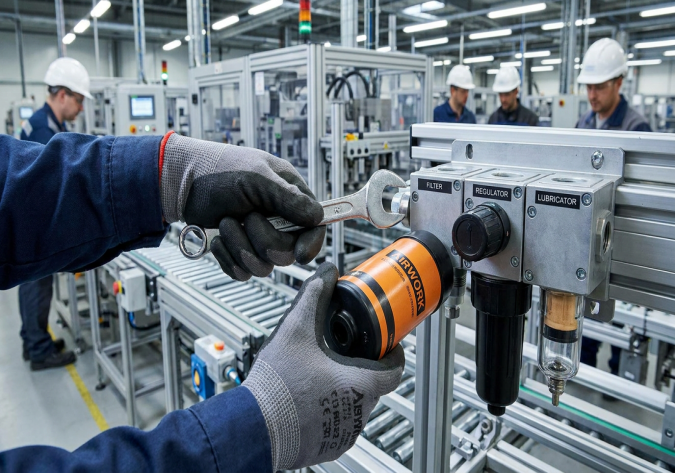
Modular FRL systems, such as the premium series manufactured by JZPNU under their flagship AIRWORK brand, completely redesign the physical connection mechanism. In a modular FRL assembly, individual components (filter, regulator, lubricator, coalescing filters, and safety shut-off valves) do not thread directly into each other.
Instead, they utilize a standardized, slide-in interface and are held together securely by robust modular bracket kits. The incoming and outgoing air lines connect to modular end-blocks, which remain permanently piped and fixed in place. The actual functional FRL components sit suspended between these end-blocks.
When a component requires servicing in a modular AIRWORK system, the replacement process is transformed:
- Isolate and bleed the pressure using the integrated modular lock-out valve.
- Loosen two captive assembly screws on the modular bracket bracket. No pipe wrenches are required; a standard hex wrench or screwdriver is sufficient.
- Slide the target component (e.g., the filter or the regulator) straight out of the assembly. The main incoming and outgoing pipes remain completely undisturbed.
- Slide the replacement unit straight in, ensuring the integrated rubber O-ring seals are in place.
- Tighten the two bracket screws, slide open the shut-off valve, and resume production.
This entire process takes less than 5 minutes. The reduction in machine downtime is staggering, yielding an immediate return on investment for the facility.
Three Key Strategic Advantages of Modular FRL Designs
For B2B procurement managers and plant directors, the business case for modularity goes far beyond fast repair times. It encompasses three long-term strategic benefits:
1. Leak Prevention and Energy Savings
According to industrial audits, the average manufacturing plant loses 20 to 30 percent of its compressed air capacity to leaks. Traditional threaded joints are primary leak sites because of thread wear, temperature expansion, and vibration-induced loosening over time.
Modular FRL units utilize face-to-face rubber O-ring or profile seals that are compressed uniformly by the modular brackets. This creates a perfect, vibration-resistant hermetic seal. By eliminating threaded connections between components, a modular AIRWORK assembly significantly reduces leak risks, saving thousands of dollars in compressor energy costs annually.
2. Design Flexibility and Scalability
Industrial production lines are not static. As production demands increase, you may need to upgrade your air treatment. For example, you might need to add a high-precision 0.01-micron coalescing filter downstream of your standard filter to accommodate a new high-speed packaging robot.
With a traditional threaded setup, adding a new component requires cut-and-paste pipe modification. With a modular AIRWORK FRL system, you simply insert a new modular bracket and slide the new filter unit into the middle of the existing assembly in minutes.
3. Simplified Spare Parts Inventory
In a large factory, maintaining spare parts can be a logistical nightmare. Modular FRL systems use standardized, interchangeable brackets, bowls, filters, and regulator inserts across a wide range of flow rates. This allows maintenance teams to stock a small, highly versatile inventory of modular spare parts that can service multiple different machines throughout the facility, reducing inventory carrying costs.
Conclusion: The Modular Mindset with AIRWORK
In the high-uptime manufacturing sector, maintaining a competitive edge requires eliminating every possible source of labor waste and mechanical downtime. Modular FRL designs are a prime example of smart engineering that directly impacts a facility's bottom line. By sourcing advanced modular air source treatment assemblies from Zhejiang Jinzhi Pneumatic Technology Co., Ltd. (JZPNU) under the AIRWORK brand, facility managers can safeguard their downstream pneumatic equipment, slash repair times from hours to minutes, and eliminate expensive compressed air leaks. Transitioning to modularity is not just a maintenance upgrade; it is a strategic investment in continuous productivity.
Table of Contents
- Q: Why 'Modular' FRL designs are the strategic choice for rapid maintenance in high-uptime factories.
- The Bottleneck of Traditional Threaded FRL Assemblies
- The Solution: Understanding the Modular FRL Architecture
- Three Key Strategic Advantages of Modular FRL Designs
- Conclusion: The Modular Mindset with AIRWORK