 EN
EN

Q: How to calculate the 'Dew Point' requirements for pneumatic systems operating in sub-zero outdoor climates.
Pneumatic systems operating in outdoor environments—such as oil and gas drilling rigs, mining operations, marine vessels, railway transportation, construction sites, and sub-zero municipal water treatment facilities—face severe environmental challenges. Unlike indoor factory systems where temperature is controlled, outdoor systems must endure the brutal freezing conditions of winter climates. Under these conditions, the single greatest threat to system integrity is moisture freezing inside the air lines.
When water freezes inside a pneumatic pipeline, it forms ice blockages that starve downstream cylinders of air, jams delicate solenoid valve spools, and can physically rupture metal pipe fittings due to thermal expansion. For facility managers and system designers, preventing these failures requires a precise calculation of the Pressure Dew Point (PDP) requirements. This B2B technical guide explains how to calculate your system's dew point needs and select the correct air drying hardware to ensure continuous, frost-free winter operation.
Defining the Terms: Atmospheric Dew Point vs. Pressure Dew Point
Before performing calculations, we must clarify a fundamental distinction in thermodynamics: the difference between Atmospheric Dew Point (ADP) and Pressure Dew Point (PDP).
- Atmospheric Dew Point (ADP) is the temperature at which water vapor in the air begins to condense into liquid water at standard atmospheric pressure (1 bar absolute).
- Pressure Dew Point (PDP) is the temperature at which water vapor in compressed air begins to condense into liquid water under actual operating pressure (typically 7 bar to 10 bar in industrial applications).
This distinction is highly critical because compressing air increases the partial pressure of the water vapor. As a result, water will condense at a much higher temperature under pressure than it would in ambient air. For example, air with an ADP of minus 20 degrees Celsius will have a PDP of approximately plus 3 degrees Celsius when compressed to 7 bar. Therefore, engineers must always calculate and design around the Pressure Dew Point (PDP), never the atmospheric dew point.
The Golden Rule of Low-Temperature Pneumatics
To prevent any condensation or freezing, the calculated Pressure Dew Point of the compressed air must always be significantly lower than the lowest ambient temperature the system will experience.
The industry-standard safety margin is the 10-Degree Rule:
- The Pressure Dew Point (PDP) of your compressed air must be at least 10 degrees Celsius (or 18 degrees Fahrenheit) below the lowest ambient outdoor temperature the system will experience.
By ensuring this 10 degrees Celsius safety margin, you guarantee that even during sudden, rapid ambient temperature drops, the compressed air will never cool down to its actual dew point, preventing the formation of a single droplet of liquid water inside the outdoor piping.
Calculating the Required Dew Point: An Engineering Example
Let us perform a practical calculation for an outdoor mining facility operating in a northern climate where winter temperatures can plummet to a lowest ambient temperature of minus 20 degrees Celsius.
- Step 1: Identify the lowest ambient temperature: T-lowest = minus 20 degrees Celsius.
- Step 2: Apply the 10-degree safety margin: PDP-required = T-lowest minus 10 degrees Celsius.
- Step 3: Perform the calculation: PDP-required = minus 20 degrees Celsius minus 10 degrees Celsius = minus 30 degrees Celsius.
In this scenario, to prevent ice formation and blockages, your compressed air system must deliver a Pressure Dew Point (PDP) of minus 30 degrees Celsius or lower at the operating pressure. If your system only achieves a PDP of plus 3 degrees Celsius, the moisture will immediately freeze as soon as it exits the heated building, causing complete machine failure.
Selecting the Correct Drying Technology to Meet Your PDP
Standard FRL units separate liquid water, but they cannot remove gaseous water vapor. To lower the Pressure Dew Point to the required sub-zero temperatures, you must integrate an industrial air dryer downstream of the compressor. There are three main technologies available, each with distinct PDP capabilities:
1. Refrigerated Air Dryers (Inadequate for Sub-Zero Environments)
Refrigerated dryers cool the compressed air using a refrigeration circuit to condense and drain water vapor.
- Performance Limit: Standard refrigerated dryers can only achieve a PDP of plus 3 degrees Celsius to plus 5 degrees Celsius. They cannot go lower because any water condensing inside the dryer's heat exchanger would freeze, blocking the unit.
- Strategic Use: Excellent for indoor factories, but completely unsuitable for outdoor pipelines exposed to freezing temperatures.
2. Desiccant Air Dryers (The Gold Standard for Sub-Zero Climates)
Desiccant dryers utilize chemical adsorption to remove water vapor. Compressed air is passed through a vessel filled with desiccant beads—typically activated alumina, silica gel, or molecular sieves—which adsorb water molecules on their extensive porous surfaces.
- Performance Limit: Desiccant dryers can achieve Pressure Dew Points of minus 40 degrees Celsius to minus 70 degrees Celsius.
- Strategic Use: This is the mandatory choice for outdoor systems operating in sub-zero winter climates. A PDP of minus 40 degrees Celsius guarantees that air lines remain completely dry and functional even in brutal arctic environments.
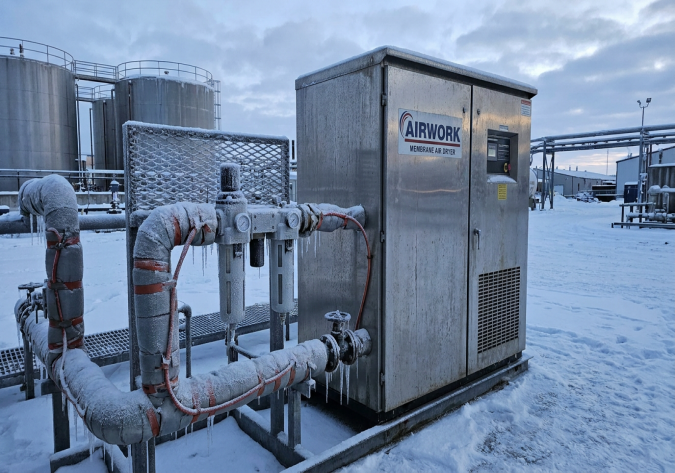
3. Membrane Air Dryers (The Specialized Point-of-Use Choice)
Membrane dryers utilize semi-permeable hollow-fiber membranes. Water vapor molecules permeate through the fiber walls faster than air molecules, allowing dry air to exit downstream while venting the moisture to the atmosphere via a small sweep air flow.
- Performance Limit: Can suppress the dew point of incoming air by 20 to 40 degrees Celsius, capable of achieving PDPs from minus 15 degrees Celsius to minus 40 degrees Celsius depending on the inlet flow.
- Strategic Use: Ideal for localized, outdoor machine drops where installing a massive desiccant dryer is logistically impossible or too expensive.
Sizing and System Design Best Practices
When designing sub-zero outdoor pneumatic systems, incorporate these engineering safeguards:
- Install Dryers Indoors: Whenever possible, position your compressor and desiccant air dryer inside a temperature-controlled building. This protects the dryer's control valves from freezing and maximizes drying efficiency.
- Insulate Outdoor Pipelines: Insulate any exposed outdoor piping to reduce heat exchange with the freezing ambient air, helping to maintain stable air temperatures.
- Heat Tracing: For critical pipelines exposed to extreme sub-zero conditions, wrap the pipes with electrical heating tape to prevent any localized freezing.
- Use Low-Temperature Lubricants: Standard pneumatic oils become highly viscous and thick in cold weather, causing valves to stick. Always specify specialized low-temperature synthetic lubricants that maintain their fluid properties down to minus 40 degrees Celsius.
Conclusion: Defying the Elements with AIRWORK
Operating pneumatic machinery in freezing outdoor climates requires rigorous thermal planning and precise Pressure Dew Point management. Sourcing high-efficiency desiccant drying and low-temperature air source components from浙江金芝气动科技有限公司 (JZPNU) under the AIRWORK brand ensures your outdoor systems are engineered for winter resilience. By applying the 10-degree rule and combining AIRWORK's advanced point-of-use membrane dryers with robust mechanical water separators, maintenance engineers can guarantee trouble-free, continuous operation, completely eliminating ice blockages and winter-related downtime.
Table of Contents
- Q: How to calculate the 'Dew Point' requirements for pneumatic systems operating in sub-zero outdoor climates.
- Defining the Terms: Atmospheric Dew Point vs. Pressure Dew Point
- The Golden Rule of Low-Temperature Pneumatics
- Calculating the Required Dew Point: An Engineering Example
- Selecting the Correct Drying Technology to Meet Your PDP
- Sizing and System Design Best Practices
- Conclusion: Defying the Elements with AIRWORK