 EN


Pneumatic Cylinder Manufacturer: Our Customer Factory Audit
Time : 2026-10-10
We are AIRWORK (Zhejiang Jinzhi Pneumatic Technology Co., Ltd.), a pneumatic cylinder manufacturer in Liushi Town, Yueqing, Zhejiang. On 28 September 2026 we welcomed a customer delegation to our plant for an on-site factory audit. We opened our machining, inspection and testing areas so the team could follow production from turned cylinder components through to pressure and function testing, and their feedback at the end of the visit was positive.
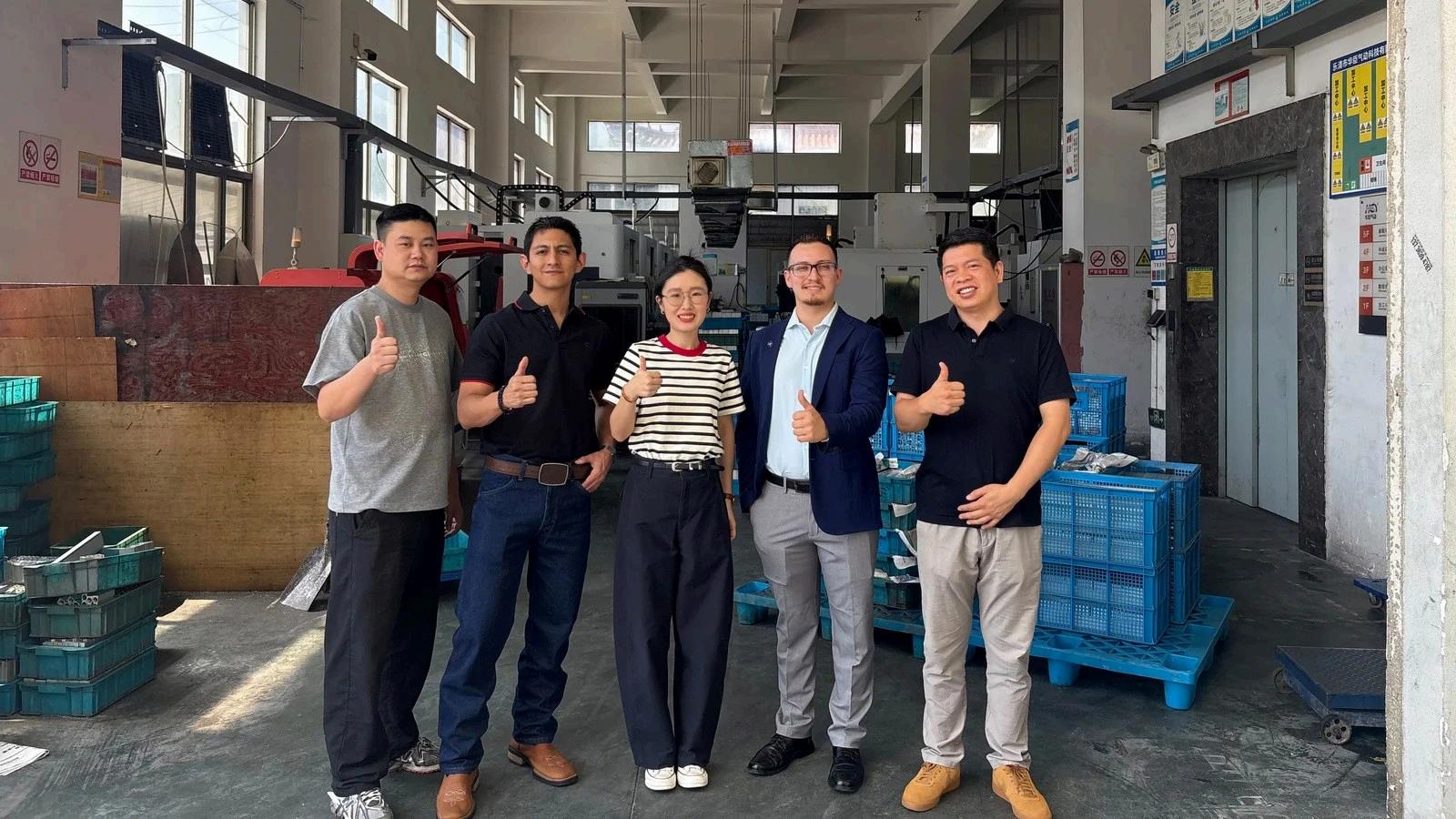
Our team with the visiting delegation at the end of the 28 September 2026 factory audit in Liushi Town,Yueqing, Zhejiang.
What We Showed the Delegation
The audit covered four stages of our cylinder manufacturing: CNC machining of cylinder bodies and end caps, in-process inspection of machined components, pressure and function testing of assembled cylinders, and the quality standards posted at each workstation. We walked the delegation through our 5,000+ sqm plant in Liushi Town, Yueqing, Zhejiang, with every stage running as normal.
We agreed the scope before the visit so the delegation could follow one continuous flow — machining, then inspection, then testing — instead of switching between separate tours. The group moved through our machining area, our inspection and testing area, and our assembly floor in sequence.
Inside Our Cylinder Machining
Our cylinder components are turned on CNC machining centres, and the delegation watched our machining cells running with automated bar feeding. We run more than 100 CNC machining centres, and the cells they inspected were producing parts at the time of the visit.
The machining stage sets the dimensional foundation of every cylinder we ship. Bore accuracy, wall thickness, the thread form at the end caps and the position of the air ports are all established before assembly begins. A dimension that drifts here is difficult to recover later in the process, which is why this floor is the first stop on an audit.
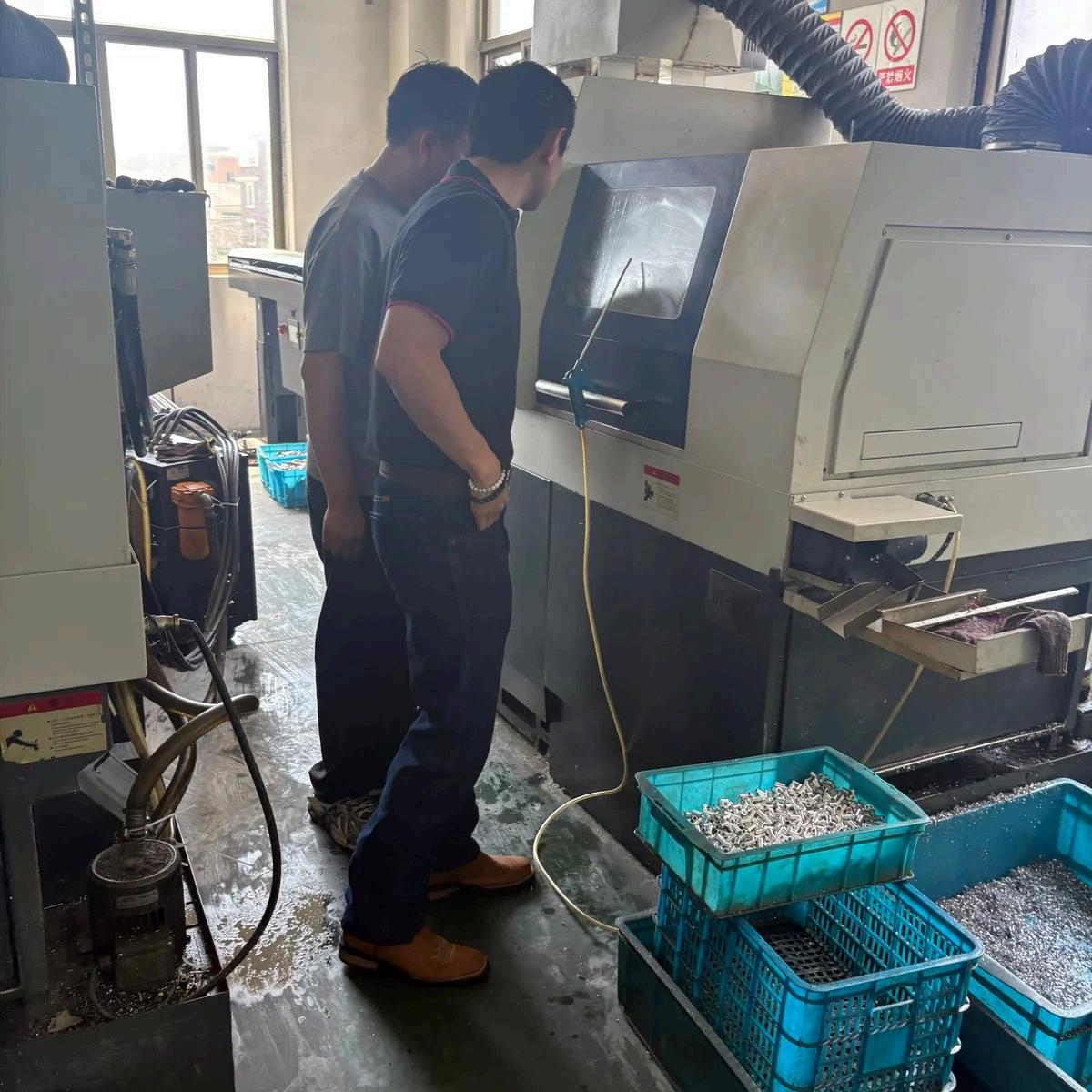
Cylinder components being turned on one of our CNC machining centres with automated bar feeding.
During the visit the delegation handled individual machined components directly at the machine rather than reviewing a finished sample set.
How We Inspect and Test Every Cylinder
We check machined parts at the machine before they move to assembly. During the audit the delegation examined machined components by hand at the workstation, with our open process bins of finished parts standing beside the machining cells.
How are pneumatic cylinders checked during production? We inspect machined components at the machine before they move to assembly, then pressure- and function-test assembled cylinders on dedicated test benches before dispatch.
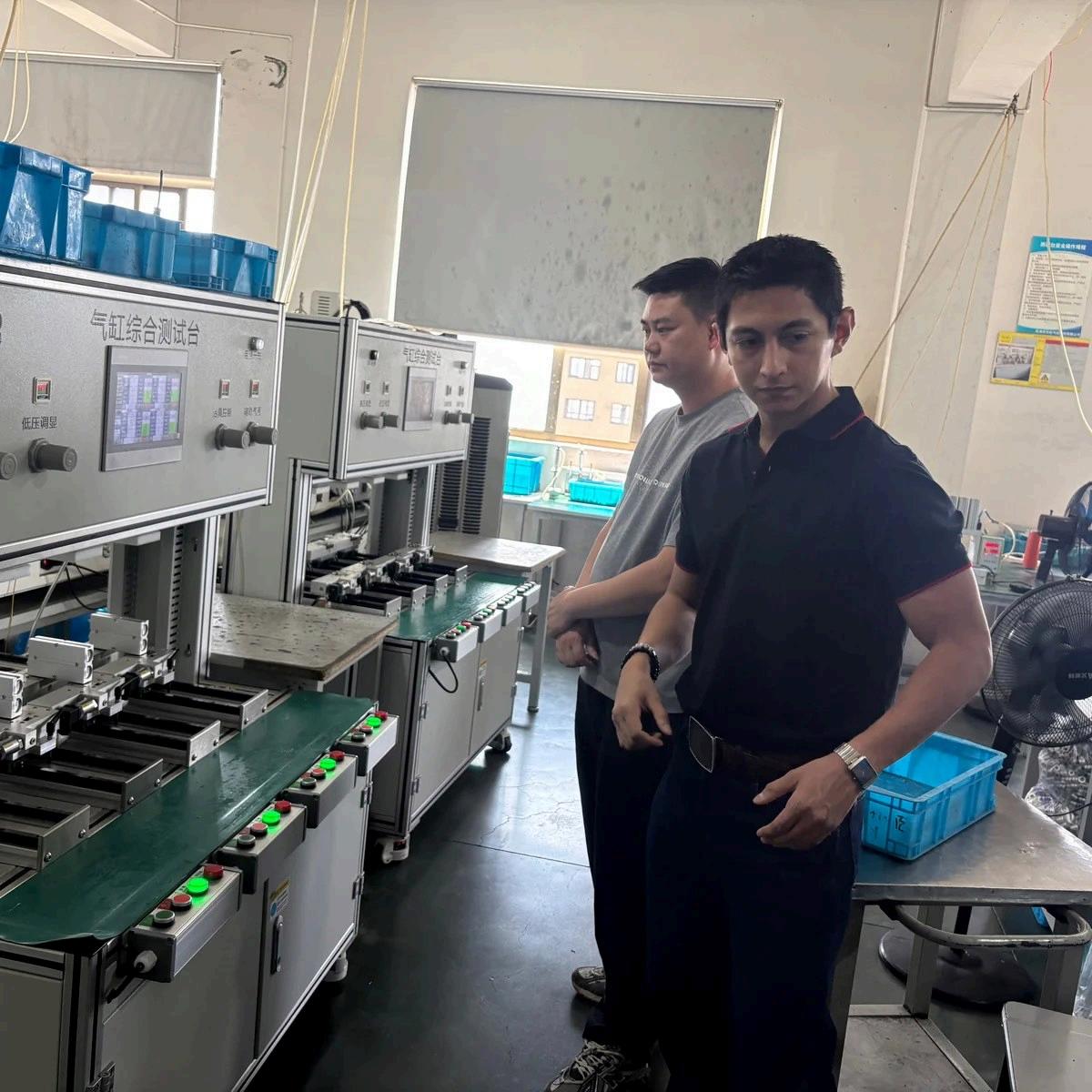
One of our cylinder test benches, with independent high- and low-pressure regulation and digital readout.
Our assembled cylinders are tested on dedicated benches in our inspection area. Those benches are fitted with independent high- and low-pressure regulation, a digital display showing live test parameters, and a buzzer that signals out-of-range conditions. The delegation watched the benches in operation and discussed the test setup with our inspection team.
Pressure testing checks that the piston seal and the end-cap joints hold under load, while function testing confirms that the cylinder strokes and returns correctly. These are the two failure modes that would otherwise surface only after a cylinder is installed in a customer's machine, where a leak or a sticking stroke becomes a line stoppage rather than a warranty claim. That is why we test before dispatch, not after a complaint.
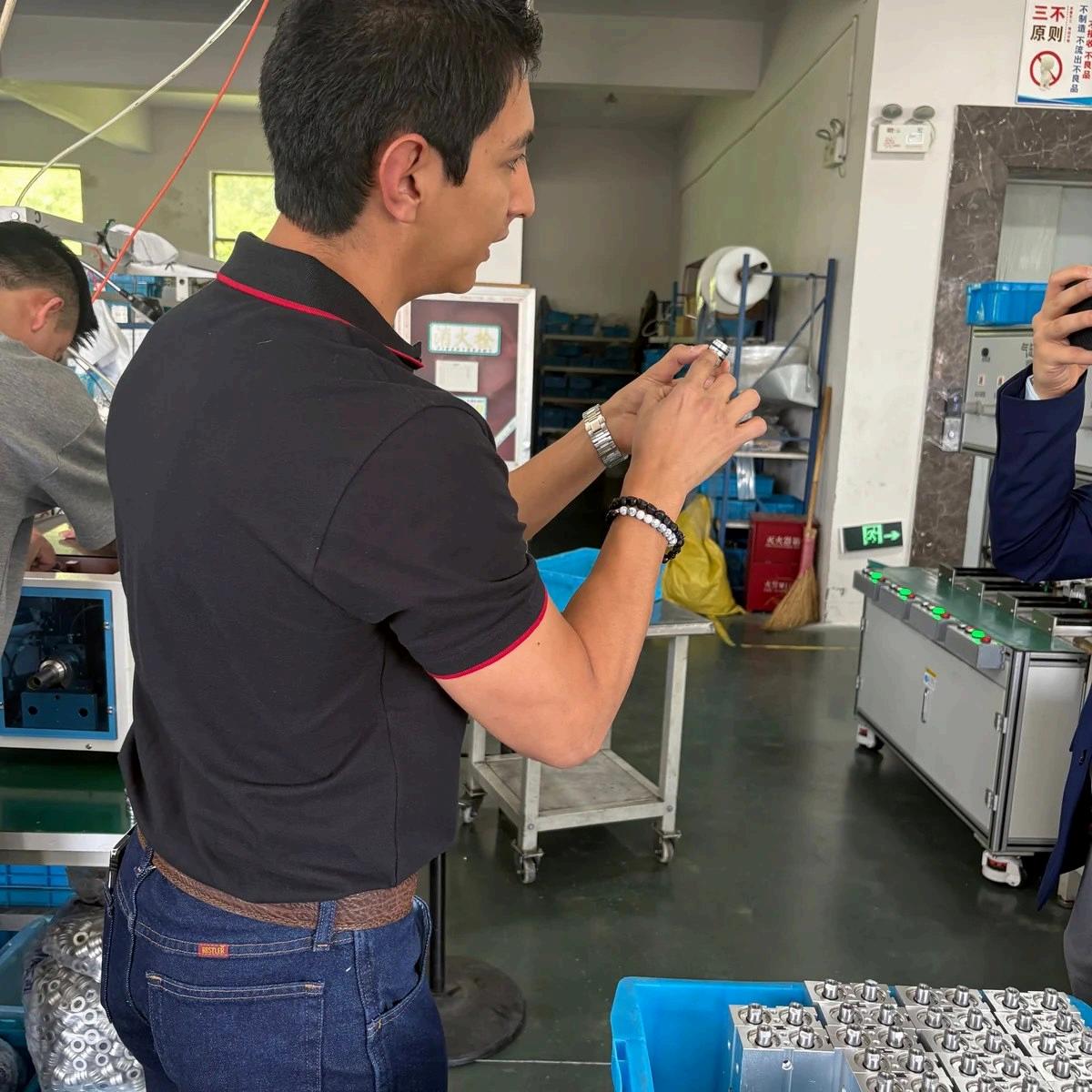
In-process inspection of machined cylinder components at one of our machining cells.
Our Quality System and CE Certification
Quality boards are posted at our workstations and on the walls of our production area, including the "Three-No Principle": a shop-floor rule that tells our operators not to accept defective parts, not to produce defective parts, and not to pass defective parts on to the next stage. Our quality management system is aligned with international standards and supported by a dedicated quality control and inspection team.
Our air cylinders hold CE certification under the 2006/42/EC Machinery Directive, certificate number M.2025.206.C132094, issued by UDEM and valid until 21 December 2030. That certificate covers more than 100 cylinder models. It covers our cylinder range; our solenoid valves and other pneumatic components are supplied outside that certificate scope.
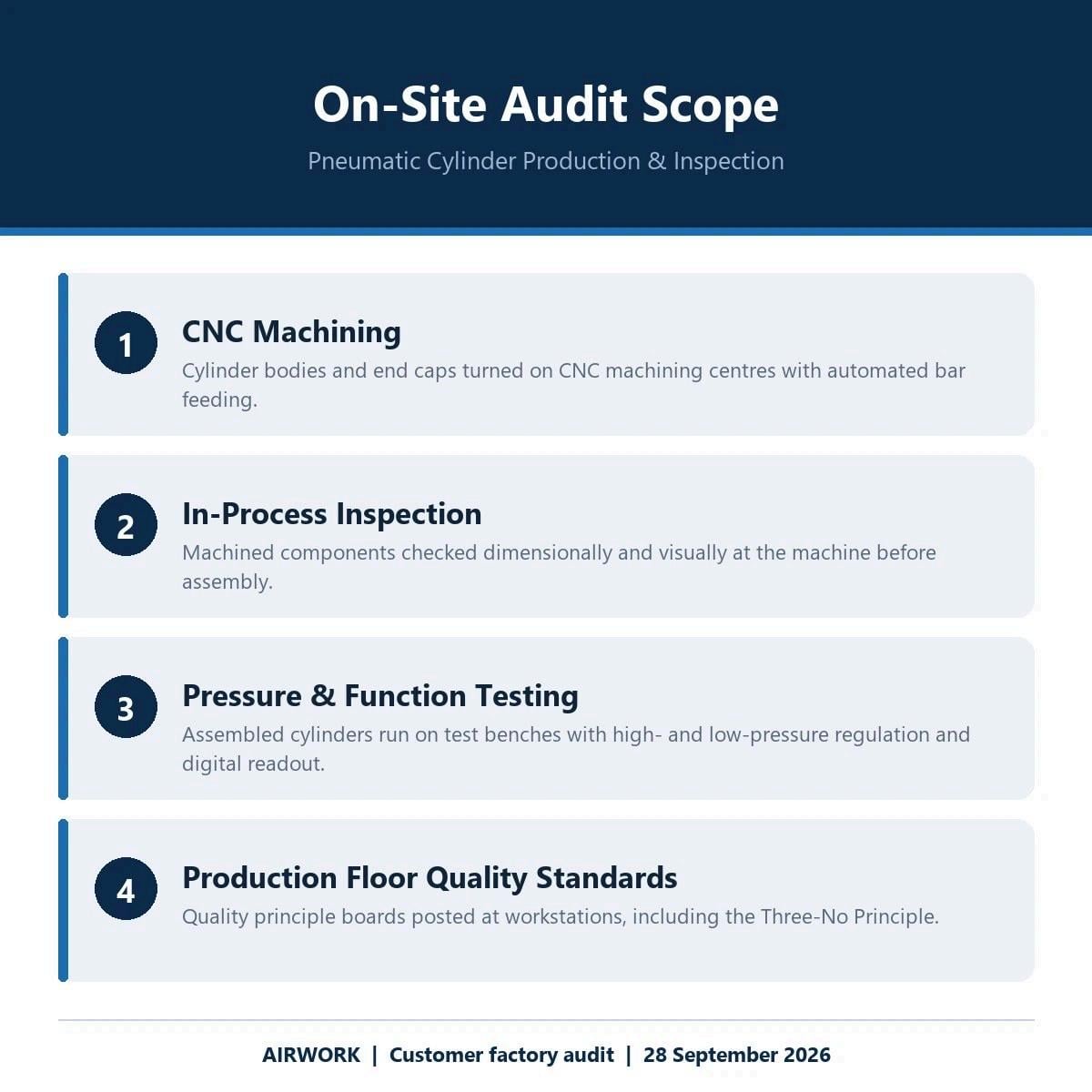
Our on-site audit scope: CNC machining, in-process inspection, pressure and function testing, and floor quality standards.
Does a factory audit replace sample approval? No. An on-site audit verifies equipment, process control and inspection routines. It does not replace dimensional reports, sample testing or first-article approval for a specific cylinder model.
What This Audit Means for Buyers
We know that a certificate on its own rarely settles a sourcing decision. An on-site audit is one of the few ways a buyer can verify manufacturing capability directly rather than through documents. We export to Southeast Asia, South America, North America and Europe, and we would rather a buyer see our equipment, our inspection stations and our quality routines at work than read about them in a quotation.
Buyers comparing suppliers tend to ask the same questions during a visit: which machining operations are performed in house, how parts are checked between operations, how finished cylinders are tested, and what happens to a part that fails a check. We answer each of those by showing the process rather than describing it. The visiting team's feedback after the audit was positive. They told us they were satisfied with the production and inspection processes they saw, and with the level of process control at our machining and testing stages.
Frequently Asked Questions
Which pneumatic cylinder series do you produce?
We produce standard, compact and dual-rod cylinders, including the ISO 15552-compliant DNC series with bore sizes from Ø32 mm to Ø100 mm and strokes from 25 mm to 300 mm, alongside our SC, SI, SU, SDA and TN series.
Are your air cylinders CE certified?
Yes. Our air cylinder range is CE certified under the 2006/42/EC Machinery Directive, certificate M.2025.206.C132094, issued by UDEM and valid until 21 December 2030, covering more than 100 cylinder models.
Can your cylinders replace AirTAC or FESTO models?
Our DNC series follows ISO 15552, the standard used by FESTO DNC cylinders, with matching mounting dimensions, bore, stroke and port configuration. Our other series are dimensionally compatible with the corresponding AirTAC ranges.
What is your minimum order quantity and standard lead time?
Air cylinders start from one piece, and standard items ship within 5 to 7 working days after deposit. Customised specifications are quoted after review.
Can a buyer request a factory visit before placing an order?
Yes. We welcome factory visits and audit requests, and we agree the scope of the visit in advance through our sales team.
Visit Our Factory
We have manufactured pneumatic components at our Liushi Town plant since 2010, supplying air cylinders, solenoid valves, air fittings, air source treatment units and air tubing, with OEM and ODM support and standard lead times of 5 to 7 working days. If you want to verify our production and inspection capability directly, request a factory visit through our sales team at [email protected], or review our product range at www.jzpnu.com.