EN


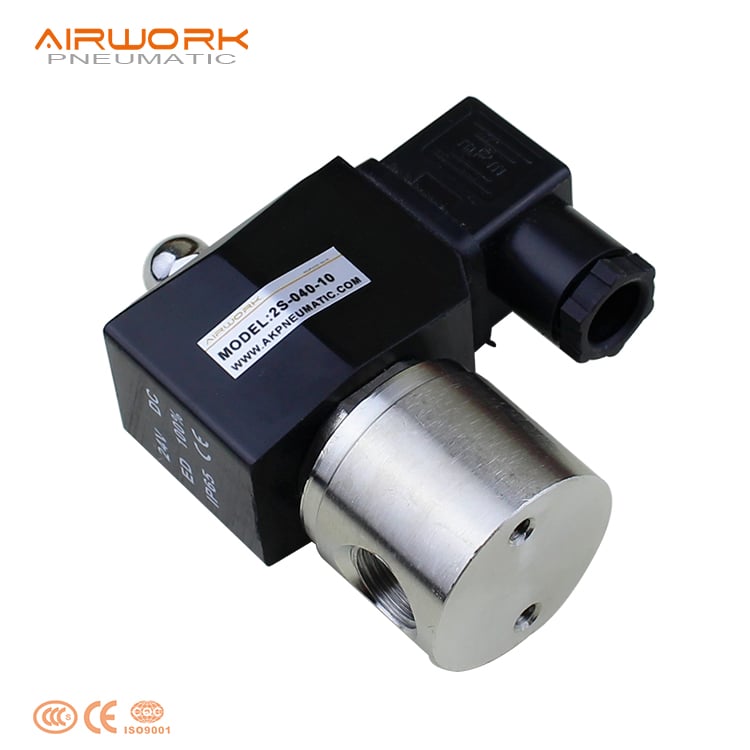
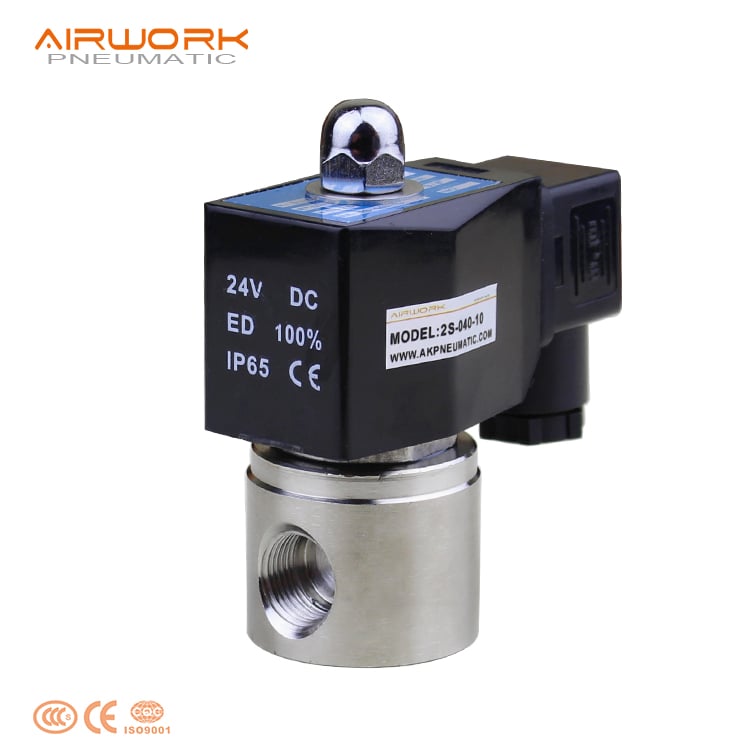
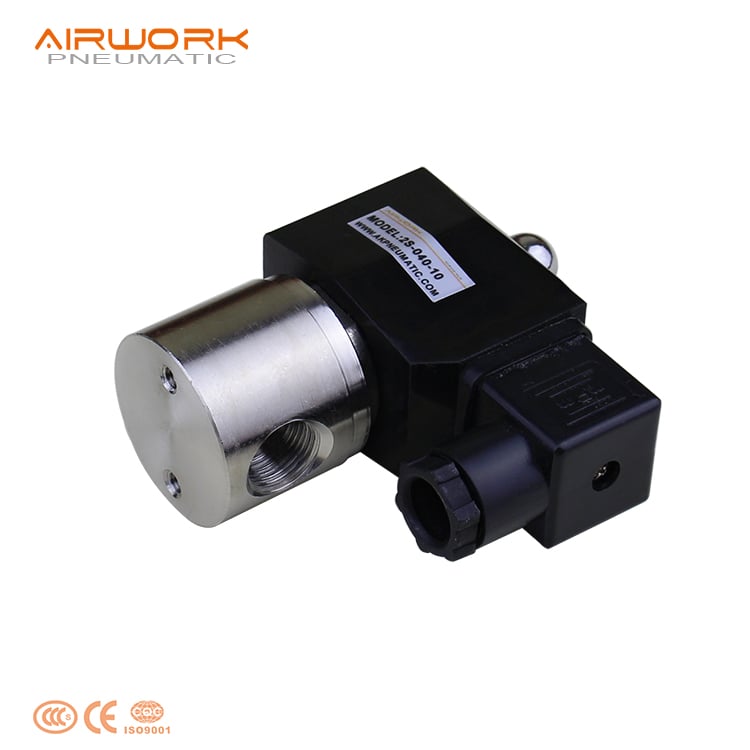
2S Series Stainless Steel Solenoid Valve Direct Acting Normally Closed 2 Way Water Air Oil Gas 1/8 To 2 Inch DC24V AC220V IP65
The 2S series is a two way normally closed solenoid valve with a stainless steel body, built for air, water, oil and gas lines from 1/8 inch to 2 inch. It is a direct acting valve, so the coil pulls the plunger itself and the valve opens from zero pressure instead of waiting for a pilot flow. Orifice sizes run from 2.5 mm to 50 mm with Cv from 0.23 to 48, and the coil is available in DC 12V, DC 24V, AC 24V, AC 110V, AC 220V and AC 380V.
- Overview
- Recommended Products
Product Detailed Description:
The 2S is a 2/2 way valve, which means one inlet and one outlet and a single seat that is either open or closed. In the normally closed version the seat is held shut by the spring and the medium, and the coil has to be energised to lift the plunger and open it, so a power failure closes the line rather than leaving it running. That is the behaviour most water, oil and gas lines want, and it is why the normally closed type is the standard build rather than an option.
Direct acting is the other half of the design. In a pilot operated valve the line pressure is what opens the seat, so a line that has dropped to zero has nothing to open it with; here the coil acts on the plunger directly, so the valve opens from a standing start with no pressure behind it. The trade is that the coil has to do the work itself, which is why the body is built in eight flow classes rather than one, and why the larger sizes carry a bigger coil rather than a bigger spring.
The body is stainless steel, which is what puts the same valve on a water skid, an oil line and a gas train without a plating to fail. The seal is chosen against the medium: NBR for air, water and general oil, EPDM where the water is treated or hot, and FKM where the oil or the chemical would swell NBR. Fluid viscosity is limited to below 20 CST, so the oil line has to be a light oil rather than a heavy one. Ports are G thread from 1/8 to 2 inch, and the coil is a 100 percent duty coil in an IP65 housing.
Product Feature :
1.Direct acting, opens at zero pressure: the coil lifts the plunger itself, so the valve works on a line that has not built pressure yet, unlike a pilot operated valve that needs a differential to start.
2.Normally closed as standard: the seat is spring held, so a power failure shuts the line instead of leaving it open, which is the safe state for water, oil and gas.
3.Stainless steel body: one body material covers water, oil, gas and mildly corrosive lines without a plated surface that pits at the thread.
4.Eight flow classes, 2.5 mm to 50 mm orifice: Cv from 0.23 up to 48, so the same series sizes from a dosing line to a 2 inch main.
5.Ports from 1/8 to 2 inch in G thread: nine port sizes, with the body sized to the orifice rather than one body with reducers.
6.Three seal compounds: NBR, EPDM or FKM selected against the medium and the temperature, so the same valve body serves water, oil and chemical duty.
7.100 percent duty coil, IP65: continuous energisation without a duty cycle limit, and a housing that survives a washdown area or a wet plant room.
Application Industries:
1.Water treatment and filtration - inlet, backwash and dosing lines on skids and panels
2.Food and beverage - water, cleaning and steam-adjacent lines outside the direct product contact area
3.Oil and lubrication systems - light oil feed, drain and return lines below 20 CST
4.Gas trains and burner lines - on/off control of air and gas at the burner or at the manifold
5.Chemical and pharmaceutical plant - dosing and transfer lines where the seal is selected to the medium
6.HVAC and boiler plant - make up water, condensate and humidifier feed
7.Irrigation and agriculture - zoned water control on filters and fertigation units
8.Machine tools and compressors - coolant, blow off and drain lines
9.Marine and offshore - deck wash, ballast and utility water in a salt atmosphere
Specification:
Item |
Detail |
Series |
2S two way solenoid valve |
Motion pattern |
Direct drive type |
Type |
Normally closed (2/2 way) |
Working medium |
Air, water, oil, gas |
Orifice |
2.5 / 5 / 16 / 20 / 25 / 35 / 40 / 50 mm by model |
Cv value |
0.23 / 0.60 / 4.8 / 7.6 / 24 / 29 / 48 by model |
Port thread |
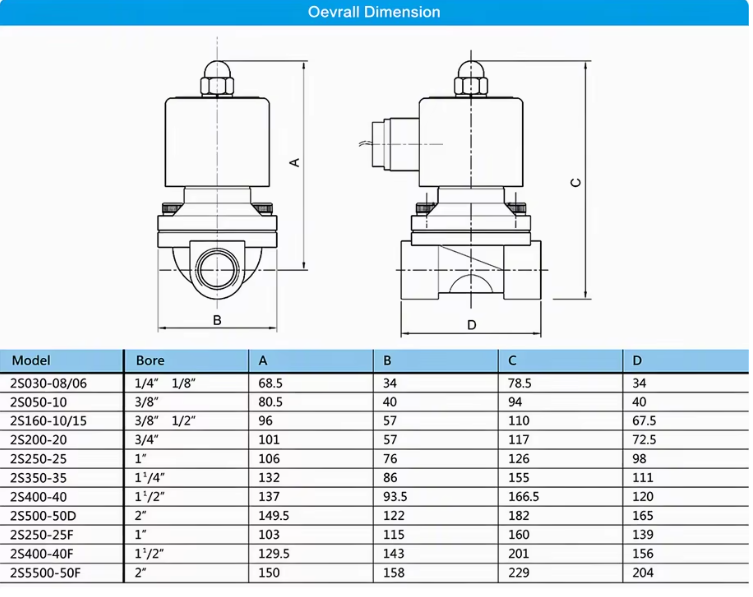
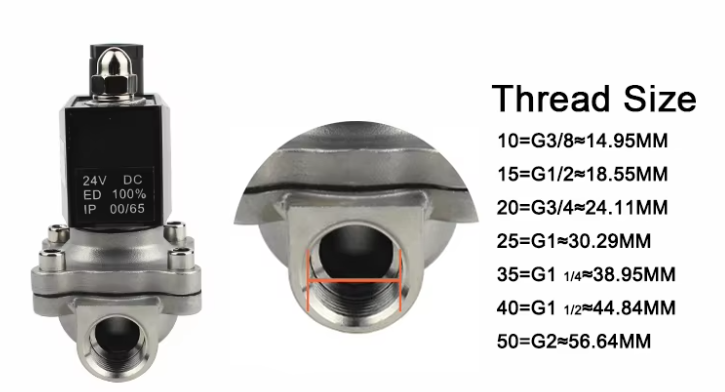
G1/8, G1/4, G3/8, G1/2, G3/4, G1, G1 1/4, G1 1/2, G2 |
Working pressure |
0 to 7 for air and gas; 0 to 5 for water and oil (unit as catalogued) |
Max pressure resistance |
10.5 |
Operating temperature |
-5 to 80 C |
Fluid viscosity |
Below 20 CST |
Voltage range |
DC 12V, DC 24V, AC 24V, AC 110V, AC 220V, AC 380V; tolerance plus or minus 10 percent |
Coil |
100 percent ED, IP65 housing |
Body material |
Stainless steel |
Seal material |
NBR, EPDM or FKM |
MOQ |
10 pcs |
Lead time |
7 days for standard models |
Customization Options:
Customization Item |
Options |
Coil voltage |
DC 12V, DC 24V, AC 24V, AC 110V, AC 220V, AC 380V |
Special voltage |
Other voltages and frequencies to order |
Seal compound |
NBR, EPDM, FKM |
Port size |
1/8 to 2 inch, matched to the orifice |
Thread standard |
G thread as standard; other standards quoted per order |
Body pattern |
Standard body or F flange pattern |
OEM marking |
Nameplate and neutral packing to customer artwork |
Application:
1.Water line on a treatment skid (water treatment): A filtration skid needs the inlet shut whenever the pump stops, not when the operator remembers. The normally closed seat does that without a control sequence: lose the coil signal and the line is closed. Because the valve is direct acting it also opens on a dry start, which is the state a skid is in after a cartridge change, and the stainless body takes the chlorine dose in the same line.
2.Light oil feed on a lubrication unit (oil line): A lubrication unit delivers light oil to a chain or a bearing from a small tank, and the feed has to stop when the machine stops. The 2S handles oil at 0 to 5 on the catalogued scale with a viscosity below 20 CST, and the FKM seal is specified where the oil would otherwise swell an NBR seat. Sizing is by Cv rather than by port: a 1/4 port with the smallest orifice will starve a long line, and a 3/8 port with the next orifice up will not.
3.Air or gas on-off at a burner manifold (gas train): At a burner manifold the valve is asked to open against a line that is already at pressure and to close on a signal drop. Direct acting means the coil does not depend on downstream demand to open, and normally closed means the safe state on a power failure is shut. The IP65 coil housing matters here because burner rooms are washed and hosed as often as they are swept.
Installation and Usage:
1.Follow the flow arrow: the body is marked for inlet and outlet. A 2/2 valve fitted backwards will hold pressure but will not close cleanly against the spring, and the leak reads as a worn seat.
2.Keep the coil upright where possible: an upright coil keeps the plunger travel vertical and the seat free of debris. Where the pipe runs horizontally, mount so the coil is not the lowest point.
3.Filter ahead of the valve: a strainer or a Y filter upstream keeps scale and swarf off the seat. Most "sticking valve" complaints on water lines are a seat with a particle on it.
4.Do not use it as a regulator or a throttle: the seat is open or closed. A valve held half open by a reduced coil voltage will chatter and burn the coil.
5.Tighten on the hex, not on the coil: use a spanner on the body flats. Turning the coil housing puts the load through the plunger tube and distorts it.
6.Seal the thread on the male end only: tape or paste on the mating female thread, two turns, kept away from the first thread so none enters the seat.
7.Match the coil to the supply: the coil is wound for one voltage with a tolerance of plus or minus 10 percent. A 220V coil on a 240V supply runs hot and a 24V DC coil on an AC supply will not hold.
FAQ:
Q1. What does 2/2 way normally closed mean?
A1. Two ports, one inlet and one outlet, and one seat. Normally closed means the seat is shut when the coil is off, and the coil must be energised to open it, so the line closes on a power failure.
Q2. Why choose direct acting instead of a pilot operated valve?
A2. A direct acting valve opens from zero pressure because the coil moves the plunger itself. A pilot operated valve needs a pressure differential to open. On a line that starts empty, or on a low pressure line, only the direct acting type will open reliably.
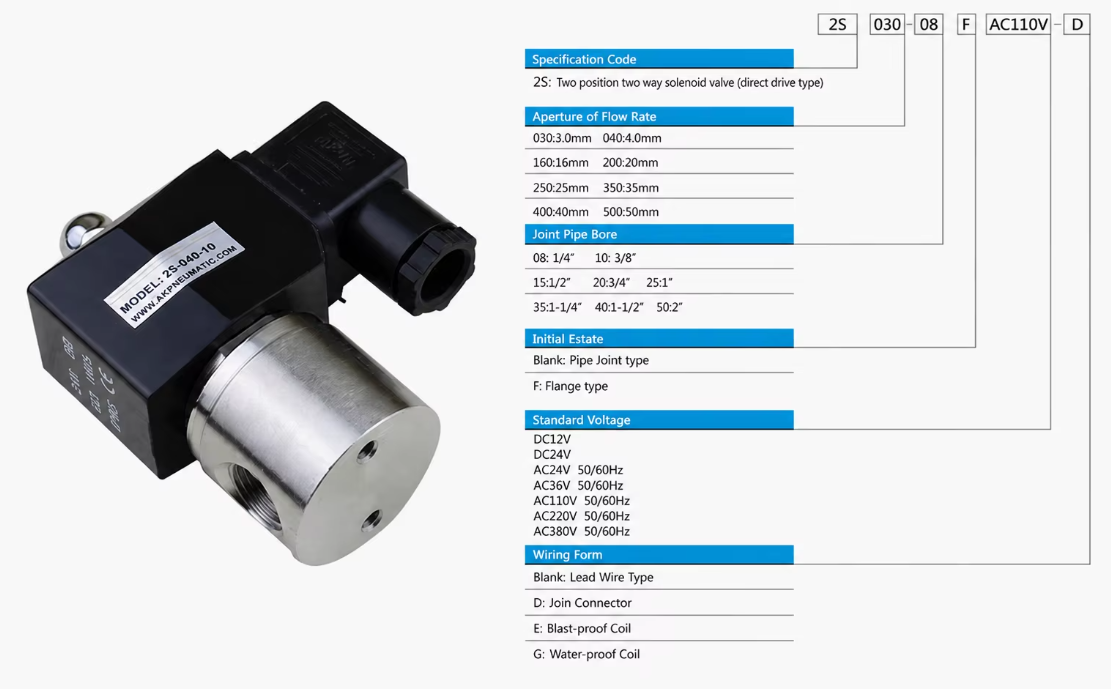
Q3. How do I read the model code?
A3. The three digits are the valve size class and the suffix is the port: 06 is 1/8, 08 is 1/4, 10 is 3/8, 15 is 1/2, 20 is 3/4, 25 is 1 inch, 35 is 1 1/4, 40 is 1 1/2 and 50 is 2 inch. An F suffix is the flange pattern of the same size.
Q4. Which seal should I take for my medium?
A4. NBR for air, water and general oil, EPDM for treated or hot water, and FKM where oil or chemical would swell NBR. Tell us the medium, the concentration and the temperature, and the seal is matched to it rather than guessed.
Q5. What are the pressure and temperature limits?
A5. Air and gas run 0 to 7, water and oil 0 to 5 on the catalogued scale, with a maximum resistance of 10.5 and a working temperature of -5 to 80 C. The unit is the one used in the catalogue; confirm it against your line gauge before ordering.
Q6. Which voltages are available?
A6. DC 12V and 24V, AC 24V, 110V, 220V and 380V, with a tolerance of plus or minus 10 percent. Other voltages are made to order, and the coil is a 100 percent duty coil in an IP65 housing.
Q7. How do I size the valve?
A7. Size by Cv against the flow you need, then choose the port that fits the pipe. A larger port with the same orifice does not increase flow; a larger orifice does. If the required Cv sits between two models, take the larger one and throttle elsewhere.
Q8. Can it be mounted in any position?
A8. It runs in most positions, but an upright coil is preferred because the plunger then travels vertically and the seat stays clear. Avoid mounting with the coil as the lowest point, where water collects in the tube.
Q9. What is the MOQ and the lead time?
A9. MOQ is 10 pcs for standard models, with a lead time of 7 days. OEM nameplates and neutral packing are available, and special voltages or seal compounds are quoted with their own lead time.
Factory Advantages and Certifications:
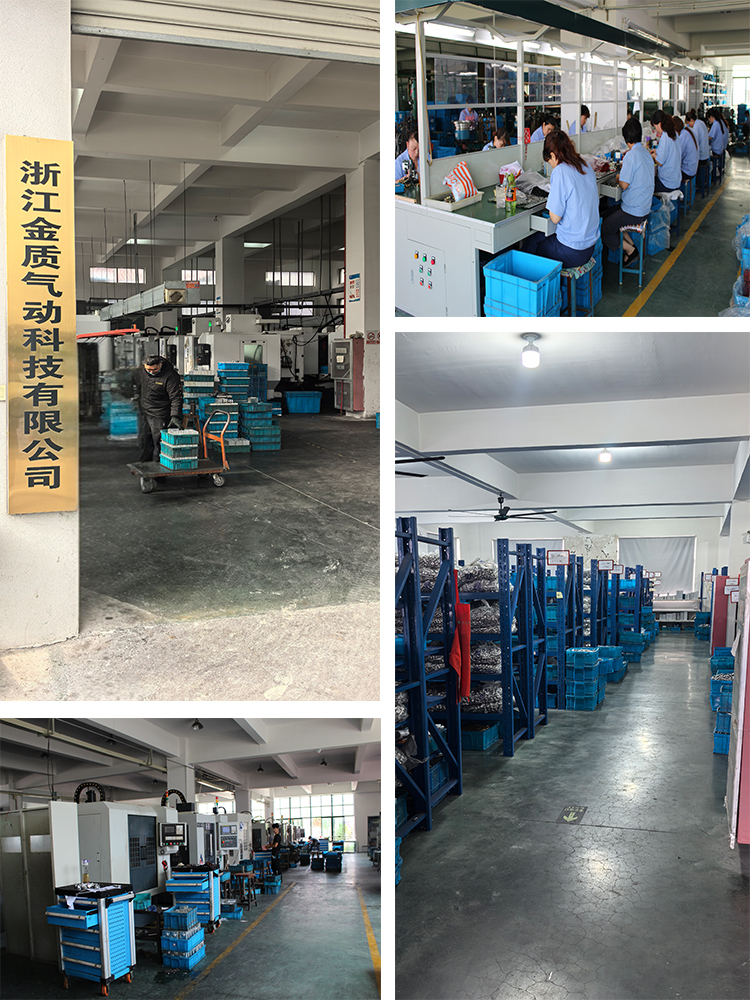
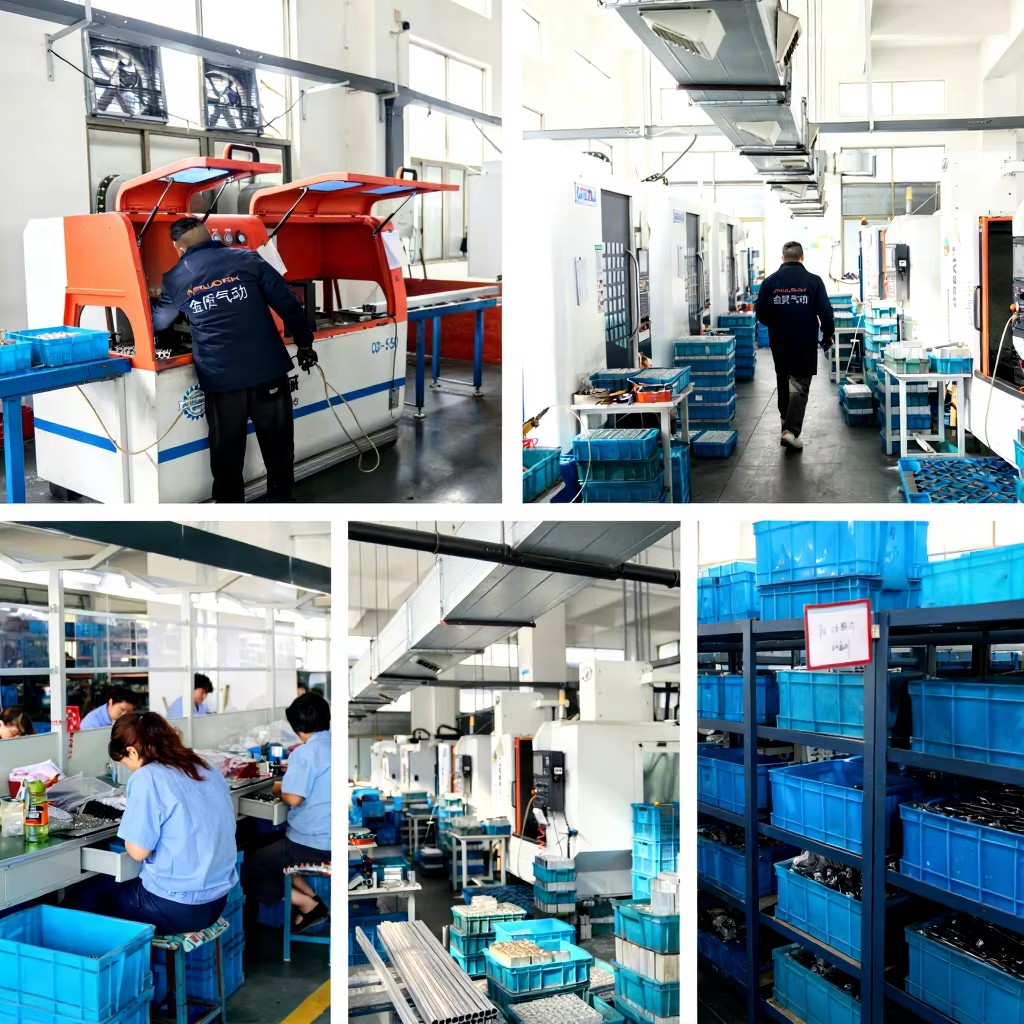
The 2S is built as one family across eight flow classes, which is what keeps the seat, the plunger tube and the port depth consistent from the 1/8 inch body to the 2 inch body. Bodies are stainless throughout rather than a plated brass body with a stainless trim, so the thread and the seat are the same material as the outside. Coils are wound to the ordered voltage and the assembly is tested at the seat before packing, and each carton carries a batch number so a complaint can be traced to a run.
Certification