 EN
EN

Q: The role of 'NAMUR' standard valves in automating chemical and process industry actuators.
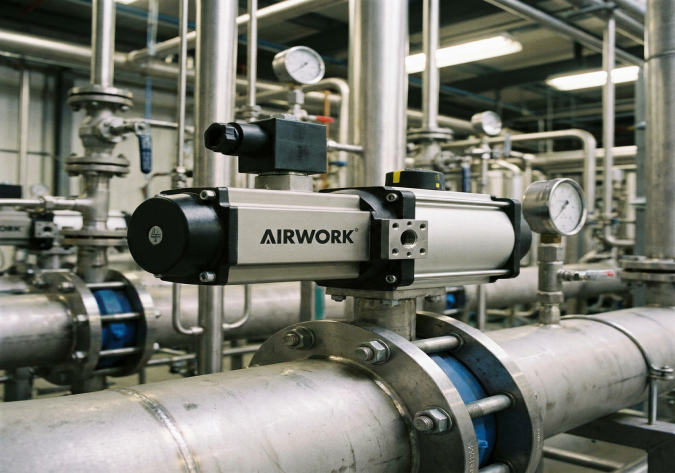
In the chemical, petrochemical, oil and gas, and water treatment industries, fluid flow is controlled by large process valves, such as ball valves, butterfly valves, and plug valves. These heavy-duty valves are rotated open and closed using quarter-turn pneumatic rotary actuators (often rack-and-pinion or scotch-yoke designs).
To control these rotary actuators electrically, engineers rely on solenoid valves. However, in harsh chemical processing environments, using standard inline solenoid valves connected via external tubing is highly discouraged due to the risk of mechanical damage, corrosion, and pressure leaks. Instead, the process industry utilizes the NAMUR standard mounting system. Below, the AIRWORK engineering team explores the role of NAMUR standard valves, their technical benefits, and how they secure process automation in critical B2B applications.
1. What is the 'NAMUR' Standard?
NAMUR is an acronym for the Normenarbeitsgemeinschaft fuer Mess- und Regeltechnik in der Chemischen Industrie, which translates from German as the Association for Standards in Measurement and Control in the Chemical Industry. This European-based association established standardization guidelines to ensure safety, reliability, and global interchangeability of process control components.
The key standard governing pneumatic interfaces is VDI/VDE 3845, commonly known as the NAMUR standard. This specification defines a standardized mounting footprint, bolt spacing, and port alignment on the flat surface of a rotary pneumatic actuator. A NAMUR-compliant solenoid valve (such as the AIRWORK 4M series) is designed with matching ports and bolt holes, allowing it to bolt directly onto the face of the actuator without any external piping or brackets.
2. Technical Advantages of NAMUR Direct Mounting
The direct-mount design of NAMUR valves provides several critical advantages over traditional inline piping:
- Elimination of Tubing and Fittings: In a non-NAMUR setup, two separate lines of polyurethane or stainless steel tubing must be run from the control valve to the two ports of the rotary actuator. Every tube connection, elbow, and threaded fitting is a potential leak point. In a chemical facility where aggressive fumes or vibrational forces are present, these tubes can degrade, crack, or shake loose. A NAMUR valve bolts directly onto the actuator body, using face-sealing O-rings. This completely eliminates external tubing, fittings, and brackets, reducing potential leak paths to zero.
- Mechanical Protection and Space Savings: By removing external piping, the valve and actuator become a single, robust, consolidated unit. This compact envelope is highly protected from accidental mechanical impacts (such as tools dropping or operators stepping on the lines) and takes up significantly less space in tight piping galleries.
- Universal Interchangeability: Because the bolt patterns and port configurations are strictly standardized, B2B procurement managers can source a NAMUR valve from one manufacturer (like JZPNU) and mount it seamlessly onto a rotary actuator from another manufacturer. This global compatibility simplifies inventory management and accelerates replacement times during plant maintenance.
3. Functional Flexibility: 3/2 and 5/2-Way Conversion
One of the most elegant engineering features of high-quality NAMUR valves is their dual-function flexibility. Process rotary actuators come in two main configurations:
- Double-Acting Actuators: These require air to drive the piston in both directions (open and close), necessitating a 5-way valve.
- Single-Acting (Spring-Return) Actuators: These use air to drive the piston in one direction (typically open), relying on heavy internal mechanical springs to drive the piston back (close) when air is exhausted. These require a 3-way valve.
To avoid the need to stock separate 3-way and 5-way NAMUR valves, manufacturers like JZPNU design their NAMUR valves (such as the AIRWORK 4M series) as 5-way valves that can be easily converted to 3-way functionality using a simple, reversible conversion plate (also known as a transition gasket or plate) included with the valve.
- When the plate is installed in the 5/2 position, all five ports are active, allowing full control of a double-acting actuator.
- When flipped to the 3/2 position, one of the working ports is blocked, and the exhaust air from the spring chamber of the actuator is recirculated back into the valve body. This prevents corrosive atmospheric chemical gases from being drawn into the actuator's spring chamber, extending actuator life.
4. Surviving Harsh Process Environments
Because chemical and process plants deal with hazardous, flammable, and corrosive materials, NAMUR valves must meet strict environmental and electrical safety standards:
- Corrosion Resistance: NAMUR valves are exposed to aggressive salt air, acid fumes, and outdoor weather. High-quality NAMUR valves feature hard-anodized or epoxy-coated aluminum bodies, or are machined from 316 stainless steel, paired with stainless steel fasteners.
- Ingress Protection (IP Rating): Valves should have an IP65 or IP67 rating to guarantee that water from high-pressure washdowns or heavy rain, along with fine chemical dust, cannot penetrate the electrical housing.
- Explosion-Proof Coils (ATEX/Ex): In chemical zones where flammable gases or dust are present, standard electrical connections can spark, causing devastating explosions. NAMUR valves must be paired with certified explosion-proof solenoid coils (such as ATEX-compliant Ex d flameproof or Ex ia intrinsically safe coils) to clamp electrical energy and prevent ignition.
The AIRWORK (JZPNU) Advantage
At Zhejiang Jinzhi Pneumatic Technology Co., Ltd. (JZPNU), we offer highly reliable NAMUR standard valves under our AIRWORK 4M series (including 4M210 and 4M310 models) engineered specifically for process automation:
- Dual 5/2 and 3/2 Capability: Our NAMUR valves come complete with interchangeable sealing plates, allowing immediate field conversion to match single-acting or double-acting process actuators.
- Superior Environmental Sealing: Every 4M series valve is built with high-quality NBR/HNBR seals and features IP65 rated DIN connector coil housings, ensuring reliable protection against water and particulate ingress.
- Explosion-Proof Configurations: We offer a variety of certified explosion-proof coils, allowing our NAMUR valves to be safely deployed in hazardous Zone 1 and Zone 2 process areas.
- High Flow Rates (Cv): Our internal spools are precision machined to provide maximum flow rates, ensuring fast, positive opening and closing cycles for even large process ball and butterfly valves.
By selecting AIRWORK brand NAMUR standard control valves, B2B buyers and system integrators in the chemical, food, and process sectors can ensure absolute mechanical compatibility, reduce installation labor, eliminate leak risks, and guarantee safe, continuous process automation.