 EN
EN

Q: How to calculate the 10-year ROI of switching to premium Push-In composite fittings?
Introduction: The Hidden Financial Impact of Small Components
In industrial pneumatics, minor components often carry major financial consequences. Fittings, though representing less than one percent of a typical plant machinery bill of materials, are the most frequent source of compressed air leaks and unexpected pneumatic system failures. Sourcing directors and procurement managers frequently make the mistake of choosing low-cost, generic fittings to minimize immediate capital expenditure. However, over a multi-year cycle, this choice leads to higher operational costs.
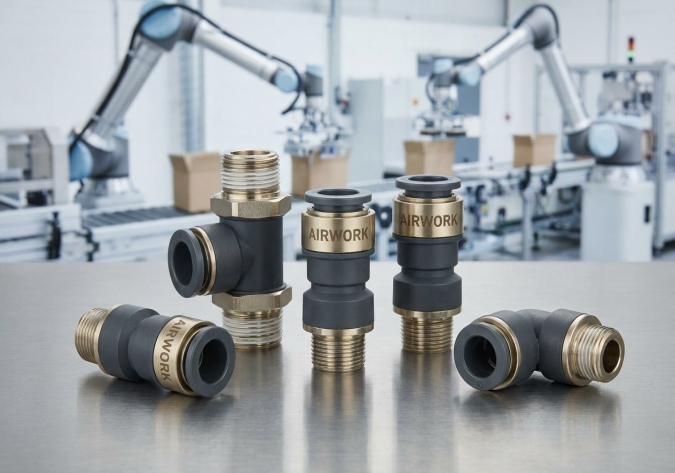
Premium composite push-in fittings from JZPNU (AIRWORK brand) are engineered to minimize air loss, withstand severe vibration, and reduce maintenance labor. To justify the higher initial cost to executive leadership, procurement managers must move beyond raw unit prices and perform a comprehensive 10-year Total Cost of Ownership (TCO) and Return on Investment (ROI) calculation.
This guide outlines the mathematical model for determining the true financial return of upgrading to premium AIRWORK push-in composite fittings.
1. Direct Purchase Price: The Capex Fallacy
To begin the ROI analysis, we must first document the baseline capital expenditure. Let us analyze a medium-sized manufacturing plant utilizing 5,000 pneumatic fittings across various assembly and packaging lines.
- Low-Cost Generic Fitting: Average wholesale cost of 0.30 USD per unit. Total initial investment: 1,500 USD.
- Premium AIRWORK Composite Fitting: Average wholesale cost of 1.20 USD per unit. Total initial investment: 6,000 USD.
- Initial Capex Difference: 4,500 USD.
At first glance, opting for the generic fitting seems to save the factory 4,500 USD. However, this calculation is a fallacy because it assumes that both fittings perform identically and have the same service lifespan, which is never the case in real-world factory environments.
2. Lifespan and Replacement Cycle Costs
Cheap pneumatic fittings typically utilize lower-grade plastics (such as standard ABS) and inferior nitrile rubber (NBR) seals. Under continuous thermal stress and pressure cycles, these seals degrade quickly, and the plastic bodies crack, requiring complete replacement every 1.5 to 2 years.
In contrast, premium AIRWORK composite fittings are made of high-strength Polybutylene Terephthalate (PBT) and feature precision-engineered stainless steel gripping claws and high-performance, wear-resistant synthetic rubber seals. These fittings are rated for a 10-year service life in standard operating conditions.
Let us calculate the replacement costs over a 10-year period:
- Generic Fittings: Requires 5 complete replacement cycles (every 2 years). Total fitting cost over 10 years: 1,500 USD multiplied by 5 equals 7,500 USD.
- Premium AIRWORK Fittings: Zero replacement cycles required over 10 years. Total fitting cost: 6,000 USD.
- Direct Component Savings: 1,500 USD in favor of premium fittings.
3. Maintenance Labor Costs
Replacing a fitting is not just about the cost of the component; it involves maintenance labor. Every time a fitting fails, a maintenance technician must locate the leak, depressurize the system, cut the tubing, unscrew the old fitting, clean the threads, apply thread sealant, install the new fitting, and re-pressurize the line.
Assuming it takes an average of 15 minutes to replace a single fitting, and the average fully burdened labor rate for an industrial maintenance technician is 40.00 USD per hour, the labor cost per replacement is 10.00 USD.
If 15 percent of the cheap fittings fail annually (which is common due to mechanical stress, thermal expansion, and vibration):
- Generic Fittings: 750 failures per year. Over 10 years, this equates to 7,500 individual failures. Total labor cost: 7,500 failures multiplied by 10.00 USD equals 75,000 USD.
- Premium AIRWORK Fittings: Average annual failure rate is less than 0.5 percent due to robust design. Over 10 years, this equates to 250 total failures. Total labor cost: 250 failures multiplied by 10.00 USD equals 2,500 USD.
- Maintenance Labor Savings: 72,500 USD.
4. Compressed Air Leakage and Energy Waste
Compressed air is one of the most expensive utilities in a manufacturing facility. It takes massive amounts of electrical energy to run industrial compressors. A single tiny leak of just 1 millimeter in diameter at a system pressure of 6.0 bar wastes approximately 1.8 liters of air per second. This equates to roughly 230 USD of wasted electricity per year per leak, assuming an energy cost of 0.10 USD per kilowatt-hour.
Because cheap fittings lack precision-formed gripping teeth, they allow the pneumatic tubing to slip and wear against the seal, creating thousands of microscopic leak points throughout the plant. Over time, an unmonitored system of cheap fittings can easily average 200 minor leaks.
- Generic Fittings: Averaging 200 active leaks of 0.5 millimeter diameter. Each leak costs approximately 58 USD per year. Total annual energy waste: 200 multiplied by 58 USD equals 11,600 USD. Over 10 years, this accumulates to 116,000 USD.
- Premium AIRWORK Fittings: Precision claw design prevents tube micro-movement, maintaining a perfect seal. Averaging less than 5 active minor leaks. Total annual energy waste: 5 multiplied by 58 USD equals 290 USD. Over 10 years, this accumulates to 2,900 USD.
- Energy Savings: 113,100 USD.
5. Unplanned Production Downtime
When a primary pneumatic line experiences a sudden fitting blowout, the entire machine or packaging line stops. In modern manufacturing, the cost of unplanned downtime is incredibly high. For a medium-sized plant, line stoppage can easily cost 1,000 USD per hour in lost output and idle labor.
If we assume that out of the 750 annual failures of the cheap fittings, only 3 failures result in major line stoppages, with an average resolution time of 1 hour:
- Generic Fittings: 3 hours of downtime per year. Over 10 years, this equals 30 hours of downtime. Total cost: 30 hours multiplied by 1,000 USD equals 30,000 USD.
- Premium AIRWORK Fittings: Failures are extremely rare and almost never lead to catastrophic blowouts. Over 10 years, total downtime is estimated at 0 hours. Total cost: 0 USD.
- Downtime Savings: 30,000 USD.
6. The 10-Year Total Cost of Ownership (TCO) Comparison
Now, let us compile all of the calculated cost segments to compare the 10-year Total Cost of Ownership (TCO) for both options:
- Cost Category: Cheap Generic Fittings vs. Premium AIRWORK Fittings
- Initial Capex: 1,500 USD vs. 6,000 USD
- Replacement Components: 6,000 USD vs. 0 USD
- Maintenance Labor: 75,000 USD vs. 2,500 USD
- Energy Waste (Leaks): 116,000 USD vs. 2,900 USD
- Production Downtime: 30,000 USD vs. 0 USD
- 10-Year TCO: 228,500 USD vs. 11,400 USD
By upgrading to premium composite fittings, the 10-year savings is calculated as:
- 228,500 USD minus 11,400 USD equals 217,100 USD.
7. Calculating the Return on Investment (ROI)
The return on investment is calculated using the standard formula:
- ROI equals (Net Financial Benefit / Net Initial Investment) multiplied by 100 percent
- Net Initial Investment (Capex Difference): 4,500 USD
- Net Financial Benefit (10-Year Savings): 217,100 USD
- ROI equals (217,100 / 4,500) multiplied by 100 percent equals 4,824 percent.
This means that every single dollar invested in upgrading to premium AIRWORK push-in composite fittings yields more than 48 USD in savings over a 10-year operating lifecycle.
Why Choose JZPNU AIRWORK Composite Fittings?
JZPNU (Zhejiang Jinzhi Pneumatic Technology Co., Ltd.) is a leading manufacturer specializing in high-performance pneumatic components. Our AIRWORK line of composite fittings is specifically engineered to maximize B2B procurement value:
- Material Integrity: Made from virgin PBT, offering superior mechanical strength and chemical resistance.
- Thread Precision: All threads feature clean, precise profiles with pre-applied Teflon sealant to ensure zero-leak connections right out of the box.
- Gripping Mechanism: High-grade stainless steel lock claw design ensures secure tubing retention without scratching or restricting flow.
- Global Compatibility: Available in both metric and imperial sizes with various thread standards (G, PT, NPT) to integrate seamlessly into global automation systems.
By making the shift to premium AIRWORK fittings, procurement directors can significantly reduce operational overhead, protect their machinery from costly downtime, and achieve an extraordinary return on investment.
Table of Contents
- Q: How to calculate the 10-year ROI of switching to premium Push-In composite fittings?
- Introduction: The Hidden Financial Impact of Small Components
- 1. Direct Purchase Price: The Capex Fallacy
- 2. Lifespan and Replacement Cycle Costs
- 3. Maintenance Labor Costs
- 4. Compressed Air Leakage and Energy Waste
- 5. Unplanned Production Downtime
- 6. The 10-Year Total Cost of Ownership (TCO) Comparison
- 7. Calculating the Return on Investment (ROI)
- Why Choose JZPNU AIRWORK Composite Fittings?