 EN
EN

Question: How do you troubleshoot 'Exhaust Noise' in high-cycle machines while avoiding back-pressure issues?
Answer: To troubleshoot and eliminate high-decibel pneumatic exhaust noise in high-cycle machinery, engineers must replace standard, undersized, or clogged silencers with specialized high-flow silencers that match or exceed the flow capacity (Cv rating) of the directional control valve's exhaust port. Standard sintered bronze silencers reduce noise by forcing air through tiny pores, but they are highly prone to clogging from compressor oil and particulate contamination, which creates excessive back-pressure. This back-pressure resists the movement of the cylinder piston, leading to sluggish actuator response, slower cycle times, and erratic machine performance. To solve this, select high-flow porous plastic (polyethylene) silencers or multi-chamber expansion silencers. These designs expand and slow down the exhausting air stream gradually, reducing noise levels to safe levels (below 80 dB) while maintaining an open, unrestricted flow path that prevents back-pressure and preserves the high-cycle performance of your automation equipment.
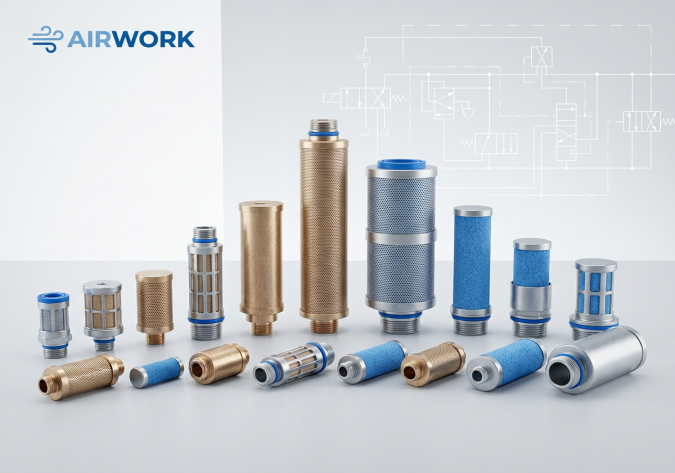
Introduction: The Hidden Threat of Pneumatic Exhaust Noise
In modern, high-speed automated factories, pneumatic systems are the workhorses of production, driving millions of high-cycle packaging, stamping, and sorting operations. However, a major byproduct of compressed air systems is extreme noise. When a directional control valve shifts, it vents compressed air directly to the atmosphere. This air, often exiting at supersonic speeds, creates a loud, high-frequency popping or rushing noise.
Exposure to prolonged industrial noise not only violates health and safety regulations (such as OSHA's 85-decibel occupational limit), but it also causes operator fatigue, reduces worker productivity, and can lead to permanent hearing damage. Because of this, silencers (or mufflers) are standard requirements on all industrial pneumatic exhaust ports. However, choosing the wrong silencer can introduce a secondary, costly engineering problem: pneumatic back-pressure.
The Mechanics of Pneumatic Back-Pressure
To understand why back-pressure is detrimental to high-cycle machines, it is helpful to look at the pressure dynamics inside a double-acting cylinder. For a cylinder to extend rapidly, compressed air must enter the cap-end chamber while the air in the rod-end chamber is exhausted as fast as possible. The exhaust path travels through the pneumatic tubing, into the directional control valve, and out through the exhaust port.
If the silencer installed on the valve exhaust port is restrictive or clogged, it acts as a physical bottleneck. Air cannot escape fast enough, causing pressure to build up inside the exhausting chamber. This is known as back-pressure. Back-pressure acts as a braking force against the cylinder's piston. It has several negative consequences:
- Slower Actuator Speeds: The pressure differential across the piston is reduced, which decreases the cylinder's acceleration and terminal velocity.
- Sluggish Valve Response: High back-pressure can interfere with the internal piloting channels of some directional control valves, causing spools to shift slowly or get stuck mid-stroke.
- Increased Heat and Wear: The physical friction of seals increases as they are subjected to prolonged, high-pressure scraping against the cylinder wall, shortening the service life of the actuator.
- Erratic Machine Sequencing: In high-cycle machines, a delay of just 50 milliseconds in cylinder retraction can throw off the entire machine timing, leading to product jams and scrap generation.
Analyzing Silencer Technologies: Materials and Designs
B2B buyers and systems integrators can select from three primary silencer technologies, each with unique performance characteristics under high-cycle conditions:
- Sintered Bronze Silencers: These are the most common and inexpensive silencers on the market. They are made by fusing tiny copper-tin alloy spheres together to create a rigid, porous metal element. While very durable and highly resistant to physical impact, their micro-pore structure acts like a mechanical filter. Any lubricating oil, moisture, or solid particulate in the compressed air line will quickly clog these pores. In high-cycle systems, sintered bronze silencers can double their back-pressure rating in just a few months of continuous use.
- Porous Polyethylene (Plastic) Silencers: These silencers utilize a lightweight, high-density polyethylene body. The plastic material has larger, more uniform pores than sintered bronze. This design provides excellent sound absorption (often reducing noise by up to 35 dB) while offering superior resistance to oil and moisture clogging. If oil mist enters the silencer, it can easily blow through the larger plastic pores rather than getting trapped, making porous plastic the preferred standard for high-cycle packaging and assembly machinery.
- High-Flow Multi-Chamber / Expansion Silencers: For heavy-duty systems with massive air volumes, expansion silencers are the gold standard. These large-body silencers contain internal baffles and expansion chambers. As the high-speed air enters, it expands into the first chamber, slowing down. It then passes through secondary baffles where its velocity is reduced further before exiting. This gradual speed reduction reduces noise dramatically with virtually zero back-pressure, making it ideal for large-bore, long-stroke cylinder exhausts.
How to Properly Size a Silencer: The Sizing Rule of Thumb
To prevent back-pressure, machine designers must never size a silencer based solely on the thread size of the valve port. Many cheap valves have large ports but very small flow passages, or vice versa. The only reliable sizing method is to match the flow capacity (Cv or Kv factor) of the silencer to the flow capacity of the valve's exhaust pathway.
- Check the Valve's Technical Sheet: Locate the Cv rating of the exhaust path (typically ports 3 and 5 on a 5/2-way valve).
- Select a Silencer with a Higher Cv: Ensure the selected silencer has a rated Cv flow capacity that is at least 10 to 15 percent higher than the valve's exhaust Cv.
- Account for Duty Cycles: For high-cycle machines (operating at over 60 cycles per minute), increase the silencer sizing margin to 25 percent to allow for the rapid, continuous volume of air without any temperature-induced restriction.
Troubleshooting and Maintenance of Exhaust Systems
When troubleshooting a machine that has slowly lost speed over several months, maintenance technicians should check the silencers first:
- Perform the Quick Bypass Test: Temporarily remove the silencer from the valve port and cycle the machine. If the cylinder immediately returns to its original high speed, the silencer is clogged and must be replaced.
- Sintered Bronze Cleaning: If using sintered bronze, the silencer can be removed and soaked in a degreasing solvent, then blown clean with a dry blowgun from the inside out. However, replacing them with porous plastic is usually more cost-effective.
- Implement Dual-Exhaust Separation: On 5-port, 2-position valves, utilize separate silencers for port 3 and port 5. This allows you to tune the speed and noise of the extension and retraction strokes independently.
Sourcing AIRWORK High-Flow Silencers
AIRWORK offers a comprehensive portfolio of high-flow porous plastic and sintered bronze silencers specifically engineered for high-cycle automation. Our plastic silencers feature a dual-layer polyethylene body that resists oil degradation and structural blowout under sudden pressure shocks.
By integrating AIRWORK precision silencers into your pneumatic control systems, you can achieve compliance with local environmental noise regulations while ensuring your machinery runs at peak efficiency. To view our full catalog of pneumatic accessories, including high-flow silencers, throttle-valve silencers, and quick-exhaust silencers, visit jzpnu.com today.
Table of Contents
- Question: How do you troubleshoot 'Exhaust Noise' in high-cycle machines while avoiding back-pressure issues?
- Introduction: The Hidden Threat of Pneumatic Exhaust Noise
- The Mechanics of Pneumatic Back-Pressure
- Analyzing Silencer Technologies: Materials and Designs
- How to Properly Size a Silencer: The Sizing Rule of Thumb
- Troubleshooting and Maintenance of Exhaust Systems
- Sourcing AIRWORK High-Flow Silencers