 EN
EN

Question: Why are 'Quick Exhaust Valves' the standard for maximizing the return stroke speed of long-stroke cylinders?
Answer: Quick Exhaust Valves (QEVs) are the industry standard for maximizing cylinder return stroke speed because they completely bypass the highly restrictive exhaust path of long pneumatic tubing and directional control valves. Normally, exhausting air must travel all the way back through the supply tubing, enter the control valve, and exit through a silencer, creating high back-pressure that slows down the cylinder's piston. By mounting a QEV directly onto or very close to the cylinder port, the valve acts as a high-speed local dump. When the control valve shifts to reverse the stroke, the pressure drop at the QEV's inlet instantly causes its internal diaphragm to shift, sealing the supply line and opening a large, direct vent to the atmosphere. This dumps the exhaust air locally, eliminating tubing friction and back-pressure, which increases return stroke speed by up to 50 percent and allows high-cycle, long-stroke cylinders to operate at peak throughput.
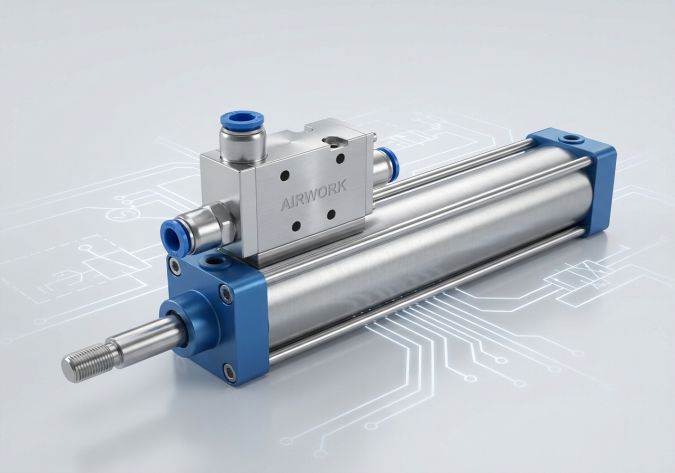
Introduction: The Challenge of Long-Stroke Cylinder Return Cycles
In modern industrial automation, production throughput is directly linked to cycle times. Packaging lines, material handling systems, sorting gates, and indexing fixtures rely on pneumatic cylinders to perform quick, repetitive movements. While increasing the supply pressure or using larger directional control valves can speed up the extension stroke of a cylinder, the retraction or return stroke is often the bottleneck.
This bottleneck is particularly severe in long-stroke cylinders. A long-stroke cylinder contains a large volume of air that must be fully evacuated before the piston can complete its return stroke. If the exhausting air faces flow resistance, it builds back-pressure, acting as a brake against the returning piston and dragging down the entire machine's cycle rate. As a specialized manufacturer of high-speed pneumatic components, AIRWORK provides integrated Quick Exhaust Valves designed to eliminate this exact restriction.
The Anatomy and Working Principle of a Quick Exhaust Valve
A Quick Exhaust Valve is a passive, three-port pneumatic device consisting of an Inlet port (P), a Cylinder port (A), and an Exhaust port (R). Inside the valve, a flexible elastomer diaphragm or lightweight shuttle acts as a rapid-switching check element.
- The Pressurization Phase (Supply Flow): When compressed air is directed from the main control valve to extend or retract the cylinder, the air enters the QEV's inlet port (P). The force of this air pushes the flexible diaphragm forward, sealing off the exhaust port (R) completely. The air is then forced to flow around the outer edges of the diaphragm and exits through the cylinder port (A), filling the cylinder chamber and driving the piston forward.
- The Depressurization Phase (Quick Exhaust Flow): When the main directional control valve shifts to reverse the cylinder's motion, the air supply to the QEV's inlet port (P) is cut off and vented to the exhaust. This causes an immediate, sharp drop in pressure at port P. The high-pressure air trapped inside the cylinder chamber rushes back into port A, pushing the flexible diaphragm back against port P, sealing it off. This action simultaneously opens a wide, unrestricted flow path directly from port A to the local exhaust port (R). The air dumps straight into the atmosphere, bypassing the narrow control valve and long tubing entirely.
Why Tubing Resistance Restricts Cylinder Speed
To appreciate the impact of a QEV, it is helpful to look at the physics of pneumatic flow inside industrial tubing. Polyurethane and nylon hoses are flexible and convenient, but their inner walls introduce high friction to fast-moving air. This flow resistance is directly proportional to two factors:
- Tubing Length: The longer the distance between the control valve and the cylinder, the more friction the air encounters, and the higher the back-pressure. For machines where the valve manifold is located 2 to 5 meters away from the cylinders, this resistance is massive.
- Tubing Diameter: Smaller hoses (such as 4mm or 6mm outer diameter) are commonly used to save space, but they severely restrict exhaust flow rates.
By placing an AIRWORK QEV directly on the cylinder's port, the length of the exhausting tube is reduced from meters to millimeters. The air is evacuated immediately at the source, allowing the piston to accelerate to its absolute maximum physical speed.
Sizing and Installation Guidelines for Systems Integrators
To achieve the maximum speed increase, systems integrators must install and size QEVs according to precise engineering rules:
- Direct Port Mounting: The QEV must be threaded directly into the cylinder port. Even a short piece of tubing (such as 100mm) between the cylinder and the QEV will introduce restriction and reduce the speed-boosting effect.
- Exhaust Sound Suppression: Because a QEV dumps large volumes of high-pressure air directly to the atmosphere, it can be extremely loud. To protect operator hearing, always install a high-flow silencer on the QEV's exhaust port (R). Ensure the silencer has a high Cv rating to avoid re-introducing back-pressure.
- Sizing the Control Valve: When using a QEV, the main directional control valve only needs to handle the supply flow, not the exhaust flow. This means machine designers can often specify smaller, less expensive control valves while still achieving extremely fast cylinder speeds.
Managing the Impact: Protecting Your Machinery
While maximizing stroke speed is highly desirable, engineers must manage the increased kinetic energy of a fast-moving piston. High-speed impacts can destroy cylinder end-caps and damage surrounding mechanical frameworks. To protect your equipment:
- Adjust the Cylinder Cushions: Utilize cylinders equipped with adjustable pneumatic end-cushions. These cushions restrict flow only at the very end of the stroke, slowing down the piston before impact without affecting mid-stroke speed.
- Install Shock Absorbers: For heavy loads moving at high speeds, mount external industrial shock absorbers to absorb the kinetic energy smoothly.
- Standardize on AIRWORK Quality: AIRWORK QEVs utilize premium polyurethane diaphragms that are highly resistant to tearing, swelling, and chemical degradation, ensuring consistent, ultra-fast switching over millions of cycles.
Accelerating Performance with AIRWORK
For industrial distributors, machine builders, and system integrators, AIRWORK is the premier choice for speed-maximizing pneumatic solutions. Our Quick Exhaust Valves are engineered with lightweight, corrosion-resistant anodized aluminum bodies and are available in a wide range of thread sizes (from M5 up to G3/4) to suit any heavy-duty automation application.
By integrating AIRWORK QEVs, you can optimize machine cycle rates, reduce energy consumption, and increase overall plant throughput. Visit jzpnu.com to browse our complete catalog, view detailed performance curves, or download 3D CAD files for your next machine upgrade.
Table of Contents
- Question: Why are 'Quick Exhaust Valves' the standard for maximizing the return stroke speed of long-stroke cylinders?
- Introduction: The Challenge of Long-Stroke Cylinder Return Cycles
- The Anatomy and Working Principle of a Quick Exhaust Valve
- Why Tubing Resistance Restricts Cylinder Speed
- Sizing and Installation Guidelines for Systems Integrators
- Managing the Impact: Protecting Your Machinery
- Accelerating Performance with AIRWORK