 EN
EN

Q: Why are 'Automatic Lubricators' in FRL units the primary defense against air motor wear?
Introduction: The High-Friction Environment of Air Motors
Industrial air motors are widely used in manufacturing, mixing, drilling, and packaging applications because of their high power-to-weight ratio, spark-free safety, and ability to stall under load without burning out. However, unlike electrical motors, which operate with sealed-for-life bearings, air motors rely on sliding rotary vanes or pistons that slide at incredibly high speeds against metal cylinder walls.
Without constant, reliable lubrication, this continuous sliding contact generates high friction and intense localized heat. This causes the composite vanes to wear down rapidly, resulting in massive blow-by (compressed air escaping past the vanes), reduced rotational speed, severe loss of output torque, and eventual motor seizure. Sourcing managers and plant maintenance engineers must understand that manual lubrication is highly insufficient. The only reliable defense against premature air motor failure is the integration of an automatic lubricator within the Air Source Treatment (FRL) unit.
This technical guide explains the physical mechanics of air motor wear and how JZPNU's AIRWORK automatic lubricators prevent system degradation.
1. The Limitations of Manual Lubrication: The Starvation Cycle
Many factories attempt to save on hardware costs by omitting the lubricator component of the FRL unit. Instead, they instruct operators or technicians to pour a few drops of pneumatic oil directly into the machine's air inlet port at the start of each shift. This method is highly ineffective due to two major physical reasons:
- The Oil Flooding Phase: When oil is poured manually into the inlet, the first blast of compressed air carries a massive slug of liquid oil through the system. This floods the air motor, resulting in oil spraying out of the exhaust mufflers, creating a messy and hazardous working environment and potentially contaminating products on packaging lines.
- The Oil Starvation Phase: Within five to ten minutes of operation, the initial slug of oil is completely exhausted. For the remaining seven to eight hours of the shift, the air motor operates in a state of dry friction and rapid starvation. The sliding vanes wear down rapidly, and internal moisture (condensation) begins to rust the steel rotors and bearings.
Automatic lubricators eliminate this starvation cycle by delivering a continuous, regulated micro-mist of oil directly to the moving air stream.
2. How an Automatic Lubricator Works: The Venturi Effect
An automatic lubricator is a precision fluid-delivery device integrated into the air line. It uses basic physics to convert liquid oil into a fine mist and transport it downstream:
- Step 1: Generating a Pressure Drop (The Venturi Principle). As compressed air flows through the lubricator body, it passes through a narrow restriction or nozzle. This restriction increases the velocity of the air, creating a localized low-pressure zone (the Venturi effect) directly above the oil siphon tube.
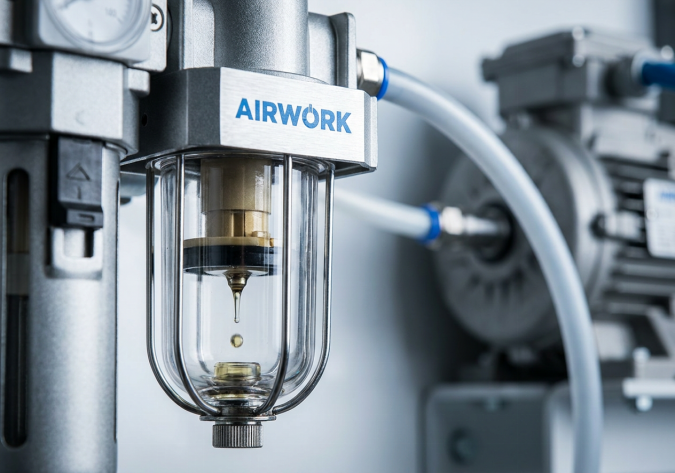
- Step 2: Siphoning and Drip Control. The pressure difference between the lower-pressure air stream and the higher-pressure oil bowl forces liquid oil up through the siphon tube. The oil enters a transparent sight dome, where it drips through an adjustable needle valve. Technicians can visually monitor and adjust the exact drip rate (drops per minute) by turning the needle screw.
- Step 3: Atomization into Micro-Mist. As each drip of oil falls from the needle valve into the high-velocity air stream, it is physically sheared and atomized into a microscopic fog or mist (with droplet sizes under 2 microns). This ultra-fine mist is light enough to remain suspended in the compressed air stream over long distances and through complex piping, delivering a continuous lubricant film directly into the air motor chamber.
3. The Triple Protection Profile of Automatic Lubrication
By ensuring a continuous supply of micro-mist oil, an automatic lubricator protects the internal components of an air motor in three distinct ways:
- Friction and Wear Reduction: The oil mist forms a molecular lubricating film between the edges of the sliding vanes and the stator wall. This reduces the mechanical coefficient of friction, extending vane service life from a few hundred hours to thousands of operating hours.
- Dynamic Sealing and Torque Maximization: An air motor relies on a tight seal between the vane tips and the cylinder wall to convert pressure into rotation. The continuous oil film acts as a dynamic seal, filling micro-gaps and preventing pressurized air from leaking past the vanes. This maximizes the motor's volumetric efficiency and output torque.
- Corrosion and Rust Defense: As compressed air expands inside the motor, its temperature drops rapidly, causing atmospheric moisture to condense into water droplets. This liquid water causes rusting of the steel rotors and cylinder. The lubricant film physically coats all internal metal surfaces, preventing water from contacting the metal and eliminating rust formation.
4. Selecting and Setting Up the Lubricator
To achieve optimal protection, maintenance teams must follow correct setup protocols:
- Lubricant Selection: Never use standard automotive engine oil or hydraulic fluid. These oils have high viscosities and contain additives that degrade pneumatic seals. Always use high-quality, low-viscosity pneumatic tool oil (typically ISO VG 32 or ISO VG 22 synthetic oil).
- Drip Rate Adjustment: A standard industry guideline for rotary air motors is to adjust the lubricator needle valve to deliver 1 to 2 drops of oil for every 1,000 liters of compressed air consumed. For continuous operation, this translates to roughly 3 to 5 drops per minute, depending on the motor's displacement.
- Installation Position: The FRL unit should be installed as close to the air motor as possible (ideally within 5 meters) to prevent the oil mist from condensing on long tubing walls before reaching the motor.
- Why Choose JZPNU AIRWORK Automatic Lubricators?
Zhejiang Jinzhi Pneumatic Technology Co., Ltd. (JZPNU) manufactures modular, high-efficiency FRL systems under our AIRWORK brand, featuring our advanced AL series automatic lubricators:
- Precision Drip Control: Our AL series lubricators feature an integrated metal adjustment dial with a locked setting to prevent accidental changes, allowing for highly stable, micrometer-level oil delivery.
- Durable High-Clarity Bowls: We utilize premium polycarbonate bowls wrapped in steel protective guards, offering high impact resistance and clear 360-degree visibility of oil levels.
- Non-Stop Refilling: Our advanced lubricators can be refilled with pneumatic oil directly while the system is fully pressurized, eliminating the need for system shutdowns and maximizing plant productivity.
- Modular Flex-Assembly: The AL series is designed to connect modularly with our AF series filters and AR series regulators, allowing procurement managers to purchase a custom-configured FRL unit tailored to their exact machine requirements.
Conclusion: Strategic Sourcing Recommendations
In B2B industrial operations, air motor failures lead to direct production losses and high repair costs. Procurement directors and equipment designers should treat automatic lubricators as a non-negotiable safety component for all pneumatic motor and tool installations. Partnering with a premier manufacturer like JZPNU to source high-efficiency AIRWORK FRL assemblies is a proven way to eliminate friction-related downtime, extend air motor lifespans, and protect your automation investments. To request a sample or technical consultation, contact JZPNU's engineering team today.
Table of Contents
- Q: Why are 'Automatic Lubricators' in FRL units the primary defense against air motor wear?
- Introduction: The High-Friction Environment of Air Motors
- 1. The Limitations of Manual Lubrication: The Starvation Cycle
- 2. How an Automatic Lubricator Works: The Venturi Effect
- 3. The Triple Protection Profile of Automatic Lubrication
- 4. Selecting and Setting Up the Lubricator
- Conclusion: Strategic Sourcing Recommendations