 EN
EN

Q: How do you successfully manage prototyping, tolerances, and lead times when sourcing custom OEM pneumatic cylinders?
Introduction: The Sourcing Challenge of Custom Actuators
While standard pneumatic cylinders manufactured to ISO 15552 or ISO 6432 meet the requirements of most general automation projects, high-volume Original Equipment Manufacturers (OEMs) and special-purpose machine builders often require custom solutions. A machine might have strict space limitations requiring an ultra-compact body, require a non-standard piston rod thread to match a specialized tool, or operate in high-temperature steel mill zones requiring custom heat-resistant seals.
Sourcing custom OEM pneumatic cylinders from China offers enormous cost and technical advantages, but it introduces operational risks. If not managed properly, B2B buyers can face prolonged prototyping cycles, parts delivered out of tolerance, and extended lead times that delay product launches.
This guide provides procurement directors and engineering leads with a structured methodology to manage prototyping, tolerances, and production schedules when sourcing custom pneumatic cylinders.
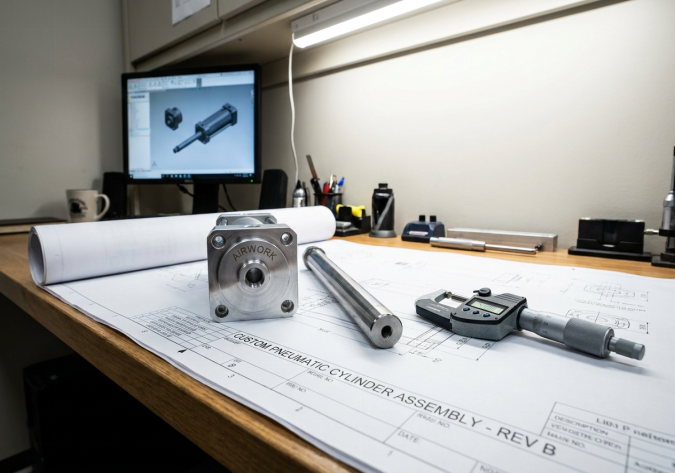
1. Managing the Prototyping Phase: Transitioning from Design to Metal
The prototyping phase is the foundation of any custom manufacturing project. To avoid costly misunderstandings and design loops, the communication between the buyer's engineering team and the manufacturer's R&D department must be flawless:
- Technical File Exchange: Never rely solely on text descriptions or hand sketches. Always provide fully defined 2D drawings (DWG/PDF format) showing all linear dimensions, thread pitches, and tolerance callouts, alongside a 3D CAD model (STEP or IGES format) to allow the factory's CNC programmers to program their machining centers accurately.
- Design for Manufacturability (DFM) Review: A high-quality manufacturer will perform a thorough DFM review before cutting metal. This involves checking for potential manufacturing bottlenecks, such as deep-drilled holes that risk tool breakage, or non-standard thread specifications that require custom tapping tools. JZPNU's engineering team routinely provides DFM feedback within 48 hours of file receipt, suggesting minor modifications that can cut manufacturing costs by 15 to 20 percent without affecting performance.
- Initial Low-Volume Testing: Always begin with a small prototype batch of 1 to 3 units. These prototypes should undergo rigorous functional and fitment testing on your actual machinery before approving full-scale production. This protects the buyer against systemic design errors.
2. Managing Mechanical Tolerances: Securing Precision and Alignment
In pneumatic cylinders, precision is directly tied to performance and lifespan. Even a minor deviation in dimensional tolerances will lead to severe internal friction, seal leakage, or binding of the piston rod. Sourcing managers must define and verify key tolerances with the factory:
- Cylinder Bore and Piston Fit (H7/h7 Tolerance): The internal clearance between the aluminum barrel and the piston must be kept within micron-level tolerances. Too tight, and the piston will bind; too loose, and air will bypass the seals, resulting in force loss.
- Piston Rod Concentricity and Thread Tolerances (g6 Tolerance): The piston rod must be perfectly straight and concentric. Rod threads must be machined to precise Class 6g standards to ensure seamless integration with industrial clevises and rod eyes.
- Verification of Machining Equipment: Ensure that your Chinese partner possesses the machinery capable of holding these tight tolerances. Ask if they utilize multi-axis CNC lathes, high-precision cylindrical grinders, and coordinate measuring machines (CMMs) in their quality control laboratory. JZPNU utilizes advanced high-speed CNC machining centers to ensure all custom components are machined with repeatable, tight tolerances.
3. Managing Production Lead Times: Streamlining the Supply Chain
Custom manufacturing naturally takes longer than shipping standard off-the-shelf items. When sourcing custom cylinders from China, the total lead time is split into design, material sourcing, manufacturing, and transport. Sourcing teams can optimize this schedule using several strategies:
- Standardize Internal Sub-Components: While the overall cylinder dimensions may be custom, try to utilize standard internal components, such as standard ISO-sized seals, piston rods, and magnets. This allows the factory to use their existing raw material stock, slashing material sourcing times from weeks to days.
- Establish a Dual-Track Delivery Schedule: For urgent projects, arrange a dual-track logistics plan. Once the prototype is approved, have the manufacturer ship the first 5 to 10 production-line units via expedited air freight to keep your assembly line running, while the bulk shipment is sent via cost-effective ocean freight.
- Sourcing Raw Material Buffers: For recurring custom contracts, negotiate a raw material buffer agreement. At JZPNU, we maintain dedicated stockpiles of custom extruded aluminum profiles and SUS316 tubing for our long-term OEM clients, reducing our custom manufacturing lead time from the standard 30 days down to less than 15 days.
- Why Choose JZPNU AIRWORK for Your Custom OEM Sourcing?
Zhejiang Jinzhi Pneumatic Technology Co., Ltd. (JZPNU) is a premier partner for OEM/ODM pneumatic cylinder manufacturing. Our AIRWORK custom solutions department is designed to support the global B2B procurement market:
- Dedicated R&D and Engineering Team: Our in-house engineering team has over a decade of experience designing custom pneumatic actuators for diverse industries, including packaging, automotive, textiles, and medical devices.
- State-of-the-Art Production Facility: Our workshop is equipped with high-precision CNC machining centers, automated welding robots, and precision grinding machines, allowing us to maintain tight tolerances and repeatable quality.
- Rapid Prototyping Capability: We can produce fully functional metal prototypes of custom cylinders within 5 to 7 business days from CAD approval, complete with comprehensive testing reports.
- Reliable Global Supply Chain: We maintain relationships with premium seal suppliers (NOK, Trelleborg) and have a highly streamlined production management system, ensuring we meet our agreed delivery dates.
Conclusion: Strategic Sourcing Recommendations
Sourcing custom OEM pneumatic cylinders from China is a highly effective way to optimize machinery design and lower overall production costs. However, success requires shifting from a simple transaction model to a collaborative engineering partnership. By providing clear CAD designs, defining tight mechanical tolerances, and choosing a highly capable manufacturer like JZPNU, procurement managers can secure flawless custom components on time, every time. Contact JZPNU's custom OEM department today to begin your technical review and request a prototype quote.
Table of Contents
- Q: How do you successfully manage prototyping, tolerances, and lead times when sourcing custom OEM pneumatic cylinders?
- Introduction: The Sourcing Challenge of Custom Actuators
- 1. Managing the Prototyping Phase: Transitioning from Design to Metal
- 2. Managing Mechanical Tolerances: Securing Precision and Alignment
- 3. Managing Production Lead Times: Streamlining the Supply Chain
- Conclusion: Strategic Sourcing Recommendations