 EN
EN

Q: How should a procurement manager vet Chinese manufacturers for ISO 15552 and ISO 6432 pneumatic cylinders?
Introduction: The Power of Global Interchangeability
For B2B procurement managers sourcing components for global manufacturing machinery, standardizing on international specifications is the ultimate way to reduce inventory complexity and lower maintenance costs. In pneumatics, the two most critical standards are ISO 15552 and ISO 6432. These standards define the precise mounting dimensions, bore sizes, stroke lengths, and thread profiles for pneumatic cylinders.
Sourcing these standard cylinders from Chinese manufacturers offers enormous cost-efficiency and supply chain flexibility. Because of the ISO standard, a cylinder produced in China can directly replace an expensive Western brand on a German-designed packaging line without modifying the machine's mounting brackets. However, quality standards vary widely across the Chinese supply chain. Procurement managers must know how to vet factories to avoid substandard parts that cause rapid seal wear, air leaks, and catastrophic line failures.
This guide provides a professional vetting framework for verifying ISO 15552 and ISO 6432 compliance and quality when sourcing from China.
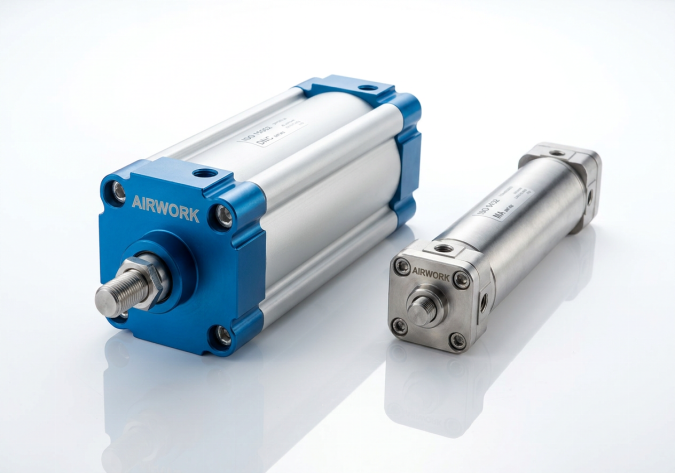
1. Demystifying the Standards: ISO 15552 vs. ISO 6432
Before initiating the supplier vetting process, it is vital to understand what these standards cover and where they are applied:
- ISO 15552 (Replaced the older ISO 6431): This standard applies to larger, profile-type and tie-rod pneumatic cylinders with bore sizes ranging from 32 millimeters to 320 millimeters and operating pressures up to 10 bar. These cylinders are the heavy workhorses of automation, featuring adjustable air cushioning at both ends to handle heavy loads. They are widely used in steel mills, automotive assembly, and heavy packaging lines.
- ISO 6432: This standard applies to compact, round-body mini cylinders (often called pencil cylinders) with bore sizes ranging from 8 millimeters to 25 millimeters. They typically feature stainless steel barrels and are designed for high-speed, light-duty applications. They are commonly used in precision electronics assembly, textile machinery, and medical packaging.
2. The Four Pillars of Quality Vetting
When evaluating a Chinese manufacturer's capability to produce reliable ISO cylinders, procurement managers should focus on four critical engineering areas:
- Pillar 1: Geometric and Dimensional Verification. ISO standards are useful only if the factory's machining tolerances are tight. Request the supplier's technical drawings and check key mating dimensions. For ISO 15552, verify the distance between mounting screw holes on the front and rear end caps, the thread pitch of the piston rod, and the port size (typically G thread). For ISO 6432, check the nose mounting thread and rod thread. Any variation beyond 0.05 millimeters will make installation impossible.
- Pillar 2: Raw Material Integrity. A cylinder is only as strong as its metal. Vetting managers should verify the specific alloys used by the manufacturer. The cylinder barrel of an ISO 15552 cylinder should be made of hard-anodized extruded aluminum with an anodization layer of at least 15 to 20 microns to ensure low friction and scratch resistance. The barrel of an ISO 6432 cylinder must be made of high-grade SUS304 stainless steel. The piston rod for both must be made of hard-chrome plated carbon steel (or stainless steel for corrosive environments) with a chrome plating thickness of at least 20 microns to prevent corrosion and seal abrasion.
- Pillar 3: Sourcing of Seals and Lubricants. The lifespan of a pneumatic cylinder is determined by its seals. Low-cost manufacturers use cheap, locally sourced rubber seals that crack under continuous friction. Ask potential suppliers about their seal supply chain. High-quality manufacturers like JZPNU equip their AIRWORK cylinders with premium seals from global leaders such as NOK (Japan) or Trelleborg, paired with high-performance synthetic grease from Kluber (Germany) to ensure low breakaway pressure and a lifecycle exceeding 5,000 kilometers of travel.
- Pillar 4: In-Factory Testing and Quality Control. A reputable manufacturer must perform 100 percent functional testing on every cylinder before packaging. This includes low-pressure starting tests (checking if the cylinder moves smoothly at less than 0.5 bar), high-pressure leakage tests (verifying zero bubble leakage under 10 bar pressure), and stroke length verification. Ask suppliers to provide video evidence of their testing lines and standard quality inspection sheets.
3. Red Flags in Chinese Pneumatic Sourcing
During your factory audits or supplier discussions, watch out for these common warning signs of subpar manufacturing:
- Unusually Low Weight: If a supplier's ISO 15552 cylinder feels significantly lighter than a premium cylinder, the factory is likely using thin-walled aluminum or casting alloys containing zinc impurities, which are prone to cracking under mechanical stress.
- Standard Nitrile Seals Sold for High-Heat Applications: Standard Nitrile (NBR) seals fail at temperatures above 80 degrees Celsius. If your machinery operates in hot zones and the supplier cannot provide certified Viton (FKM) seals, seek another manufacturer.
- Lack of ISO 9001:2015 Certification: A factory that does not maintain ISO 9001 certification for its production processes cannot guarantee batch-to-batch consistency.
4. Why JZPNU AIRWORK is Your Strategic Sourcing Partner
Zhejiang Jinzhi Pneumatic Technology Co., Ltd. (JZPNU) is a premier manufacturer of pneumatic components, specializing in high-performance standard cylinders under our AIRWORK brand. We offer a world-class platform for global B2B procurement:
- Flawless ISO Adherence: Our DNC and SI series cylinders are designed and manufactured in strict compliance with ISO 15552, while our MA series round-body cylinders fully meet ISO 6432 standards, ensuring 100 percent global interchangeability.
- Precision Machining: We utilize advanced CNC machining centers to process our cylinder end caps and piston rods, maintaining micron-level dimensional accuracy.
- Material Traceability: We maintain full material traceability for our extruded aluminum profiles, stainless steel tubing, and high-grade piston rods, providing official material test reports to our B2B clients.
- Rapid OEM/ODM Customization: While we offer standard catalog dimensions, we can quickly customize cylinder strokes, specialized seal packages, and mounting accessories to meet your exact engineering specifications.
Conclusion: Strategic Sourcing Recommendations
Sourcing ISO 15552 and ISO 6432 pneumatic cylinders from China is a highly effective strategy to optimize capital efficiency and supply chain flexibility. However, success depends on a rigorous vetting process that looks beyond initial quotes. By verifying dimensions, checking raw material grades, demanding premium seals, and partnering with a dedicated manufacturer like JZPNU, procurement leads can guarantee that every component integrated into their automated lines matches the performance and reliability of global leading brands. For detailed technical specifications or to request samples, contact JZPNU's international sales division today.
Table of Contents
- Q: How should a procurement manager vet Chinese manufacturers for ISO 15552 and ISO 6432 pneumatic cylinders?
- Introduction: The Power of Global Interchangeability
- 1. Demystifying the Standards: ISO 15552 vs. ISO 6432
- 2. The Four Pillars of Quality Vetting
- 3. Red Flags in Chinese Pneumatic Sourcing
- 4. Why JZPNU AIRWORK is Your Strategic Sourcing Partner
- Conclusion: Strategic Sourcing Recommendations