 EN
EN

Q: What makes marine and offshore environments uniquely corrosive to standard industrial pneumatic systems?
Marine and offshore environments are among the most hostile settings on earth for mechanical and electrical systems. For pneumatic components located on ship decks, offshore oil rigs, wind turbines, and coastal port facilities, exposure to the elements is continuous and punishing. Standard industrial-grade pneumatic components made from aluminum, brass, or standard carbon steel will degrade rapidly, often failing within weeks of installation.
The primary culprit is salt spray, which is rich in sodium chloride (NaCl) and other dissolved minerals. This saltwater mist acts as an extremely efficient electrolyte, accelerating electrochemical and galvanic corrosion. When moisture and salt settle on metal surfaces, they create micro-galvanic cells that break down the protective oxide layers of standard metals.
Several environmental factors intensify this corrosive process in marine applications:
- High Humidity and Moisture: Coastal and oceanic air is constantly saturated with moisture, meaning metal parts are rarely dry. This continuous presence of water is necessary for rust and oxide formation.
- Temperature Fluctuations: Marine equipment is subjected to direct solar heating during the day and rapid cooling at night, as well as seasonal extremes. This expansion and contraction can cause microscopic cracks in painted or plated protective coatings, allowing salt-laden moisture to penetrate to the underlying metal.
- Chemical and Mechanical Abrasion: Offshore rigs and cargo vessels are exposed to industrial chemicals, drilling muds, and abrasive sand or salt crystals blown by high winds. This mechanical abrasion physically strips away standard coatings, leaving raw metals exposed to chemical attacks.
Under these conditions, standard zinc-plated steels and anodized aluminum alloys suffer from severe pitting, crevice corrosion, and exfoliating rust. This degradation leads to air leaks, stuck cylinder rods, seized valve spools, and structural failures that can compromise maritime safety and halt operations.
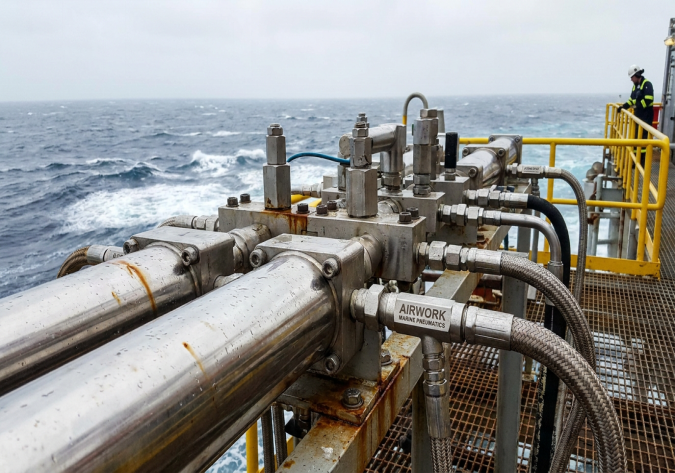
Q: Why is SUS316 stainless steel considered the industry standard and mandatory material for marine pneumatic components?
To withstand the extreme conditions of maritime applications, R&D engineers and B2B procurement directors specify SUS316 (also known as AISI 316) stainless steel. While many steel alloys offer basic corrosion resistance, SUS316 has a specific chemical formulation that makes it uniquely suited for chloride-rich marine environments.
The critical difference lies in the alloying elements. SUS316 is an austenitic stainless steel that contains high percentages of chromium, nickel, and molybdenum:
- Chromium (16-18%): Chromium reacts with oxygen in the atmosphere to form a microscopic, self-healing passive chromium oxide film on the metal's surface. This film prevents oxygen and moisture from reaching the underlying steel.
- Nickel (10-14%): Nickel stabilizes the austenitic crystal structure of the steel, improving its mechanical strength, ductility, and resistance to acid corrosion.
- Molybdenum (2-3%): This is the key element that distinguishes SUS316 from SUS304. Molybdenum drastically increases the alloy's resistance to localized pitting corrosion and crevice corrosion in chloride-containing environments.
When standard SUS304 or carbon steel is exposed to saltwater, chloride ions can attack weak spots in the passive oxide layer, creating deep microscopic pits that weaken the metal structurally. The addition of molybdenum in SUS316 neutralizes these chloride ions, allowing the passive oxide layer to remain intact and self-repair even under continuous salt spray.
Additionally, SUS316 offers excellent mechanical properties, retaining its strength at high temperatures and resisting stress corrosion cracking under heavy physical loads. For maritime safety, where equipment failure could mean losing control of cargo hatches, steering gear, or subsea valves, the extra security of SUS316 is a non-negotiable requirement.
Q: Which specific pneumatic components must be upgraded to SUS316, and what solutions does AIRWORK offer?
In a marine pneumatic circuit, every single component exposed to the atmosphere represents a potential point of failure. It is not enough to have a stainless steel cylinder if the fittings or the mounting bracket rust away. Sourcing a complete, integrated system is critical. AIRWORK has developed a comprehensive line of certified marine-grade pneumatic solutions constructed entirely from high-grade SUS316:
- SUS316 Marine Cylinders: AIRWORK manufactures ISO 15552 and ISO 6432 standard cylinders with bodies, rods, end caps, and mounting hardware made entirely from SUS316. Our rods are precision-ground and polished to a mirror finish to minimize seal wear, and we incorporate specialized scraping seals that prevent ice, salt crusts, and marine grime from entering the cylinder interior.
- SUS316 Pneumatic Valves: Our control valves and solenoid manifolds feature SUS316 bodies and internal spools. For electronic control, we offer explosion-proof, epoxy-encapsulated coils that are sealed against moisture and salt intrusion (IP67 or IP68 ratings).
- SUS316 Push-In Fittings and Accessories: To prevent leaks in the air distribution network, AIRWORK offers a wide range of SUS316 fittings, speed controllers, and silencers. These fittings utilize high-durability fluororubber (FKM) O-rings to maintain a reliable seal across a wide temperature range.
- SUS316 Air Preparation (FRL) Units: Clean, dry air is essential for system longevity. AIRWORK's SUS316 filters, regulators, and lubricators ensure that the compressed air supply is cleaned of moisture and contaminants, even when exposed to harsh outdoor maritime conditions.
Q: What are the economic and operational benefits of investing in SUS316 marine pneumatics from AIRWORK?
For B2B procurement directors, the initial purchase price of SUS316 pneumatic components is higher than that of standard aluminum or brass. However, a Total Cost of Ownership (TCO) analysis reveals that investing in high-quality marine-grade equipment from AIRWORK yields a far higher Return on Investment (ROI):
- Drastic Reduction in Downtime: On an offshore platform or cargo ship, unscheduled maintenance can cost tens of thousands of dollars per hour. AIRWORK's SUS316 components drastically reduce unexpected breakdowns, keeping critical systems operational.
- Extended Equipment Lifespan: While standard components may need replacement every few months in saltwater environments, AIRWORK's SUS316 systems are designed to last for years, reducing the frequency and cost of replacement parts.
- Reduced Maintenance Costs: Offshore and marine labor is highly specialized and expensive. By utilizing maintenance-free, self-healing SUS316 pneumatic systems, shipowners can reduce the burden on onboard engineering crews.
- Safety Compliance: Maritime operations are subject to strict international safety regulations (such as DNV, ABS, or Lloyd's Register). Using certified, high-grade SUS316 components from AIRWORK simplifies compliance audits and ensures that fail-safe logic systems perform exactly when needed.
By partnering with AIRWORK, maritime and offshore procurement managers gain access to a trusted, engineering-driven manufacturer capable of delivering full-system SUS316 solutions. This ensures compatibility, simplifies compliance, and guarantees long-term durability in the world's most challenging environments.
Table of Contents
- Q: What makes marine and offshore environments uniquely corrosive to standard industrial pneumatic systems?
- Q: Why is SUS316 stainless steel considered the industry standard and mandatory material for marine pneumatic components?
- Q: Which specific pneumatic components must be upgraded to SUS316, and what solutions does AIRWORK offer?
- Q: What are the economic and operational benefits of investing in SUS316 marine pneumatics from AIRWORK?