 EN
EN

Q: Troubleshooting 'Slow Response Time' in pneumatic valves: The impact of air quality and FRL.
In high-speed B2B production environments, pneumatic systems must execute movements with millisecond precision. A robotic sorter, a packaging machine, or a bottle-capping line relies on the instantaneous shifting of directional control valves to maintain cycle speeds. However, over time, operators often notice a gradual degradation in system speed, commonly diagnosed as slow response time or valve sluggishness.
When a cylinder takes slightly longer to extend, or when there is a noticeable delay between sending an electrical signal to the solenoid and the actual movement of the actuator, productivity drops and product defects increase. While it is tempting to blame the solenoid valve itself, the root cause is almost always related to the quality of the compressed air feeding the system. Below, the AIRWORK engineering team explores the critical relationship between air quality, the Filter-Regulator-Lubricator (FRL) unit, and valve response times, providing a comprehensive troubleshooting framework for maintenance engineers.
1. What Defines 'Slow Response Time' in Pneumatic Valves?
From a technical perspective, the response time of a pneumatic solenoid valve is divided into two distinct components:
- Electrical Response: The time required for the solenoid coil to generate a magnetic field and pull the internal plunger (typically 5 to 15 milliseconds).
- Pneumatic/Mechanical Response: The time required for the pilot air pressure to build up, shift the main spool inside the valve body, and fill the cylinder chamber to the working pressure (typically 10 to 40 milliseconds depending on valve size).
When troubleshooting slow response times, we are almost always dealing with a delay in the second phase: the mechanical shifting of the valve spool or the rate of air volume transfer.
2. The Impact of Compressed Air Impurities on Valve Speed
Compressed air is not naturally clean. As ambient air is drawn in and compressed, moisture, oil, and atmospheric dust are concentrated. If these contaminants are not properly filtered out, they cause severe mechanical friction and pneumatic blockages:
Water and Moisture Condensation
When compressed air cools down in the piping, water vapor condenses into liquid droplets. This liquid water is highly destructive. It washes away the factory-applied lubricant on the valve's spool and seals. Without this lubrication, the rubber seals rub directly against the aluminum valve body, causing high dry friction. The valve requires significantly higher pressure to shift, leading to a delayed reaction. Furthermore, water causes rust on iron components inside the pilot system, such as plungers and springs, causing them to stick.
Oil Degradation and Varnish
Some air systems use lubricated compressors. If compressor oil carries over into the air lines, it can mix with particulate matter to form a thick, sticky paste or varnish. This varnish coats the spool seals and fills the micro-tolerances of the valve body, acting like glue. The spool must drag through this sticky substance, dramatically slowing down its shifting time.
Solid Particulates and Rust Scales
Tiny particles of dust, metal, or rust from older piping can bypass poor filters. These abrasives act like sandpaper, scoring the fine edges of the rubber seals and aluminum spool. This not only causes internal air leaks (which drop pilot pressure) but can also physically jam or slow down the spool's physical movement.
3. The Critical Role of the FRL Unit in Restoring Speed
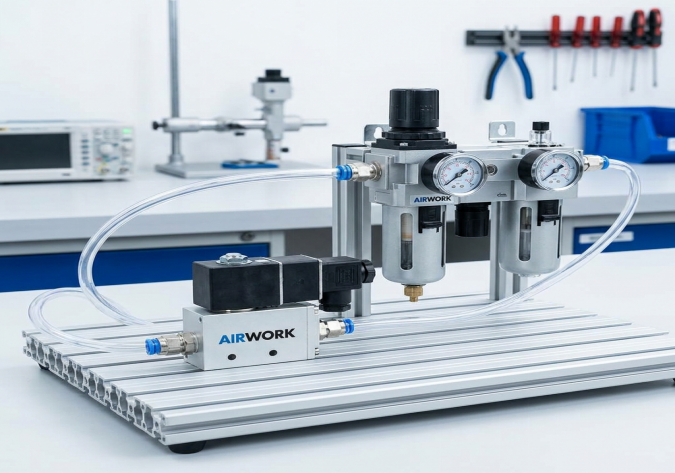
To prevent contamination and guarantee optimal valve response times, a high-quality Filter-Regulator-Lubricator (FRL) assembly must be installed at the entry point of every pneumatic machine. Each component of the FRL plays an active role in maintaining system speed:
- The Filter: A standard 40-micron filter is sufficient for raw machinery, but high-speed directional control valves require 5-micron filtration to capture microscopic dust and oil aerosols. Advanced filters also feature water separators with automatic drains to purge liquid water from the air stream before it washes away valve lubricants.
- The Regulator: Solenoid valves require stable inlet pressure to shift reliably. If the system pressure drops below the minimum pilot pressure (typically 0.15 to 0.2 MPa), the valve will shift sluggishly or fail to shift completely. A high-flow regulator maintains a stable pressure profile, even during high-frequency cycling when air demand peaks.
- The Lubricator: For traditional spool valves, a lubricator injects a fine mist of pneumatic oil into the air stream. This oil coats the moving spool seals, minimizing friction and ensuring rapid, repeatable shifting. Modern oil-free valves can operate without lubrication, but once a system has been lubricated, it must remain lubricated, as the dry air will rapidly wear out the seals.
4. Troubleshooting Steps for Sluggish Valves
If your pneumatic valves are experiencing slow response times, follow this systematic diagnostic checklist:
- Step 1: Inspect Upstream and Downstream Pressure. Use pressure gauges before and after the valve manifold. If a large pressure drop is observed when the valve shifts, the supply line or the regulator is undersized, starving the valve of the volume needed for fast action.
- Step 2: Check the Filter Bowl. Is the filter element clogged? A dirty element restricts air flow, causing a high pressure drop and slowing down cylinder filling. Also, ensure the water separator drain is working; a flooded bowl will bypass water directly into the valves.
- Step 3: Check Exhaust Silencers. This is a common and easily fixed issue. Pneumatic silencers (mufflers) screw into the exhaust ports of the valves. Over time, they accumulate oil mist and dust, becoming clogged. This restricts the exhaust air from escaping, building up high backpressure on the opposite side of the cylinder piston, making the system incredibly sluggish. Remove the silencer and cycle the valve. If speed returns, replace the silencer.
- Step 4: Examine the Lubricator. Ensure the lubricator has oil and is adjusted to drip at the correct rate (typically 1 to 3 drops per 1000 liters of air). If the oil is discolored or yellow, flush the system and refill with fresh pneumatic lubricant.
The AIRWORK (JZPNU) Solution
At Zhejiang Jinzhi Pneumatic Technology Co., Ltd. (JZPNU), we offer advanced FRL air source treatment units, including our popular OU, AC, and BC series. Manufactured with high-efficiency copper filter elements and precision adjustment dials, our FRL units provide clean, dry, and stable air to your pneumatic machinery, protecting sensitive solenoid spools. When paired with our high-precision AIRWORK control valves, which are manufactured with strict tolerance control to ensure minimal friction, you can guarantee fast, reliable response times and prolong the operating life of your entire automated line.
Table of Contents
- Q: Troubleshooting 'Slow Response Time' in pneumatic valves: The impact of air quality and FRL.
- 1. What Defines 'Slow Response Time' in Pneumatic Valves?
- 2. The Impact of Compressed Air Impurities on Valve Speed
- Water and Moisture Condensation
- Oil Degradation and Varnish
- Solid Particulates and Rust Scales
- 3. The Critical Role of the FRL Unit in Restoring Speed
- 4. Troubleshooting Steps for Sluggish Valves
- The AIRWORK (JZPNU) Solution