 EN
EN

Q: Selecting between 3-Way and 5-Way Solenoid Valves: A technical guide for complex pneumatic logic.
In pneumatic system design, directional control valves serve as the brains, routing compressed air to various actuators to execute precise movements. When selecting a solenoid valve, one of the most fundamental engineering decisions is choosing between a 3-way (3/2-way) and a 5-way (5/2 or 5/3-way) configuration. Making the wrong choice not only impacts the functionality of the system but can also lead to pneumatic inefficiency, increased energy consumption, and safety hazards.
To help B2B procurement managers and system integrators make informed decisions, this technical guide dives deep into the differences in ports, flow paths, actuator compatibility, and the complex pneumatic logic that determines which valve is suited for your specific application.
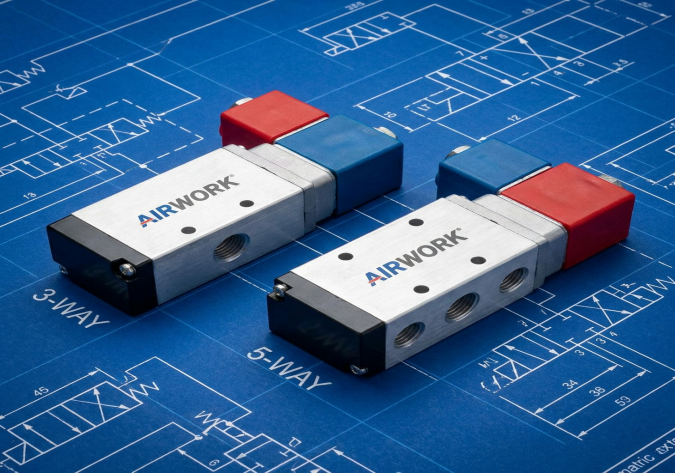
1. Deconstructing the Terminology: What Do the Numbers Mean?
Before comparing applications, we must clarify the standardized pneumatic terminology, typically represented as a fraction (e.g., 3/2 or 5/2):
- The first number indicates the number of ports (connections) on the valve body.
- The second number indicates the number of switching positions the valve spool can assume.
Therefore, a 3/2-way valve has 3 ports and 2 positions, while a 5/2-way valve has 5 ports and 2 positions. A 5/3-way valve has 5 ports and 3 distinct positions, with the third position typically being a neutral or center state.
2. Technical Profile of 3-Way Solenoid Valves
A typical 3-way valve (3/2) contains three distinct ports:
- Port 1: Air Inlet (P) from the compressor or FRL unit.
- Port 2: Outlet/Working Port (A) connected to the actuator.
- Port 3: Exhaust Port (R) to vent air to the atmosphere.
How It Works
In the de-energized state, Port 1 is closed, and Port 2 is connected to Port 3, allowing air to escape from the actuator. When energized, the internal spool shifts, blocking Port 3, while opening a path from Port 1 to Port 2, pressurizing the actuator.
Primary Applications
3-way valves are primarily used to control single-acting actuators. These are pneumatic devices that require compressed air for motion in only one direction, relying on an internal mechanical spring or an external gravity load to return to their starting position. Examples include:
- Single-acting cylinders (spring-return cylinders).
- Pneumatic clamping devices.
- Air bags or bellows.
- Pilot control circuits for larger process valves (such as heavy-duty angle seat valves).
Using a 3-way valve is highly efficient here because it avoids the need for a second working line, simplifying plumbing and lowering component costs.
3. Technical Profile of 5-Way Solenoid Valves
A 5-way valve is more complex, designed with five separate ports:
- Port 1: Air Inlet (P).
- Port 2: Working Port A (for cylinder extension).
- Port 4: Working Port B (for cylinder retraction).
- Port 3: Exhaust Port R (vents Working Port A).
- Port 5: Exhaust Port S (vents Working Port B).
How It Works
In a standard 5/2-way valve, when de-energized, air flows from inlet Port 1 to Working Port 2, while Working Port 4 is connected to exhaust Port 5. When the solenoid is energized, the spool shifts, routing inlet air from Port 1 to Working Port 4, while Working Port 2 is simultaneously connected to exhaust Port 3. This dual-action routing allows for positive control in both directions.
Primary Applications
5-way valves are the industry standard for controlling double-acting cylinders. Because double-acting cylinders require compressed air to both extend and retract, they need a control device that can feed air to one side of the piston while venting the other. Common applications include:
- Standard double-acting linear cylinders (such as JZPNU DNC or SC series).
- Pneumatic rotary actuators (for ball valves or butterfly valves).
- High-speed robotic pick-and-place arms.
4. Complex Pneumatic Logic: Moving Beyond 2 Positions
While 3/2 and 5/2 valves are ideal for simple binary states (on/off, open/closed), complex automation often requires intermediate control, which is where 3-position 5-way (5/3) valves become essential. These valves feature a center position, maintained by centering springs when neither solenoid is energized. There are three primary center configurations, each serving a specific logic function:
- Closed Center: All ports are blocked in the neutral state. Air remains trapped in both chambers of the cylinder. This is used to suspend or lock a load in mid-stroke during an emergency stop, or to hold a cylinder's position temporarily.
- Exhaust Center (Open Center): Working ports 2 and 4 are vented to exhaust ports 3 and 5 in the neutral state. The cylinder is completely depressurized, allowing operators to manually move the cylinder rod or slide. This is ideal for safety circuits where a machine must be rendered safe to touch during maintenance.
- Pressure Center: Inlet air Port 1 is connected to both working ports 2 and 4 simultaneously in the neutral state. Because the pressure is equalized on both sides, the cylinder piston rod is held rigid. Due to the area difference between the piston side and the rod side, this logic can also be used for specialized crawling or deceleration circuits.
5. Decision Parameters for B2B Engineers
When designing your next manifold or control panel, consider these technical guidelines to choose the optimal configuration:
- Actuator Type: Single-acting always equals 3-way. Double-acting always equals 5-way.
- Safety and Fail-Safe States: Does the system need to vent air pressure, trap air pressure, or float freely during a power outage? Select a 5/3 configuration with the appropriate center function to meet safety compliance standards.
- Space and Port Sizing: Manifold mounting multiple 3-way or 5-way valves on a single block is a great way to optimize space. AIRWORK offers custom manifold blocks for both series to reduce total piping volume.
- Flow Path Efficiency: Using separate exhaust ports (such as the independent R and S exhausts in a 5-way valve) allows you to install speed control mufflers directly on the exhaust ports. This enables independent adjustment of cylinder extension and retraction speeds, which is impossible with a basic 3-way layout unless inline flow controls are added.
The AIRWORK Solution
At Zhejiang Jinzhi Pneumatic Technology Co., Ltd. (JZPNU), we offer a comprehensive portfolio of AIRWORK brand solenoid control valves, including the 3V series (3-way) and 4V series (5-way). Machined from high-grade aluminum alloys and equipped with durable, low-friction NBR/HNBR spools, our valves ensure precise switching, low leakage, and an exceptionally long service life in demanding B2B industrial environments. Consult our technical engineering team today to select the perfect valve configuration for your specific machinery logic.
Table of Contents
- Q: Selecting between 3-Way and 5-Way Solenoid Valves: A technical guide for complex pneumatic logic.
- 1. Deconstructing the Terminology: What Do the Numbers Mean?
- 2. Technical Profile of 3-Way Solenoid Valves
- How It Works
- Primary Applications
- 3. Technical Profile of 5-Way Solenoid Valves
- How It Works
- Primary Applications
- 4. Complex Pneumatic Logic: Moving Beyond 2 Positions
- 5. Decision Parameters for B2B Engineers
- The AIRWORK Solution