 EN
EN

Q: Why does my 4V Series Solenoid Valve coil burn out repeatedly? (Voltage peaks vs. duty cycles)
In high-volume B2B manufacturing, the 4V Series solenoid valve is a workhorse. Controlling everything from standard double-acting air cylinders to complex industrial packaging lines, these directional control valves are valued for their reliability and rapid response times. However, one of the most frustrating maintenance issues engineers face is the repeated burnout of solenoid coils.
When a coil fails, the valve stops shifting, halting production lines and resulting in expensive downtime. If you find yourself replacing the coil on the same 4V series valve multiple times, it is highly unlikely to be a simple manufacturing defect. Instead, it is a symptom of an underlying system issue. Below, we provide a deep technical analysis of the primary causes of coil burnout, focusing on the interplay between voltage peaks, duty cycles, and mechanical constraints, along with actionable solutions from the AIRWORK engineering team.
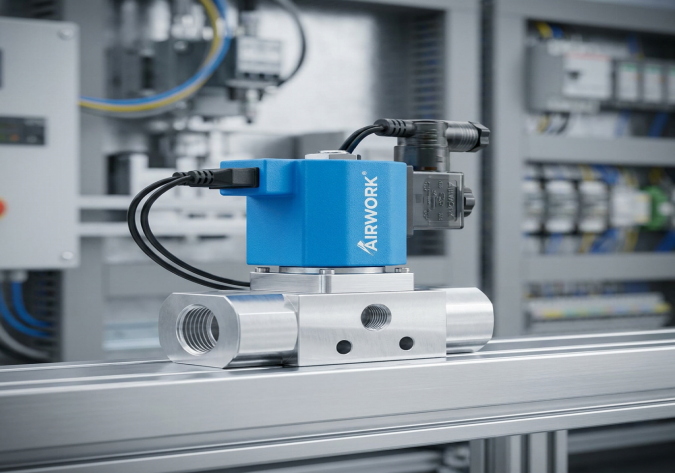
1. Understanding the Solenoid Coil and Its Electrical Characteristics
To understand why a coil burns out, we must first understand how it operates. A solenoid coil is essentially a copper wire wound thousands of times around a hollow core. When an electrical current flows through this wire, it generates an electromagnetic field that pulls the valve plunger, shifting the spool inside the 4V series valve body.
Depending on whether your system uses Alternating Current (AC) or Direct Current (DC), the coil behaves differently:
- DC Coils: These rely strictly on the resistance of the copper wire to limit current flow. The current remains constant regardless of whether the plunger is fully pulled in or stuck.
- AC Coils: These rely on inductive reactance to limit current. When an AC coil is first energized, it draws a massive inrush current (often 5 to 10 times the holding current) until the steel plunger shifts into place, completing the magnetic circuit. Once closed, the current drops to a much lower holding level.
This difference is critical when diagnosing burnout issues.
2. The Primary Culprits of Coil Burnout
Here are the main technical factors that lead to repeated coil failures in industrial environments:
Voltage Peaks and Power Supply Quality
In many factories, the electrical grid is shared with heavy industrial equipment, such as large motors, welding machines, and variable frequency drives (VFDs). The startup and shutdown of these machines can send high-voltage spikes and transient surges through the electrical lines.
- Overvoltage: Running a coil continuously at a voltage higher than its rated capacity (typically plus or minus 10 percent) causes excessive heat generation. The heat degrades the insulation coating on the copper winding, leading to short circuits between the turns.
- Voltage Spikes: Sudden microsecond spikes can exceed the dielectric strength of the coil insulation, causing immediate puncture and failure.
- AC Voltage Drops: If the supply voltage drops significantly, an AC coil may not generate enough magnetic force to pull the plunger in fully. Because the plunger remains out, the high inrush current continues to flow, rapidly overheating and burning out the coil in minutes.
Duty Cycle and Continuous Energization
Duty cycle refers to the ratio of active time to rest time for the solenoid. A 100 percent duty cycle means the valve is continuously energized. While many modern coils are rated for continuous duty, they still require adequate heat dissipation.
- Heat Accumulation: When a coil is energized, it naturally generates heat due to electrical resistance. In compact enclosures, or when valves are mounted tightly together on a manifold, heat cannot escape. The ambient temperature rises, and if it exceeds the coil's thermal insulation class (typically Class B or Class F), the insulation melts.
- Long Cycle Times: If a valve remains energized for days at a time, the coil operates at its maximum thermal limit constantly, leaving zero safety margin for minor voltage spikes.
Mechanical Spool Sticking
This is perhaps the most overlooked cause of AC coil burnout. As established, an AC coil draws a high inrush current until the plunger is fully seated.
- If the spool inside the 4V valve is stuck due to particulate contamination, dry air (lack of lubrication), or swollen rubber seals, the plunger cannot complete its stroke.
- Consequently, the coil remains in the inrush current phase indefinitely. The current is far too high for the wire gauge to sustain, and the coil burns out within a short period.
3. Engineering Solutions and Preventive Maintenance
To eliminate repeated coil burnout, maintenance teams should adopt a structured diagnostic and preventive approach:
- Implement Surge Protection: Install metal oxide varistors (MOVs) or transient voltage suppression (TVS) diodes in your control panels to clamp high-voltage spikes before they reach the solenoid valves. Choosing connector plugs with integrated LED indicators and surge suppressors is a highly effective field upgrade.
- Verify Duty Cycle Alignment: If an application requires a valve to be energized 99 percent of the time, consider changing the pneumatic logic. For instance, switch from a normally closed (NC) setup to a normally open (NO) setup, so the valve only draws power when it needs to be closed. Alternatively, use a double-solenoid 5/2-way valve where momentary pulses on either side shift the spool, requiring no continuous power to maintain position.
- Monitor Environmental Temperature and Ventilation: Ensure that the valve manifold is located in a well-ventilated area. If valves are housed inside a control cabinet, consider adding exhaust fans or passive vents. Keep valves away from direct radiant heat sources.
- Ensure Air Quality and Lubrication: Prevent mechanical sticking by maintaining clean, dry, and lightly lubricated compressed air. Use a high-quality Filter-Regulator-Lubricator (FRL) unit at the main air inlet to capture abrasive debris and moisture, ensuring smooth spool movement and reducing load on the coil.
4. The AIRWORK (JZPNU) Advantage
At Zhejiang Jinzhi Pneumatic Technology Co., Ltd. (JZPNU), we design our AIRWORK brand 4V series solenoid valves with B2B durability in mind.
- High-Grade Copper Winding: We use premium enameled copper wire with superior thermal properties, ensuring our coils can withstand temperatures up to Class F specifications (155 degrees Celsius).
- Advanced Encapsulation: Our coils are injection-molded using high-strength thermosetting plastics, providing excellent heat dissipation, moisture resistance, and mechanical protection.
- Precision Finished Spools: The spools of our 4V valves are precision machined using advanced CNC equipment and finished with low-friction coatings, minimizing the risk of mechanical sticking and subsequent coil overload.
By matching high-quality components with robust system design and electrical safeguards, you can successfully eliminate repeated solenoid coil burnout and ensure your automated production lines run smoothly with zero unplanned interruptions.
Table of Contents
- Q: Why does my 4V Series Solenoid Valve coil burn out repeatedly? (Voltage peaks vs. duty cycles)
- 1. Understanding the Solenoid Coil and Its Electrical Characteristics
- 2. The Primary Culprits of Coil Burnout
- Voltage Peaks and Power Supply Quality
- Duty Cycle and Continuous Energization
- Mechanical Spool Sticking
- 3. Engineering Solutions and Preventive Maintenance
- 4. The AIRWORK (JZPNU) Advantage