 EN
EN

Q: What are cleanroom classification standards, and why do standard pneumatic components fail to meet cleanroom requirements?
In high-tech industries such as semiconductor manufacturing, biotechnology, pharmaceuticals, and medical device assembly, production must take place within highly controlled environments called cleanrooms. These spaces are regulated by the international standard ISO 14644-1, which classifies cleanrooms from Class 1 (the cleanest) to Class 9 based on the maximum allowable concentration of airborne particles per cubic meter of air.
For example, an ISO Class 4 cleanroom, common in semiconductor wafer processing, allows no more than 352 particles of size 0.5 microns or larger per cubic meter of air. To put this in perspective, standard room air contains millions of such particles. In these ultra-clean environments, even a single microscopic dust particle or chemical vapor droplet settling on a silicon wafer can ruin an entire batch of microchips, causing millions of dollars in losses.
Sourcing pneumatic components for these cleanrooms is a major challenge for procurement managers and R&D engineers because standard pneumatic components are major particle generators:
- Particle Generation from Seal Friction: As a standard pneumatic cylinder rod moves back and forth, the constant sliding friction between the rubber seals and the metal rod sheds micro-particles of rubber and metal into the air. In standard applications, this is invisible and harmless, but in a cleanroom, it constitutes a severe pollution source.
- Exhaust Air Contamination: When a standard solenoid valve switches, it vents pressurized air directly into the room. This exhaust air contains microscopic droplets of compressor oil and grease particles worn from the valve's internal spools, which instantly compromises the cleanroom's air quality.
- Outgassing of Standard Lubricants: The grease used to lubricate standard industrial cylinders and valves contains volatile organic compounds (VOCs). Under cleanroom vacuum or temperature fluctuations, these lubricants outgas, releasing chemical vapors that can contaminate sensitive chemical processes, optical lenses, or high-purity silicon substrates.
To prevent these issues, standard pneumatic components are completely prohibited in cleanrooms. Engineers must specify and source specialized cleanroom-grade pneumatics designed to minimize particle emissions and prevent chemical contamination.
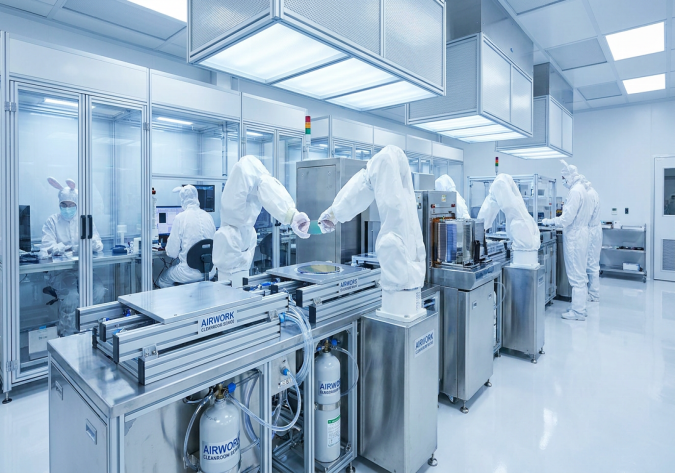
Q: What design features are engineered into cleanroom-grade pneumatic components to minimize particle emissions?
To meet strict ISO 14644-1 cleanliness standards, cleanroom-grade pneumatic components undergo significant design modifications compared to standard industrial models. Sourcing directors should look for these advanced engineering features:
- Integrated Suction Ports: Cleanroom-grade cylinders, such as those engineered by AIRWORK, incorporate a secondary vacuum suction port on the cylinder rod guide. This port is connected to an external vacuum line. Any micro-particles generated by the friction of the rod seals are sucked into this port and routed safely out of the cleanroom, rather than being released into the cleanroom atmosphere. This suction design is highly effective, enabling the cylinders to operate in environments as clean as ISO Class 3.
- Double-Lip Scraper Seals: Specialized cylinders use high-durability, double-lip seals made of fluororubber (FKM) or specialized polyurethane. The outer lip prevents external contaminants from entering the cylinder, while the inner lip acts as a high-efficiency scraper that keeps internal lubricants from escaping along the piston rod.
- Non-Shedding Materials: Materials are selected to minimize wear and particle generation. Cylinder tubes are typically made of hard-anodized aluminum or polished SUS316 stainless steel, which resist scratching and do not flake. Plastic parts are limited to non-shedding engineering polymers like PEEK, PTFE, or POM.
- Closed-Exhaust Solenoid Valves: In cleanroom-grade valve manifolds, the exhaust ports are not vented locally. Instead, the manifold is designed with a fully enclosed exhaust system. All exhaust air from the valves is piped through dedicated, sealed polyurethane tubing to an exhaust manifold that vents completely outside of the cleanroom environment.
Q: What are the lubricant standards for cleanroom pneumatics, and why are standard greases prohibited?
Lubrication is a critical element in pneumatic performance, as it ensures low friction, prevents seal wear, and extends component life. However, in cleanrooms, the choice of lubricant is subject to strict chemical standards. Standard industrial lubricants are strictly prohibited due to their physical and chemical properties:
- High Vapor Pressure and Outgassing: Standard greases have high vapor pressure, meaning they evaporate easily at room temperature. This evaporation releases volatile organic compounds (VOCs) that can settle on wafer surfaces, causing molecular organic contamination.
- Particle Shedding: Standard lubricants can break down under high-speed operation, shedding tiny grease droplets into the exhausted air stream.
Cleanroom-grade pneumatics must utilize specialized fluorinated or synthetic lubricants that comply with strict low-outgassing and low-vapor-pressure standards:
- Fluorine-Based (PFPE) Greases: Perfluoropolyether (PFPE) lubricants are the gold standard for cleanrooms. They are chemically inert, have exceptionally low vapor pressure, and do not evaporate or outgas even under high vacuum conditions. PFPE grease is resistant to high temperatures and harsh chemicals, ensuring that it remains stable inside the cylinder for its entire service life.
- Food-Grade (NSF H1) Certification: In pharmaceutical cleanrooms, lubricants must also be food-grade, ensuring that if accidental contact with the product occurs, it does not cause toxic contamination. Sourcing from AIRWORK guarantees that all cleanroom-grade lubricants are fully certified and compliant with both NSF H1 and ISO cleanliness standards.
Q: What parameters should B2B buyers verify when sourcing cleanroom pneumatics from AIRWORK?
When managing procurement for a cleanroom automation project, purchasing managers must verify specific quality and performance parameters to ensure compliance:
- ISO Cleanliness Certification: Verify the component's certified ISO Class. AIRWORK's cleanroom-grade cylinders and valves are tested and certified for use in environments up to ISO Class 4, making them ideal for semiconductor and pharmaceutical assembly.
- Packaging and Assembly Standards: Cleanroom components must not be assembled in standard factories. AIRWORK manufactures, inspects, and double-packages its cleanroom series inside a Class 100 cleanroom. This ensures that the parts are completely free of particles when they arrive at your facility.
- Material Traceability: Ensure the supplier provides certificates of compliance for all non-outgassing polymers and fluorinated lubricants used in the assembly. This is an essential requirement for FDA audits in medical device and pharmaceutical manufacturing lines.
By partnering with AIRWORK, B2B buyers can confidently source cleanroom-grade pneumatic solutions that combine high performance with absolute environmental compliance. Our specialized design features, low-outgassing lubricants, and certified cleanroom packaging ensure that your automated lines run smoothly without risking sensitive cleanroom processes.
Table of Contents
- Q: What are cleanroom classification standards, and why do standard pneumatic components fail to meet cleanroom requirements?
- Q: What design features are engineered into cleanroom-grade pneumatic components to minimize particle emissions?
- Q: What are the lubricant standards for cleanroom pneumatics, and why are standard greases prohibited?
- Q: What parameters should B2B buyers verify when sourcing cleanroom pneumatics from AIRWORK?