 EN
EN

Q: What is fail-safe logic in the process industries, and why is the selection of pneumatic cylinders so critical to plant safety?
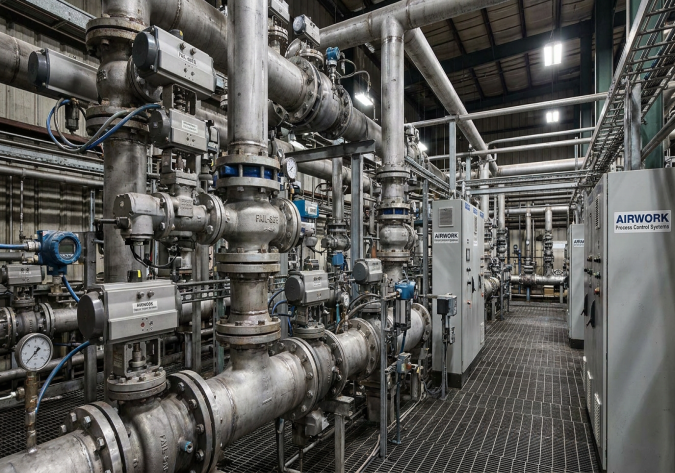
In process industries such as chemical manufacturing, petroleum refining, power generation, water treatment, and food processing, fluid control systems must operate with absolute reliability. These facilities handle volatile chemicals, high-pressure steam, and hazardous liquids. If a sudden emergency occurs—such as a plant-wide electrical blackout, a ruptured main air compressor line, or a control system failure—the automated valves regulating these fluids must immediately transition to a pre-determined, safe state. This is known as fail-safe logic.
Pneumatic actuators (cylinders) are the primary mechanical force used to open and close these critical process valves. When the control system loses power, the pneumatic cylinder is responsible for executing the fail-safe action. The choice of cylinder type—Double-Acting versus Single-Acting—is the fundamental engineering decision that dictates how the system will behave during a power or pressure loss.
There are three primary fail-safe states required in industrial processes:
- Fail-Closed (FC): The valve must immediately shut tight to prevent the flow of hazardous chemicals or fuel. An example is a fuel gas shut-off valve for a boiler.
- Fail-Open (FO): The valve must immediately open wide to vent pressure, prevent tank over-pressurization, or allow cooling water to flow. An example is an emergency relief valve.
- Fail-Last or Fail-Freeze (FL): The valve must lock in its exact position at the moment of failure, preventing any sudden process changes. An example is a control valve regulating a stable chemical reaction where sudden movement could disrupt the process balance.
Selecting the wrong cylinder type or fail-safe circuit can lead to catastrophic accidents, environmental contamination, and multi-million dollar equipment damage. Therefore, R&D engineers and procurement managers must understand the physical mechanisms and logic behind both actuator types.
Q: How do single-acting (spring-return) cylinders provide a highly reliable mechanical solution for fail-safe open or fail-safe closed logic?
Single-acting pneumatic cylinders, often referred to as spring-return cylinders, are the industry standard for executing simple Fail-Closed (FC) or Fail-Open (FO) logic. These cylinders utilize compressed air to move the piston in one direction (for example, to extend the rod and open a valve) and incorporate a heavy-duty internal mechanical spring to move the piston in the opposite direction (to retract the rod and close the valve).
The engineering beauty of the single-acting design is its simplicity and reliance on stored mechanical energy rather than external utilities:
- Purely Mechanical Energy Storage: A mechanical spring does not require electricity, compressed air, or an active control signal to function. When the cylinder is pressurized, the air pressure compresses the spring, storing energy. The moment the compressed air supply is cut off—whether due to a broken pipe or a de-energized solenoid valve—the stored mechanical energy in the spring is instantly released. The spring pushes the piston back to its default position, forcing the valve into its safe state.
- High Reliability: Because there are no complex electronic circuits or auxiliary air tanks required to activate the spring, single-acting cylinders represent the most reliable fail-safe technology available. Even if the entire plant loses both power and air, the spring will perform its duty.
- Simplified Solenoid Control: Single-acting cylinders are controlled using simple 3/2-way (three-port, two-position) solenoid valves. When de-energized, the valve automatically exhausts the air inside the cylinder, allowing the spring to return the piston. This minimizes the number of potential failure points in the electrical and pneumatic control loop.
However, single-acting cylinders have some limitations. Because a portion of the pneumatic force must overcome the spring resistance during the active stroke, they deliver less net output force than a double-acting cylinder of the same size. Additionally, the physical length of the internal spring limits the maximum stroke length, making them unsuitable for applications requiring long linear movements.
Q: Why are double-acting cylinders chosen for high-force and long-stroke applications, and how do engineers implement fail-safe logic with them?
Double-acting cylinders use compressed air to power both the extension and retraction strokes. They do not contain an internal spring, meaning they offer several distinct advantages over single-acting designs for specific process applications:
- High Force in Both Directions: Since there is no spring resisting the piston's movement, the full pressure of the compressed air is converted into linear force. This makes double-acting cylinders ideal for operating large, heavy process valves (such as high-pressure gate valves or large butterfly valves) that require maximum torque to open and seal tightly.
- Unlimited Stroke Lengths: Without the physical space constraints of an internal spring, double-acting cylinders can be manufactured with extremely long strokes, often exceeding several meters, which is essential for material handling and large-scale bulk processing.
- Precise Positioning: Double-acting cylinders provide stable, balanced control, allowing for precise modulating control of process valves at intermediate positions (such as keeping a valve 45% open).
However, because double-acting cylinders require active air pressure to move in both directions, they do not have an inherent, mechanical default state. If the air supply fails, the piston will float freely, and the valve can drift due to fluid forces, which is highly dangerous. To implement fail-safe logic with double-acting cylinders, engineers must integrate specialized external pneumatic accessories, a specialty of AIRWORK's engineering team:
- Air Accumulator Tanks (Air Reservoirs): A pressurized steel tank is installed near the cylinder. If the main air supply fails, a non-return check valve isolates the tank, and a pilot-operated valve directs the stored air from the accumulator tank to the cylinder, forcing it to slide to the fail-safe position.
- Pilot-Operated Check Valves (Lock-Up Valves): These valves are mounted directly on the cylinder's air ports. They monitor the main air pressure. If the supply pressure drops below a safe threshold, the check valves instantly close, trapping the air inside both chambers of the cylinder. This locks the piston in place, executing Fail-Last/Fail-Freeze logic with high precision.
Q: How does AIRWORK assist B2B procurement managers and engineers in optimizing fail-safe actuator systems?
Choosing between double-acting and single-acting cylinders involves balancing safety requirements, spatial constraints, mechanical force, and equipment budget. Sourcing from a highly experienced manufacturer like AIRWORK simplifies this process for B2B buyers:
- Comprehensive Portfolio: AIRWORK manufactures a complete range of both double-acting and single-acting cylinders adhering to ISO 15552 and ISO 6431 standards, as well as a full suite of fail-safe control valves, accumulator packages, and lock-up accessories.
- Specialized Engineering Support: Our technical team helps R&D engineers calculate the precise force requirements, accounting for spring resistance and air pressure drops, to select the most compact and cost-effective cylinder size.
- Custom Fail-Safe Manifolds: AIRWORK designs custom-integrated pneumatic panels that combine the control valves, accumulator tanks, and safety check valves into a single pre-tested assembly. This reduces installation time and eliminates potential leak paths in your plant.
By partnering with AIRWORK, process plant operators and machine builders can guarantee that their automated systems comply with strict international safety standards, minimize operating risks, and execute flawless fail-safe actions during critical emergency events.
Table of Contents
- Q: What is fail-safe logic in the process industries, and why is the selection of pneumatic cylinders so critical to plant safety?
- Q: How do single-acting (spring-return) cylinders provide a highly reliable mechanical solution for fail-safe open or fail-safe closed logic?
- Q: Why are double-acting cylinders chosen for high-force and long-stroke applications, and how do engineers implement fail-safe logic with them?
- Q: How does AIRWORK assist B2B procurement managers and engineers in optimizing fail-safe actuator systems?