 EN
EN

Q: Selecting Lubricators for high-speed pneumatic tools: Managing the oil-fog delivery over long distances.
High-speed pneumatic tools, such as air grinders, impact wrenches, turbine drills, and automated assembly nutrunners, are the heavy-duty workhorses of modern manufacturing and assembly plants. Operating at speeds often exceeding 10000 RPM, these tools generate massive internal friction and heat within their rotary vanes and bearings. Without proper and continuous lubrication, the life of these high-value tools is measured in days, if not hours.
Pneumatic lubricators are integrated into the air line to introduce a controlled, fine mist of lubricating oil into the compressed air stream. However, selecting the right lubricator involves much more than picking a unit with matching port sizes. For facility managers and maintenance engineers, the core technical challenge lies in managing oil-fog delivery over long distances without causing the oil to pool in the piping before it reaches the tool. This B2B guide analyzes the engineering principles behind oil-fog transport, lubricator selection, and optimal lubrication management.
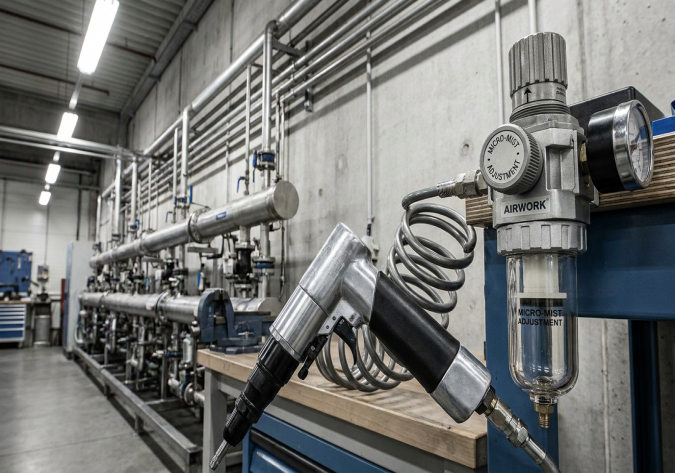
The Mechanical Necessity of Pneumatic Tool Lubrication
Inside a high-speed pneumatic tool, compressed air pushes against rotary vanes to spin a rotor. This mechanical action creates high-velocity sliding friction between the vanes and the internal cylinder walls. Adequate lubrication is essential to:
- Reduce Friction and Heat: Prevents thermal expansion of internal parts, which causes tool lock-up.
- Create a Dynamic Seal: The oil film helps seal the tiny clearances between the vanes and the cylinder wall, maximizing torque and speed efficiency.
- Prevent Corrosion: Prevents ambient moisture in the compressed air from rusting the tool's internal steel bearings and gears during idle periods.
Understanding Lubricator Technologies: Oil-Fog vs. Micro-Mist
When sourcing lubricators from manufacturers like Zhejiang Jinzhi Pneumatic Technology Co., Ltd. (JZPNU) under their premium AIRWORK brand, you will encounter two primary technical designs: standard Oil-Fog lubricators and advanced Micro-Mist lubricators. Selecting the correct technology is entirely dependent on the physical distance between the FRL unit and the pneumatic tool.
1. Standard Oil-Fog Lubricators
In a standard oil-fog lubricator, compressed air passes through a venturi nozzle inside the unit, creating a localized pressure drop. This pressure differential draws oil up from the reservoir bowl through a siphon tube and drops it into the air stream. 100 percent of the oil drops visible in the sight dome are introduced directly into the flowing air.
These oil droplets are relatively large, typically ranging from 10 to 100 microns in diameter. Because of their mass, these droplets tend to remain in suspension only over short distances.
- Distance Limit: Standard oil-fog lubricators must be installed very close to the tool, ideally within 5 to 8 meters. If the hose is longer, or if there are multiple bends, elbows, or vertical rises, the heavy oil droplets will fall out of suspension due to gravity and centrifugal forces.
- The Pooling Problem: Liquid oil accumulates on the pipe walls, creating a sluggish sludge, while the high-speed tool downstream remains bone dry.
2. Advanced Micro-Mist Lubricators
For applications where the FRL unit is centrally located or positioned far from the actual workspace (such as overhead assembly lines or extensive piping networks), a micro-mist lubricator is an absolute engineering requirement.
In a micro-mist lubricator, the oil is atomized into an ultra-fine aerosol inside the unit. The larger droplets (over 2 microns) are automatically separated and returned to the oil reservoir. Only the extremely small, lightweight droplets—measuring under 2 microns—are permitted to enter the downstream air line. This represents about 10 percent of the oil drawn from the reservoir.
- Long-Distance Transportation: These tiny micro-mist particles behave like a gas. They can remain suspended in the compressed air stream over long distances, up to 30 meters or more, and can easily navigate multiple pipe elbows and vertical rises without falling out of suspension.
- Uniform Delivery: This ensures that every high-speed tool along a lengthy assembly line receives a highly consistent, fine film of oil, preventing starvation.
Selection Criteria for Maintenance Engineers
To ensure peak tool performance, use this technical checklist when selecting a lubricator:
1. Match the Minimum Flow Rate
Lubricators require a minimum air velocity to create the venturi effect necessary to draw oil up from the reservoir. If you install an over-sized lubricator on a low-flow tool, the air velocity will be too low to trigger oil siphonage, and the tool will receive zero lubrication. Always consult the AIRWORK minimum flow rate charts before purchasing.
2. Oil Chemistry and Viscosity Compatibility
Never use automotive engine oils, gear oils, or penetrating oils in a pneumatic system. These oils are too viscous and contain chemical additives that will cause the polyurethane seals in your pneumatic valves and cylinders to swell, crack, and disintegrate. Always specify specialized, low-viscosity pneumatic tool oil (typically ISO VG 32 or equivalent). This oil is formulated to flow smoothly at low temperatures, atomize easily, and resist emulsification with water.
3. Setting the Lubrication Drip Rate
A common mistake is over-lubricating pneumatic tools. This wastes oil, creates an oily exhaust mist that contaminates the workspace, and can clog tool mufflers. A standard rule of thumb for high-speed tools is 1 to 3 drops of oil per 1000 liters of air consumed. For a typical tool consuming 500 liters per minute, set the lubricator drip adjustment screw to deliver approximately 1 drop of oil every 2 minutes of continuous operation.
Best Practices for Long-Distance Oil-Fog Management
- Minimize Vertical Runs: If you must use a standard oil-fog lubricator, avoid vertical climbs after the FRL unit. Gravity will force the heavy oil droplets downward, starving the tool.
- Avoid Sagging Hoses: Ensure that flexible air hoses do not sag or form low loops. These low points act as traps where oil will pool, occasionally releasing massive, damaging slugs of liquid oil into the tool when the air flow spikes.
- Centralize with Micro-Mist: If your facility utilizes a central distribution manifold, install a high-capacity AIRWORK micro-mist lubricator at the manifold inlet to safely lubricate multiple workstations simultaneously.
Conclusion: The AIRWORK Advantage
Properly managing pneumatic tool lubrication is a critical factor in maximizing factory tool lifespans and reducing repair costs. JZPNU's AIRWORK brand offers a comprehensive suite of modular oil-fog and micro-mist lubricators engineered with precise, micro-adjustable drip knobs and highly visible flow domes. By matching the right AIRWORK lubricator technology to your pipeline length and tool flow requirements, maintenance managers can guarantee flawless high-speed tool operation and continuous production uptime.
Table of Contents
- Q: Selecting Lubricators for high-speed pneumatic tools: Managing the oil-fog delivery over long distances.
- The Mechanical Necessity of Pneumatic Tool Lubrication
- Understanding Lubricator Technologies: Oil-Fog vs. Micro-Mist
- Selection Criteria for Maintenance Engineers
- Best Practices for Long-Distance Oil-Fog Management
- Conclusion: The AIRWORK Advantage