 EN
EN

Q: The engineering behind 'Precision Regulators': How to maintain constant output pressure for sensitive testing.
In manufacturing facilities, testing laboratories, and quality control departments, pneumatic operations often require far more than general force generation. Applications such as leak-decay testing, medical device calibration, semiconductor wafer handling, precision tension control, and micro-fluidic dosing demand absolute stability of compressed air pressure. In these sensitive environments, even a microscopic pressure fluctuation of 0.05 bar can corrupt test results, skew product tolerances, and lead to high reject rates.
While standard air regulators are perfectly suitable for general machinery like air cylinders, they lack the sensitivity and stability required for these specialized tasks. To achieve constant output pressure regardless of fluctuating inlet pressures and flow rates, engineers must implement precision regulators. This article examines the internal mechanics, design features, and operating principles that separate precision regulators from standard air regulators.
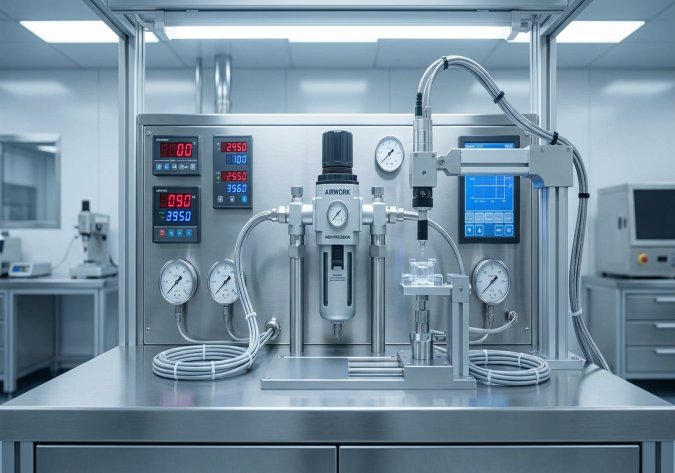
The Limitations of Standard Regulators: Understanding Hysteresis and Droop
To appreciate the engineering of a precision regulator, we must first analyze how standard regulators function and why they fail in sensitive applications.
Standard air regulators utilize a simple spring-loaded diaphragm design. The user turns an adjustment knob to compress a heavy steel range spring. This spring pushes downward on a flexible elastomer diaphragm, which in turn unseats an internal valve poppet to allow air to flow from the inlet to the outlet. As outlet pressure builds, it acts on the underside of the diaphragm, pushing upward against the spring force. When the forces balance, the poppet closes to maintain the set pressure.
While robust and cost-effective, standard regulators are plagued by two physical phenomena:
- Pressure Droop: As downstream air flow demand increases, the regulator must open wider. To do this, the diaphragm must move downward, which causes the range spring to relax slightly. According to Hooke's Law, as a spring relaxes, its force decreases. Therefore, the regulator balances at a lower outlet pressure. This loss of pressure during dynamic flow is known as droop.
- Inlet Pressure Sensitivity: If the inlet pressure from the main factory header spikes or drops, the force acting on the face of the regulator's valve poppet changes. This force change shifts the diaphragm position, directly altering the outlet pressure. This means your machine's operating pressure is constantly at the mercy of other machines cycling on the same line.
The Engineering Innovations of Precision Regulators
Precision regulators, such as those engineered by JZPNU under their professional AIRWORK brand, utilize advanced mechanical designs to completely eliminate droop and inlet pressure sensitivity. They achieve an output sensitivity down to 0.01 bar or less through three primary engineering innovations:
1. The Pilot-Operated Double-Diaphragm System
Instead of using a heavy, stiff range spring to directly push the main valve poppet, a precision regulator uses a highly sensitive double-diaphragm pilot assembly. The adjustment knob compresses a very light control spring, which acts on a highly sensitive pilot diaphragm. This pilot stage manages a small, precise pilot air chamber rather than the main flow.
The air pressure in this pilot chamber then acts as the force that pushes down on a larger main diaphragm, which controls the main valve poppet. Because the pilot diaphragm is extremely thin and has negligible travel, the spring force remains constant. This completely eliminates Hooke's Law droop, maintaining flat pressure curves even at high dynamic flow rates.
2. The Constant Bleed Design
At the heart of every true precision regulator is a constant bleed mechanism. Inside the regulator, a tiny amount of compressed air is continuously exhausted to the atmosphere through a minute bleed orifice. This constant airflow creates a dynamic state of equilibrium within the pilot chamber.
Because the air is always moving, the internal control surfaces are never in a static, high-friction state. The regulator can respond instantaneously to microscopic changes in downstream pressure. If a downstream pressure drop occurs, the pilot valve immediately adjusts the pilot chamber pressure, which instantly opens the main poppet to compensate. This makes the response time of the regulator virtually lag-free.
3. High-Capacity Self-Relieving Mechanism
In testing setups, downstream pressure can sometimes rise above the set point. For instance, in a leak testing chamber, placing a sealed volume inside a fixture can compress the air inside the line, causing a localized pressure spike.
A precision regulator features an extremely large, highly sensitive relieving seat in the center of the main diaphragm. If the outlet pressure exceeds the set point by as little as 0.005 bar, the main diaphragm immediately lifts off the relief seat, venting the excess pressure directly to the atmosphere through the exhaust port. This guarantees that your testing equipment is never exposed to over-pressurization.
Key Parameters for B2B Selection and Implementation
When sourcing precision regulators for your laboratory or factory test bench, evaluate these technical parameters:
- Sensitivity: Look for a regulator that specifies a sensitivity of 0.2 percent of full span or better. This ensures the regulator can correct for microscopic pressure changes.
- Repeatability: In quality control, repeatability is critical. Precision regulators must return to the exact set pressure (within 0.5 percent) even after the air supply has been completely shut off and re-pressurized.
- Air Consumption (Constant Bleed Rate): Because precision regulators utilize a constant bleed design, they continuously consume a small volume of air (usually between 1 and 5 liters per minute). Ensure your system design accounts for this minor, continuous air loss.
- Mounting Orientation: Due to the high sensitivity of the internal diaphragms and light pilot springs, some precision regulators are sensitive to gravity. For maximum accuracy, they should always be mounted in a perfectly vertical orientation as specified by the manufacturer.
- Staging Filtration: Because the internal pilot nozzle and bleed orifice are extremely small (often under 0.5 millimeters), precision regulators are highly vulnerable to particulate and oil contamination. You must always install a 5-micron or 0.3-micron coalescing filter upstream to protect the regulator's internal components.
Conclusion: Uncompromising Accuracy with AIRWORK
When precision is the only acceptable metric, standard air regulators cannot deliver. Sourcing the high-performance AIRWORK precision regulator series from Zhejiang Jinzhi Pneumatic Technology Co., Ltd. (JZPNU) provides quality control teams with the engineering reliability required for sensitive testing and calibration systems. With an ultra-sensitive double-diaphragm pilot system, rapid-response self-relieving exhaust, and robust construction, AIRWORK precision regulators ensure your testing data remains clean, accurate, and completely repeatable.
Table of Contents
- Q: The engineering behind 'Precision Regulators': How to maintain constant output pressure for sensitive testing.
- The Limitations of Standard Regulators: Understanding Hysteresis and Droop
- The Engineering Innovations of Precision Regulators
- Key Parameters for B2B Selection and Implementation
- Conclusion: Uncompromising Accuracy with AIRWORK