 EN
EN

Q: Selecting 'Pilot-Operated' vs. 'Direct-Acting' solenoid valves for specific pressure ranges.
When designing or maintaining a B2B pneumatic control system, selecting the correct solenoid valve mechanism is vital for system reliability. A common area of confusion for procurement managers and mechanical engineers is the distinction between direct-acting and pilot-operated (also known as indirect-acting) solenoid valves.
Selecting the wrong type can result in a valve that refuses to open, leaks continuously, or requires an excessively large electrical power supply. The choice is primarily governed by the working pressure range of your system, flow rate requirements, and media quality. Below, the AIRWORK engineering team provides a technical analysis of how these two valve designs function, their respective benefits and limitations, and how to select the right valve for your specific operating parameters.
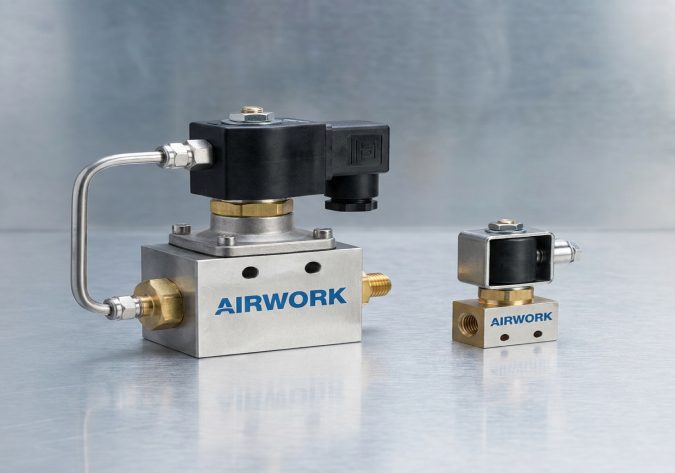
1. Mechanical Anatomy of Direct-Acting Solenoid Valves
In a direct-acting solenoid valve, the mechanical shifting of the valve spool or seal is performed directly by the magnetic force generated by the solenoid coil.
- How It Works: When electrical current enters the coil, it creates an electromagnetic field that pulls the armature (plunger) upward. This action directly opens or closes the flow orifice. When power is cut, an internal spring pushes the plunger back to its original position.
- Zero Minimum Pressure Required: Because the coil is physically lifting the sealing plunger, direct-acting valves do not require any line pressure to operate. They can switch from 0 MPa (zero vacuum) up to their maximum rated pressure. This makes them highly versatile for low-pressure, gravity-fed, or vacuum applications.
- Orifice and Flow Limits (The Force Trade-off): The primary limitation of direct-acting valves is flow capacity. The force required to open a valve is directly proportional to the orifice area and the air pressure acting against it. To open a large orifice at high pressure, a massive solenoid coil would be required, drawing excessive electrical power and generating high heat. Therefore, direct-acting valves are typically limited to small orifice sizes (usually under 3 millimeters to 4 millimeters) and lower flow rates (low Cv values).
2. Mechanical Anatomy of Pilot-Operated Solenoid Valves
A pilot-operated valve overcomes the orifice and flow limits of direct-acting designs by utilizing the energy of the compressed air already in the system to shift the main spool.
- How It Works: In a pilot-operated valve, the solenoid coil does not move the main spool. Instead, when energized, the coil opens a tiny pilot port (which requires very little electromagnetic force). Compressed air from the inlet line rushes through this pilot port and acts like a hydraulic fluid, pressing against an internal piston or diaphragm. This pilot air pressure pushes the main spool, opening the primary flow path. When de-energized, the pilot port closes, and the air on the piston exhausts, allowing a return spring to push the spool back.
- Minimum Operating Pressure Requirement: Because the valve relies on line pressure to shift the main spool, pilot-operated valves require a minimum differential pressure (usually 0.15 to 0.2 MPa, or 1.5 to 2.0 bar) to function. If system pressure drops below this threshold, there will not be enough force to slide the main spool, and the valve will fail to shift, even if the electrical coil is energized.
- High Flow Capacity with Low Power: Because the heavy lifting is done by the compressed air itself, the solenoid coil can remain small and energy-efficient (often drawing only 2 to 3 watts). This design allows pilot-operated valves to handle large orifices and high flow rates (high Cv values) at working pressures up to 1.0 MPa or more.
3. Comparative Technical Parameters
To simplify the B2B engineering selection process, we can compare these two configurations across several key operational metrics:
Operating Pressure Range
- Direct-Acting: 0 to 0.8 MPa (0 to 8 bar). Excellent for vacuum and ultra-low pressure logic circuits.
- Pilot-Operated: 0.15 to 0.8 MPa (1.5 to 8 bar). Requires stable compressed air lines.
Orifice Size and Flow Rate (Cv Value)
- Direct-Acting: Tiny orifices (0.5mm to 4.0mm). Low flow rate. Ideal for piloting larger process valves or small cylinder logic.
- Pilot-Operated: Medium to large orifices (up to 50mm or more). High flow rate. Standard choice for driving power actuators like double-acting cylinders (e.g., JZPNU 4V series).
Electrical Power Consumption
- Direct-Acting: High power consumption (typically 5W to 20W or more) because the magnetic force must fight the spring and air pressure directly.
- Pilot-Operated: Low power consumption (typically 1.5W to 4.5W). Ideal for multi-valve manifolds controlled by PLCs where total current draw must be minimized.
Media Purity Sensitivity
- Direct-Acting: Highly robust. Because there are no tiny pilot channels, they can tolerate slightly dusty air or media with minor particulate contamination.
- Pilot-Operated: Extremely sensitive. The tiny internal pilot channels (often under 0.8mm) can easily become clogged by particulate dust, rust scales, or sticky oil varnish. Once clogged, the pilot air cannot pass, and the valve stops functioning. Therefore, high-quality filtration (5-micron or better) is a strict requirement.
4. Selection Guide for B2B Procurement
When sourcing solenoid valves from AIRWORK, use the following rules of thumb:
- Choose Direct-Acting if: Your application involves absolute vacuum, zero-pressure gravity flow, low-pressure dosing, or if you need a pilot valve to actuate a larger process valve. Look at our AIRWORK 2V025 and 2V012 direct-acting series.
- Choose Pilot-Operated if: You are operating a standard industrial pneumatic line (normally pressurized at 0.5 to 0.7 MPa) to actuate cylinders and pneumatic tools, and you need high flow rates with minimal electrical power consumption. Our flagship AIRWORK 4V series (4V110, 4V210, 4V310, 4V410) is the industry-standard choice.
The AIRWORK (JZPNU) Advantage
At Zhejiang Jinzhi Pneumatic Technology Co., Ltd. (JZPNU), we manufacture a diverse catalog of both direct-acting and pilot-operated valves under our AIRWORK brand.
- Precision-wound solenoids designed to minimize heat generation.
- Superior mechanical tolerances, ensuring lower minimum pilot pressures for our pilot-operated series.
- Robust vulcanized sealing elements that ensure low internal leakage across all pressure ranges.
By matching your specific pressure, flow, and electrical parameters with the appropriate AIRWORK valve type, you can maximize system reliability, reduce energy costs, and prevent premature component failure on your production floor.
Table of Contents
- Q: Selecting 'Pilot-Operated' vs. 'Direct-Acting' solenoid valves for specific pressure ranges.
- 1. Mechanical Anatomy of Direct-Acting Solenoid Valves
- 2. Mechanical Anatomy of Pilot-Operated Solenoid Valves
- 3. Comparative Technical Parameters
- Operating Pressure Range
- Orifice Size and Flow Rate (Cv Value)
- Electrical Power Consumption
- Media Purity Sensitivity
- 4. Selection Guide for B2B Procurement
- The AIRWORK (JZPNU) Advantage