 EN
EN

Q: What is IO-Link technology, and how does it revolutionize traditional pneumatic systems in Industry 4.0?
Traditional pneumatic systems have long been viewed as 'deaf and dumb' mechanical systems. Standard solenoid valves are controlled by basic 24V digital signals that tell them to open or close, and basic magnetic reed switches merely detect if a cylinder piston has reached the end of its stroke. There is no bidirectional communication, no diagnostic feedback, and no way to know if a component is wearing out until it actually breaks, stopping the entire production line.
IO-Link (IEC 61131-9) is the first open, standardized, point-to-point, bidirectional digital communication technology that connects sensors and actuators to industrial fieldbus networks (such as PROFINET, EtherNet/IP, and EtherCAT). It acts as the 'last mile' communication link, enabling smart field-level devices to transmit not just raw process data (like ON/OFF signals), but also comprehensive diagnostic and parameterization data.
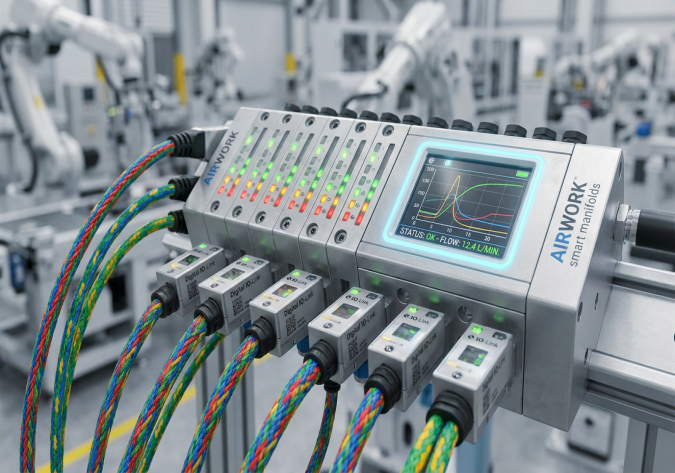
By integrating IO-Link technology with pneumatic valve manifolds and cylinder sensors, AIRWORK has transformed traditional pneumatics into highly intelligent, data-rich Industry 4.0 automation systems. Instead of simple mechanical movement, an IO-Link-enabled pneumatic system provides continuous, real-time insights into its own performance, operating health, and environmental conditions. This shift enables B2B manufacturers to transition from reactive maintenance to highly optimized, data-driven predictive Operations & Maintenance (O&M) strategies.
Q: What specific diagnostic and O&M capabilities are unlocked by integrating IO-Link with pneumatic valve manifolds and sensors?
Integrating smart IO-Link sensors with pneumatic manifolds and cylinders unlocks a wide range of advanced diagnostic, control, and O&M (Operations & Maintenance) capabilities that were previously impossible with traditional wiring setups:
- Real-Time Cycle Counting: Every time a solenoid valve fires or a cylinder completes a stroke, the IO-Link module registers the action. Since pneumatic components have a rated service life (known as the B10d value, representing the number of cycles before a statistical failure), the system can track cumulative cycles and automatically alert maintenance teams when a component is nearing its rated lifespan, allowing for a planned replacement during scheduled downtime.
- Actuator Travel Time Monitoring: By cross-referencing the valve trigger signal with the cylinder's end-of-stroke sensors, the IO-Link controller can measure the exact milliseconds it takes for the cylinder to complete its travel. If the travel time begins to slow down, it indicates a drop in pressure, a localized air leak, or increased mechanical friction in the guides. This allows technicians to address the root cause before the actuator jams completely.
- Continuous Pressure and Flow Diagnostics: IO-Link pressure and flow sensors integrated into the valve manifold continuously monitor the compressed air supply. They can detect subtle pressure drops during high-speed operation or a slow, continuous rise in air consumption (a classic sign of a growing air leak in the tubing or cylinder seals), sending immediate warnings to prevent energy waste and operational failures.
- Solenoid Coil Health Monitoring: The IO-Link-enabled pneumatic manifold can continuously monitor the electrical properties of individual solenoid coils. It can detect open circuits, short circuits, or coil overheating, instantly identifying the exact valve module that needs attention on a digital control interface.
- Parameterization and Auto-Configuration: Traditional smart sensors require manual tuning using buttons or pot screws on the sensor body. With IO-Link, all configuration parameters (such as pressure thresholds, sensor sensitivity, and timer settings) are stored digitally on the IO-Link master. If a sensor or valve is damaged, a technician can simply plug in a new, identical unit. The master automatically writes the stored parameters to the new device, requiring zero manual programming or calibration.
Q: How does the physical wiring and installation of an IO-Link pneumatic system compare to traditional hardwired manifolds?
For B2B procurement managers and system integrators, the reduction in installation cost and complexity is one of the most compelling reasons to adopt IO-Link technology. Traditional hardwired pneumatic systems are highly labor-intensive to design, install, and commission:
- Complex Multi-Core Cables: Connecting a 16-station solenoid valve manifold and associated cylinder sensors to a PLC cabinet requires routing massive, thick multi-core cables. Every single wire must be manually stripped, crimped, labeled, and landed on terminal blocks in both the PLC cabinet and the manifold junction box. This manual wiring is prone to errors and takes hours of labor.
- Bulky Cable Trays: Large multi-core cables are heavy and stiff, requiring expensive and bulky cable management systems on the machine frame.
IO-Link completely simplifies this infrastructure:
- Standardized Unshielded 3-Wire or 4-Wire Cables: All IO-Link devices, including complex valve manifolds and smart sensors, connect using standard, inexpensive, unshielded M12 or M8 cables. A single, thin 3-wire cable carries the digital communication, 24V power supply, and ground.
- Decentralized Architecture: Instead of routing all wires back to a central PLC cabinet, sensors and valves connect locally to an IP67-rated IO-Link master block mounted directly on the machine frame. The master then aggregates the data from up to 8 or 16 devices and sends it to the PLC via a single industrial Ethernet cable (such as PROFINET).
- Reduced Cabinet Footprint: By moving the terminal connections and master blocks out of the electrical cabinet and onto the machine frame, cabinet size can be reduced by up to 50%, saving valuable floor space and reducing overall hardware costs.
Q: What smart IO-Link solutions does AIRWORK provide for modern industrial manufacturing plants?
AIRWORK has developed a robust ecosystem of smart, IO-Link-compatible pneumatic products designed to seamlessly integrate with modern PLC networks and Industry 4.0 software platforms:
- IO-Link Integrated Valve Manifolds: Our high-end valve manifolds feature integrated IO-Link communication modules. A single M12 connection supports up to 32 solenoid coils, providing full digital control, individual channel diagnostics, and automated cycle counting.
- Smart Cylinder Position Sensors: AIRWORK's magnetic cylinder sensors utilize IO-Link to transmit continuous, absolute position data along the cylinder stroke, rather than just basic end-of-stroke signals. This allows engineers to program multiple switching points and monitor cylinder speed in real-time.
- Digital Pressure and Flow Sensors: Our compact, inline IO-Link sensors provide real-time pressure, flow, and temperature readouts, with built-in diagnostic logging that simplifies energy audit tracking.
By partnering with AIRWORK, industrial manufacturers and machine builders can easily upgrade their pneumatic infrastructure to meet Industry 4.0 standards. The combination of simple M12 wiring, advanced real-time diagnostics, and automated parameterization reduces commissioning times, minimizes wiring errors, and guarantees maximum machine uptime through intelligent predictive maintenance.
Table of Contents
- Q: What is IO-Link technology, and how does it revolutionize traditional pneumatic systems in Industry 4.0?
- Q: What specific diagnostic and O&M capabilities are unlocked by integrating IO-Link with pneumatic valve manifolds and sensors?
- Q: How does the physical wiring and installation of an IO-Link pneumatic system compare to traditional hardwired manifolds?
- Q: What smart IO-Link solutions does AIRWORK provide for modern industrial manufacturing plants?