 EN
EN

Q: Why are the requirements for power inverters and pneumatic components so unique and stringent in medical ventilators and laboratory automation equipment?
Medical ventilators and laboratory automation systems belong to a specialized class of life-critical and high-precision equipment. Unlike standard industrial machinery, where power efficiency and mechanical force are the main priorities, medical and laboratory hardware must operate within highly controlled, sensitive human environments. This imposes unique and stringent requirements on both the electrical power systems, specifically power inverters, and the pneumatic flow control systems, such as proportional valves.
In a hospital ICU or clinical laboratory, patients and healthcare workers are surrounded by sensitive electronic diagnostics and diagnostic systems. In these environments, three major challenges dictate the design of ventilators and automated lab systems:
- Life-Critical Continuous Operation: A medical ventilator must never stop. If primary AC mains power fails, the device must seamlessly transition to internal DC battery power. This requires highly efficient and fast-switching DC-AC power inverters that deliver clean, pure sine wave power to internal air compressors and micro-blowers.
- Noise-Sensitive Environments: Continuous background noise in hospital wards is proven to increase patient stress, delay recovery, and interfere with clinical workflows. Any inverter-driven motor or pneumatic valve must operate with ultra-low audible noise.
- Uncompromising Bio-Compatibility and Precision: Flow control components must deliver precise, repeatable micro-volumes of oxygen, respiratory air, or clinical reagents. These components must be manufactured from bio-compatible, non-outgassing materials that do not introduce particles or chemical vapors into the patient's breathing circuit or test samples.
Because of these stringent guidelines, R&D engineers and procurement managers must carefully evaluate and specify both the inverters and the pneumatic valves to ensure they are certified for medical and clinical laboratory standards.
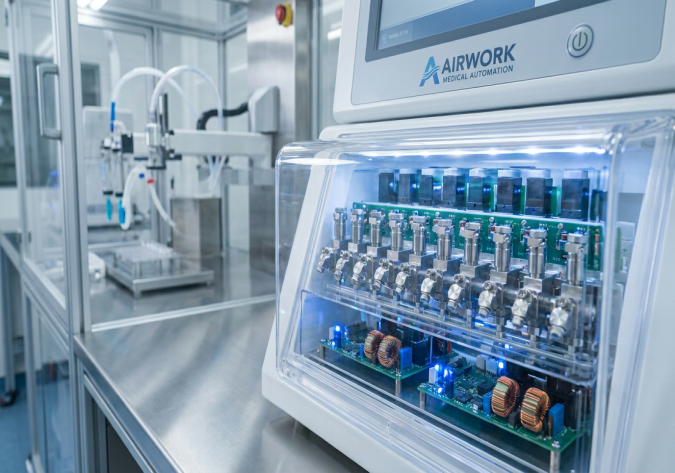
Q: What are the engineering criteria for selecting power inverters in battery-backed medical ventilators and clinical lab instruments?
Power inverters in medical equipment do not simply convert power; they act as the primary defense against electrical instability. When a ventilator's internal micro-blower or a laboratory liquid handler's automated positioning motor runs, it relies on high-quality AC power. When designing these systems, R&D engineers look for several critical inverter performance indicators:
- Pure Sine Wave Output: Medical inverters must produce a clean, pure sine wave with extremely low total harmonic distortion (THD, typically less than 2%). Modified sine wave inverters are completely unacceptable because they generate high-frequency electrical noise, which can cause micro-blowers to overheat, vibrate, and fail prematurely.
- Electromagnetic Compatibility (EMC): Ventilator inverters must comply with strict medical EMC standards such as IEC 60601-1-2. They must not emit electromagnetic interference (EMI) that could corrupt readings on nearby ECGs or patient monitors, nor should they be vulnerable to external EMI.
- High Conversion Efficiency: To maximize battery run-time during patient transport or power outages, inverters must operate with high energy efficiency (above 90%). Every percent of lost efficiency translates directly to reduced operational battery life.
- Low Acoustic and Thermal Signature: Ventilator inverters must use advanced thermal management. Large, noisy cooling fans are avoided. Instead, inverters are designed to dissipate heat through conduction to the device's aluminum chassis, ensuring completely silent electrical conversion.
Q: How do ultra-low noise, high-response proportional pneumatic valves function in ventilator and lab automation systems, and how does AIRWORK meet these standards?
At the heart of every ventilator and automated analyzer is the need to control fluids (air, oxygen, or liquid samples) with microsecond precision and absolute silence. Traditional on-off solenoid valves are too crude for these applications. Instead, engineers specify high-response proportional valves.
Proportional valves adjust the flow rate continuously by changing the electrical current supplied to the solenoid. This allows for precise control over the mixing ratio of air and oxygen in a ventilator, tailoring the flow to the patient's breathing cycle. In laboratory automation, these valves control the micro-pressures used for automated pipetting, sample dispensing, and reagent routing.
AIRWORK has developed specialized low-noise, high-response micro-valves that address these exact clinical needs:
- Ultra-Low Audible Noise: Traditional valves create a distinct clicking sound as the internal armature hits the valve seat. AIRWORK eliminates this by using specialized damping elastomers and friction-optimized internal spools, keeping audible noise below 35 decibels (dBA) during operation.
- High-Frequency Response Times: Our micro-proportional valves feature response times of less than 5 milliseconds. This allows a ventilator to respond instantly to a patient's spontaneous inhalation effort, reducing the work of breathing and improving clinical outcomes.
- High-Resolution Flow Control: AIRWORK valves offer exceptionally low hysteresis (less than 3%) and high repeatability, ensuring that the same electrical signal always yields the exact same flow rate. This is critical for lab automation systems that must dispense micro-liter volumes of liquid with high accuracy.
- Certified Safe Materials: AIRWORK medical-grade valves are manufactured from FDA-compliant polymers, stainless steel, and medical-grade elastomers. They undergo extraction testing to guarantee zero particle emissions and zero outgassing of volatile organic compounds (VOCs).
Q: What key factors should B2B procurement managers prioritize when sourcing components for medical and laboratory automation systems?
When managing procurement for medical-grade projects, purchasing directors must prioritize regulatory compliance and long-term supplier stability. Here are the key sourcing considerations:
- International Certifications: Ensure that all inverters are certified to IEC 60601-1 (medical electrical equipment safety) and that pneumatic components comply with FDA guidelines or ISO 13485 (medical device quality management systems).
- Traceability and Quality Control: Sourcing from a reliable manufacturer like AIRWORK ensures that every component is individually tested, serialized, and fully traceable back to its raw materials. This is an essential requirement for medical device audits.
- Life-Cycle Reliability: Medical devices often have a service life of 10 years or more. AIRWORK uses high-end, wear-resistant seals that have been endurance-tested for over 50 million cycles, ensuring that the valves will perform reliably for the entire lifespan of the device.
- Technical Customization Support: Standard catalog parts rarely fit the tight spatial constraints of portable ventilators or laboratory instruments. AIRWORK provides dedicated R&D engineering support to customize manifold layouts, electrical connections, and flow ranges, allowing for seamless integration with your inverter and control hardware.
By selecting AIRWORK as your single-source partner for precision flow control and micro-pneumatics, medical OEMs can accelerate their product development cycles, reduce regulatory hurdles, and guarantee that their critical devices provide safe, silent, and highly reliable patient care.
Table of Contents
- Q: Why are the requirements for power inverters and pneumatic components so unique and stringent in medical ventilators and laboratory automation equipment?
- Q: What are the engineering criteria for selecting power inverters in battery-backed medical ventilators and clinical lab instruments?
- Q: How do ultra-low noise, high-response proportional pneumatic valves function in ventilator and lab automation systems, and how does AIRWORK meet these standards?
- Q: What key factors should B2B procurement managers prioritize when sourcing components for medical and laboratory automation systems?