 EN
EN

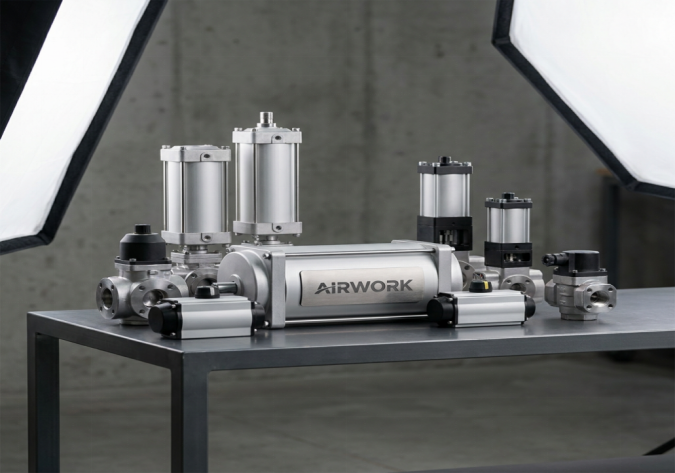
Introduction: The Strategic Core of Industrial Automation
In the rapidly evolving landscape of industrial automation, pneumatic systems remain the backbone of efficient manufacturing. For B2B buyers and procurement managers, selecting the right components—specifically pneumatic actuators and valves—is not just a technical requirement but a strategic investment. These components dictate the speed, precision, and energy efficiency of the entire production line.
This manual provides a deep dive into the essentials of these components, moving beyond the surface-level specs to explore the engineering nuances that ensure your production lines operate with maximum precision and minimum disruption. At AIRWORK (Zhejiang Jinzhi Pneumatic Technology Co., Ltd.), we believe that an informed buyer is our best partner.
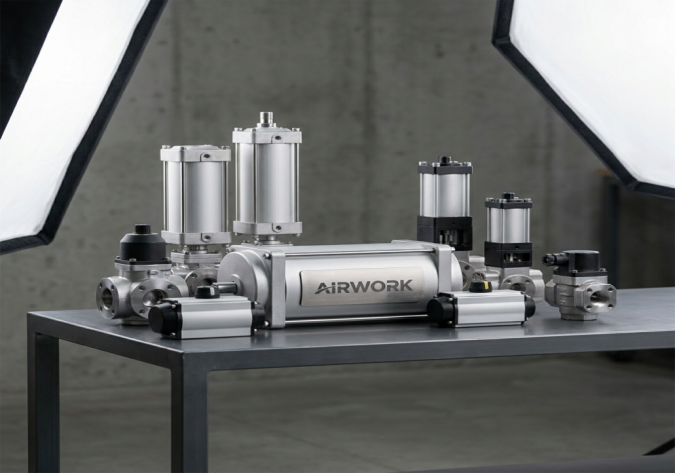
1. Pneumatic Actuators: The Muscle of the System
A pneumatic actuator is a device that converts the potential energy of compressed air into mechanical motion. For a B2B buyer, understanding the distinction between different types is crucial for matching the component to the application's specific physical requirements.
Linear Actuators (Pneumatic Cylinders)
Linear actuators provide straight-line motion. They are the most common type and include several specialized designs:
- Single-Acting Cylinders: These use air to move in one direction and an internal spring to return. They are ideal for simple, low-safety-risk tasks like clamping or ejection.
- Double-Acting Cylinders: These use air for both extension and retraction, offering full control and power in both directions. They are the 'Gold Standard' for most industrial automation tasks.
- Rodless Cylinders: Perfect for long-stroke applications where space is at a premium. Since the piston moves within the cylinder body length, they require 50% less space than a standard rod-style cylinder of the same stroke.
- Compact Cylinders (SDA/CQ2 Series): Designed for short strokes where space is extremely limited, such as in electronic assembly or textile machines.
Rotary Actuators
When an application requires a twisting or turning motion (e.g., opening a ball valve or rotating a robotic arm), rotary actuators are used. These typically come in Rack and Pinion or Vane designs, offering precise angular movement, often 90° or 180°.
2. Pneumatic Valves: The Brain of the Circuit
If actuators are the muscle, valves are the brain. They control the direction, flow rate, and pressure of the air, determining exactly when and how the actuators move.
Directional Control Valves (DCV)
These are categorized by their 'Ways' and 'Positions'. For example, a 5/2-Way Valve has five ports and two positions.
- 3/2-Way Valves: Used to control single-acting cylinders.
- 5/2-Way Valves: The standard for controlling double-acting cylinders.
- 5/3-Way Valves: Features a 'neutral' center position. This is critical for safety; if the power fails, a 5/3 valve can lock the cylinder in place (Closed Center) or allow it to move freely (Exhaust Center).
Actuation Methods
- Solenoid Operated: Controlled by an electrical signal. For B2B buyers, specifying the correct voltage (DC24V, AC110V, AC220V) and connector type (DIN or Lead Wire) is essential for system compatibility.
- Pilot-Operated: Uses a small air signal to move a larger spool. This is ideal for high-flow applications where a small solenoid wouldn't have the force to move the large internal spool.
- Manual/Mechanical: Operated by levers, buttons, or foot pedals. These are primarily used for setup, emergency stops, or simple manual machines.
3. Technical Specifications for Professional Selection
When reviewing a quote or a technical data sheet, look for these critical performance metrics:
1. Flow Rate (Cv or L/min): This determines how fast the air can fill the cylinder. A valve with too low a flow rate will cause your high-speed cylinder to crawl.
2. Pressure Range: Most standard components operate between 1.5 to 8 bar. High-pressure applications require specialized 'Heavy Duty' variants.
3. Duty Cycle: For high-volume factories, valves must be rated for 'Continuous Duty' (100% ED). This ensures the solenoid coils won't burn out during 24/7 operation.
4. Response Time: In high-speed sorting, a difference of 5 milliseconds in valve response time can be the difference between a successful sort and a system jam.
4. Industry Use Cases and System Integration
Use Case: Automotive Body Shop
In automotive welding lines, cylinders must exert massive force to hold steel panels in place. Here, ISO 15552 (DNC Series) cylinders are paired with high-flow 4V Series solenoid valves. The valves are often mounted in 'manifolds' to centralize control and simplify the electrical wiring of the robot.
Use Case: Pharmaceutical Packaging
In clean-room environments, the focus is on hygiene and air quality. Actuators are often made of stainless steel with food-grade lubricants. The valves are located in a 'dry' cabinet away from the washdown area, connected to the actuators by long runs of anti-microbial tubing.
5. B2B Selection Criteria: Moving from Price to Value
Procurement of pneumatic components should be based on the Total Cost of Ownership (TCO). A cheap valve that fails after 1 million cycles is far more expensive than a premium valve that lasts 50 million cycles.
- Interchangeability: Ensure the components follow ISO or VDMA standards. This prevents 'vendor lock-in' and makes it easier for your maintenance team to source parts globally.
- Certification and Compliance: Look for CE, RoHS, and ISO 9001:2015 certifications to ensure the products meet safety and quality standards.
- Technical Support: Does the supplier provide 3D CAD files? Can they help with the pneumatic circuit design? AIRWORK provides full engineering support to help our B2B clients optimize their designs.
Conclusion: Partnering for Automation Success
Understanding the synergy between actuators and valves is the key to building a high-performance pneumatic system. By selecting components that are not only high-quality but also perfectly matched to the application's technical demands, B2B buyers can ensure long-term reliability and efficiency. At AIRWORK, we are dedicated to providing the high-precision actuators and responsive valves that power modern industry. Whether you are building a new machine or retrofitting an existing line, our technical team is here to guide you toward the optimal pneumatic solution.
Table of Contents
- Introduction: The Strategic Core of Industrial Automation
- 1. Pneumatic Actuators: The Muscle of the System
- 2. Pneumatic Valves: The Brain of the Circuit
- 3. Technical Specifications for Professional Selection
- 4. Industry Use Cases and System Integration
- 5. B2B Selection Criteria: Moving from Price to Value
- Conclusion: Partnering for Automation Success