 EN
EN

Question: Troubleshooting 'Cylinder Stick-Slip' (Crawling) effect in low-speed automation workflows?
Answer: Troubleshooting pneumatic cylinder stick-slip (crawling) requires addressing the friction imbalance between the piston seals and the cylinder barrel wall. Stick-slip is characterized by jerky, staggered, or uneven motion when a cylinder operates at very low velocities (typically under 50 millimeters per second). This occurs because the static coefficient of friction is significantly higher than the dynamic coefficient of friction. The piston sticks, pressure builds up until it overcomes static friction, the piston slips forward rapidly, and then sticks again. To eliminate crawling, design engineers must implement meter-out flow controls, upgrade to specialized low-friction PTFE-based piston seals, apply high-performance fluorinated lubricants, and ensure perfect alignment to prevent mechanical binding.
Introduction: The Mystery of Jerky Cylinder Motion
In high-precision industrial automation, smooth and controlled movement is essential. Whether a machine is feeding a cutting tool, applying a delicate adhesive bead, or slowly positioning a delicate electronic component, consistency is key. However, when pneumatic cylinders are dialed down to run at slow speeds, they often exhibit a frustrating phenomenon known as stick-slip, or crawling.
Instead of a smooth glide, the piston rod moves in a series of tiny, violent jumps. This erratic behavior can ruin delicate processes, cause structural vibrations in the machine frame, accelerate mechanical wear, and shorten the operating lifespan of the cylinder. As a premier provider of advanced pneumatic systems, AIRWORK is dedicated to helping manufacturers understand the physics of stick-slip and implement robust solutions to ensure fluid, predictable linear motion.
The Physics of Stick-Slip: Static vs Dynamic Friction
To resolve stick-slip, we must look at the tribology (the study of friction, lubrication, and wear) of the piston and rod seals sliding against metal surfaces. Every elastomer-on-metal sliding interface has two distinct coefficients of friction:
- Static Friction (Breakaway Friction): The force required to initiate motion between two resting surfaces. At rest, the elastomer seal molecules microscopic-level weld or interlock with the microscopic peaks (asperities) of the metal barrel wall.
- Dynamic Friction (Sliding Friction): The force required to maintain motion once the surfaces are already sliding. This is always lower than static friction.
When a cylinder is commanded to move at a very slow speed, compressed air enters the cylinder chamber very slowly. The pressure builds up, but the piston does not move because the force is still lower than the static friction. During this period, the piston is stuck.
As the air continues to enter, the pressure eventually crosses the breakaway threshold. The static friction is broken, and the system instantly shifts to dynamic friction. Because dynamic friction is lower, the force generated by the accumulated compressed air is now much higher than what is needed to move the load. The piston suddenly slips forward. This rapid movement quickly expands the cylinder chamber volume, causing the internal pressure to drop instantly. As the pressure drops, the driving force falls below the static friction limit again, and the piston sticks once more.
This cycle of stick-slip-stick-slip repeats continuously, creating the staggered crawling motion. At high speeds, the inertial momentum of the piston and load easily carries the system past these transition phases, making stick-slip invisible. At low speeds, however, there is not enough momentum to overcome the friction transition, resulting in severe crawling.
Key Causes of Cylinder Stick-Slip in B2B Systems
Several design and environmental factors can trigger or worsen the stick-slip effect in low-speed workflows:
- High Seal Pre-Load and Tension: To prevent external and internal leakage, standard cylinder seals are designed with a high radial pre-load. This means the seal lip is pressed tightly against the cylinder barrel. While excellent for high-pressure holding, this high radial force drastically increases breakaway friction.
- Loss of Lubrication: Over time, compressed air containing moisture can wash away the factory grease inside the cylinder barrel. If the cylinder runs dry, the metal-on-elastomer contact is direct, sending breakaway friction skyrocketing.
- Incorrect Flow Control Configuration: Controlling a cylinder's speed by regulating the air entering the cylinder (meter-in control) is a common mistake. Because there is no backpressure on the exhaust side to stabilize the piston, the cylinder is highly susceptible to stick-slip.
- Mechanical Misalignment: If the cylinder is slightly misaligned with the external linear guides, the piston rod will experience side loads. This forces the piston sideways, causing high localized contact pressure on one side of the seal, multiplying static friction.
Step-by-Step Engineering Solutions to Eliminate Crawling
By systematically applying these engineering techniques, you can successfully eliminate stick-slip and restore ultra-smooth low-speed performance:
- Solution 1: Implement Meter-Out Flow Controls. Always control cylinder speed by regulating the exhausting air (meter-out) rather than the incoming air (meter-in). Meter-out flow control maintains a constant, stable backpressure in the exhaust chamber. This backpressure acts as an adjustable pneumatic cushion, resisting sudden jumps and damping any slip tendencies, keeping the piston motion stable.
- Solution 2: Specialize in Low-Friction Seals. For low-speed workflows, standard polyurethane or nitrile seals are inadequate. Design engineers should specify AIRWORK cylinders equipped with low-friction seal kits. These kits utilize Glyd Rings made from PTFE (Teflon) compounds energized by standard NBR O-rings. PTFE has an incredibly low coefficient of friction, and its static and dynamic friction coefficients are nearly identical, which mechanically eliminates the physics behind stick-slip.
- Solution 3: Re-Lubricate with Specialty Fluorinated Grease. Standard lithium or silicone greases can fail under slow, high-friction conditions. Re-lubricating the cylinder bore with premium fluorinated greases (such as PFPE-based lubricants) provides a highly stable, long-lasting lubricating film that resists washing out and lowers breakaway friction.
- Solution 4: Optimize Air Quality and Pressure. Fluctuations in supply pressure can worsen stick-slip. Ensure the system is powered by a stable, well-regulated air supply using a high-precision AIRWORK Filter-Regulator. Additionally, dry air can accelerate seal drying, so a mist lubricator should be considered if standard seals are used.
- Solution 5: Use external slide guides. Ensure the cylinder rod is not absorbing side loads. Use self-aligning couplers and high-quality linear guide rails to keep the cylinder moving in a perfectly straight, frictionless axis.
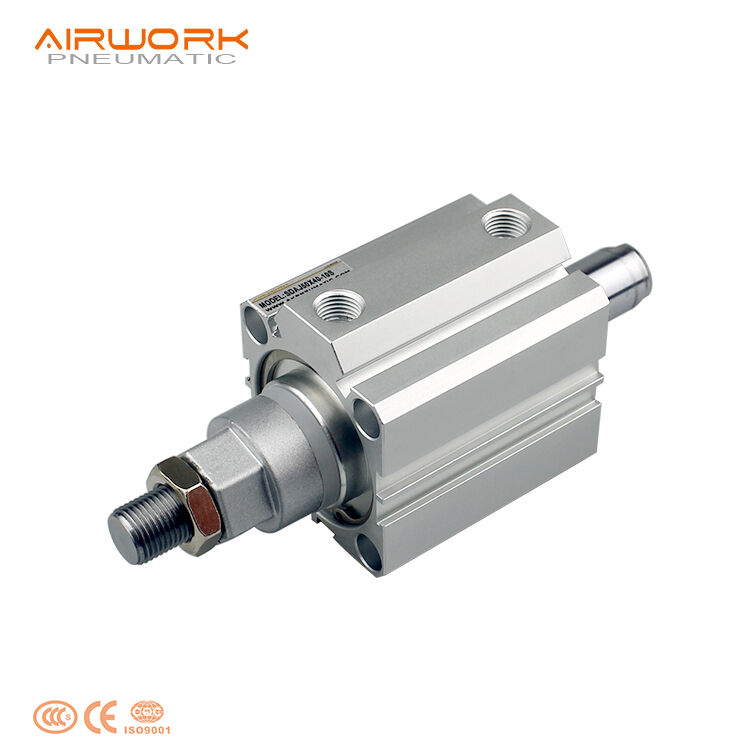
AIRWORK Low-Friction Pneumatic Cylinder Series
AIRWORK offers a dedicated range of low-friction, high-smoothness cylinders engineered specifically for delicate low-speed automation. Our cylinders feature micro-honed aluminum barrels with a surface roughness (Ra) of under 0.2 microns and are assembled with premium low-friction PTFE energized seals and specialized high-stability lubricants.
Conclusion: Achieve Precision Control with AIRWORK
Cylinder stick-slip is a common physical challenge in low-speed automation, but it is entirely solvable. By adopting meter-out speed regulation, utilizing low-friction PTFE seals, and ensuring perfect mechanical alignment, machine builders can achieve smooth, crawling-free linear motion.
Visit jzpnu.com today to explore our specialized low-friction cylinder configurations, download technical application notes, and consult with our motion control experts.
Table of Contents
- Question: Troubleshooting 'Cylinder Stick-Slip' (Crawling) effect in low-speed automation workflows?
- Introduction: The Mystery of Jerky Cylinder Motion
- The Physics of Stick-Slip: Static vs Dynamic Friction
- Key Causes of Cylinder Stick-Slip in B2B Systems
- Step-by-Step Engineering Solutions to Eliminate Crawling
- AIRWORK Low-Friction Pneumatic Cylinder Series
- Conclusion: Achieve Precision Control with AIRWORK