 EN
EN

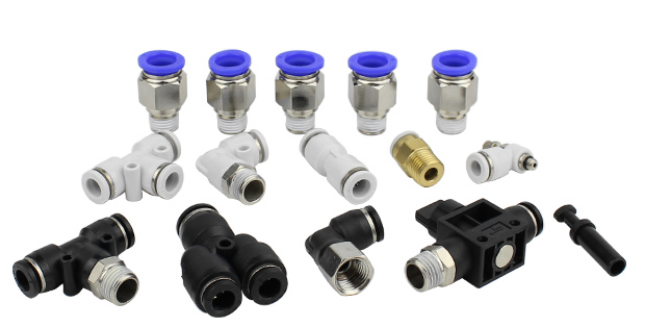
Introduction: The Critical Links in Pneumatic Circuits
In any pneumatic circuit, the fittings are the critical links that hold the entire system together. While they may seem like small, inexpensive components, the choice of a pneumatic fitting can dictate the reliability, safety, and leak-free operation of an entire industrial machine. A single failed fitting can halt a million-dollar production line. For B2B buyers and engineers, understanding the nuances of materials, thread standards, and application-specific designs is essential for making informed wholesale purchasing decisions.
At AIRWORK (Zhejiang Jinzhi Pneumatic Technology Co., Ltd.), we manufacture a vast array of fittings that meet global standards. This guide provides the technical depth required for professional procurement and engineering selection.
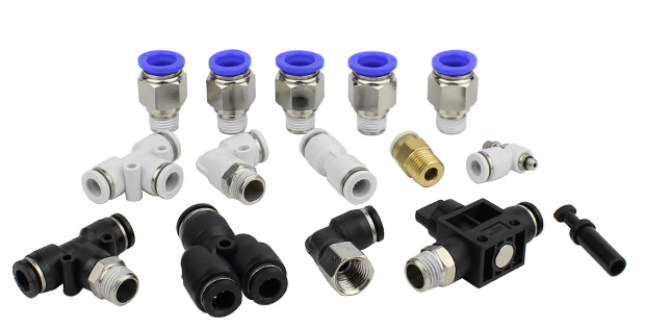
1. Material Science in Pneumatic Fittings
The environment in which your machinery operates will largely determine the material of the fittings you should select. At AIRWORK, we categorize fittings into three primary material groups based on their mechanical and chemical resistance properties.
Composite & Plastic 'Push-to-Connect' Fittings
These are the most common fittings found in general industrial automation. Typically made from high-strength PBT (Polybutylene terephthalate) bodies with nickel-plated brass threads and stainless steel gripping claws.
- Advantages: Lightweight, cost-effective, and tool-free installation. They are ideal for applications requiring rapid assembly and frequent reconfiguration.
- Technical Specs: Working pressure up to 1.0 MPa (10 bar), temperature range 0°C to 60°C.
- Best For: Electronics assembly, textile machinery, and general packaging lines.
Nickel-Plated Brass Fittings
For applications requiring higher mechanical strength and resistance to moderate heat or vibration, nickel-plated brass is the industry standard. These fittings offer superior durability compared to plastic.
- Advantages: Excellent corrosion resistance, higher pressure ratings (up to 1.5 MPa), and resistance to 'tube pull-out' in high-vibration environments.
- Technical Specs: Temperature range up to 80°C or higher depending on the seal material.
- Best For: Automotive assembly lines, heavy machinery, and machine tool manufacturing.
Stainless Steel (304/316) Fittings
In harsh or specialized environments, stainless steel is non-negotiable. These fittings are built for longevity in extreme conditions.
- Advantages: Resistance to aggressive cleaning chemicals, high temperatures (up to 200°C with FKM seals), and high-pressure washdowns.
- Best For: Food and beverage processing (hygienic design), pharmaceutical manufacturing, and marine/offshore applications.
2. Navigating the World of Global Thread Standards
One of the biggest challenges for global B2B buyers is the lack of a single universal thread standard. Using the wrong thread can lead to leaks, stripped threads, and machine damage. AIRWORK supports all major international standards:
G Thread (BSPP - British Standard Pipe Parallel)
- Geometry: Parallel threads with a 55° flank angle.
- Sealing: Requires an O-ring or a flat gasket to seal against a flat face. Most common in European and Asian machinery.
- Advantage: Reusable without losing sealing integrity; easy to orient (e.g., aiming an elbow fitting).
R Thread (BSPT - British Standard Pipe Tapered)
- Geometry: Tapered threads (1:16 taper) with a 55° flank angle.
- Sealing: Sealing occurs on the threads themselves, often requiring PTFE tape or thread sealant.
- Advantage: Self-sealing and very secure under high pressure.
NPT Thread (National Pipe Tapered)
- Geometry: North American standard tapered threads with a 60° flank angle.
- Warning: NPT and BSPT threads look similar but are not interchangeable due to the different flank angles (60° vs 55°). Forcing them together will cause a leak and destroy the threads.
3. Specialized Fittings for Advanced Applications
Beyond standard connectors, several specialized fittings are essential for optimizing pneumatic performance:
- Speed Controllers (Flow Controls): These allow engineers to adjust the speed of a cylinder's extension and retraction independently. AIRWORK’s meter-out controllers are standard for preventing 'piston lunging'.
- Hand Valves & Check Valves: Integrated directly into the fitting body to allow for manual shutoff or one-way air flow, simplifying circuit design and reducing the number of components.
- Rotary Fittings: Designed for applications where the tubing must rotate during operation (e.g., on a robotic wrist or a rotating table) to prevent tubing kinks and fatigue.
4. B2B Selection Criteria and Procurement Strategy
When purchasing wholesale pneumatic fittings, professional buyers should look beyond the per-unit price. The 'Total Cost of Leakage' is far higher than the cost of a premium fitting.
Quality Indicators to Watch For:
1. Seal Quality: Ensure the O-rings are made of high-grade NBR or Viton. Low-quality rubber will crack over time, leading to micro-leaks.
2. Gripping Claw Design: The internal claw should be stainless steel to ensure a firm grip on various tubing materials (PU, Nylon, PE) without scoring the tube too deeply.
3. Finish Consistency: High-quality nickel plating should be uniform and free of burrs, which can damage seals during installation.
Strategic Wholesale Sourcing:
- Standardization: Try to standardize on one thread type (e.g., G-thread with O-rings) across your facility to reduce inventory complexity.
- Bulk Packaging: Look for suppliers that offer industrial-sized packaging (100 or 500 pcs per bag) to reduce waste and shipping costs.
- Technical Documentation: A reliable supplier like AIRWORK provides full CAD models, helping your design engineers integrate fittings into their 3D assemblies accurately.
Conclusion: The Reliability is in the Details
Pneumatic fittings may be the smallest parts of your automation system, but they carry the heavy responsibility of maintaining pressure and preventing waste. By selecting the right materials for your environment and ensuring thread compatibility with global standards, you build a foundation for long-term reliability. At AIRWORK, we combine decades of manufacturing expertise with a commitment to quality, ensuring that every fitting we ship meets the rigorous demands of modern industry. Whether you are an OEM building new machinery or a distributor servicing the MRO market, our fittings are engineered to keep the air flowing and the production lines moving.