 EN
EN

Q: What is the trend of miniaturization in pneumatics, and why is it so critical for the development of modern medical devices?
In the medical device industry, there is a powerful and continuous shift toward portability, home-based healthcare, and wearable patient-care systems. Patients and healthcare providers are moving away from bulky, stationary hospital bedside machines in favor of lightweight, battery-powered devices that allow patients to maintain their mobility, continue their therapy at home, and improve their overall quality of life. Typical examples include portable oxygen concentrators (POCs), mini-ventilators, compression therapy devices, wound therapy systems, surgical hand tools, and automated diagnostic blood analyzers.
To make these portable devices a reality, the internal mechanical and pneumatic control systems must undergo a radical downsizing. This is where 'miniaturization' in pneumatics comes into play. Traditional industrial pneumatic components—designed for high force and heavy factory machinery—are completely unsuitable for medical hardware. They are too heavy, consume too much electricity, and are too large to fit within compact, hand-held, or wearable enclosures.
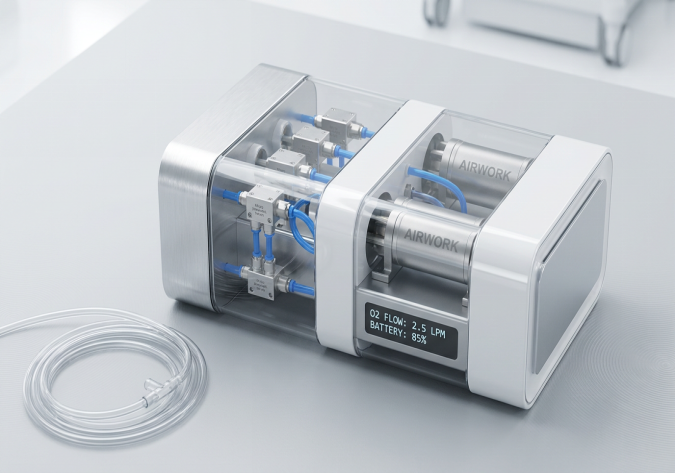
Miniaturization in pneumatics involves engineering micro-scale pneumatic components—such as micro solenoid valves, miniature pressure regulators, tiny diaphragm pumps, and ultra-compact air filters—that deliver the same, or even better, precision and reliability as their large industrial counterparts. For medical R&D engineers, sourcing micro-pneumatics is the key to unlocking the potential of next-generation healthcare technology, enabling devices that are small enough to be carried in a shoulder bag or worn on a belt. Without micro-pneumatics, modern home-care ventilators and portable oxygen therapy systems would not exist.
Q: What are the primary engineering and design challenges associated with miniaturizing pneumatic components for portable medical devices?
Designing micro-pneumatic components for life-critical, battery-powered medical devices is a complex task. Simply shrinking the physical size of a standard industrial valve is not enough. R&D engineers must overcome several interconnected physical and performance challenges:
- Severe Space and Weight Constraints: Every millimeter and gram matters in a portable device. Micro-valves must have a physical footprint measured in millimeters and weigh only a few grams, allowing them to be packed tightly on complex, integrated manifolds inside compact plastic enclosures. Reducing the weight of the valve block direct decreases the burden on patients carrying the device.
- Strict Power Budget (Battery Optimization): Portable devices rely on lithium-ion batteries. To maximize the device's operational run-time on a single charge (ideally lasting 4 to 8 hours), micro-valves must operate with extremely low power consumption. Standard valves require several Watts of electricity, while medical micro-valves must operate on milliwatts (often 0.5 Watts or less) to prevent rapid battery drain.
- High Flow Rates at Low Pressures: Despite their tiny physical size, micro-valves must still deliver sufficient air or oxygen flow rates to meet the physiological needs of patients. Achieving a high flow-to-size ratio requires sophisticated internal flow geometry and highly efficient magnetic solenoid circuits.
- Silent and Vibration-Free Operation: A portable oxygen concentrator or therapy device worn by a patient must operate quietly, especially when the patient is sleeping or in public spaces. Traditional solenoid valves produce loud mechanical clicks and vibrations as they switch. Micro-pneumatics must incorporate specialized sound-damping materials, friction-free designs, and soft-closing armatures to keep audible noise below 30 decibels (dBA).
- High Reliability and Longevity: Portable devices are subjected to continuous movement, vibration, and accidental drops. The micro-pneumatic components must perform flawlessly for tens of millions of cycles, ensuring patient safety and minimizing product return and warranty costs for medical device OEMs.
Q: How has AIRWORK engineered its micro-pneumatic portfolio to address these demanding medical requirements?
To meet the exacting demands of the medical device industry, AIRWORK has developed a state-of-the-art line of micro-pneumatic components that leverage advanced materials, precision machining, and innovative magnetic designs:
- Ultra-Low Power Solenoid Micro-Valves: AIRWORK's micro solenoid valves operate with a nominal power consumption of just 0.3 to 1 Watt. By utilizing advanced magnetic simulation software, we have optimized the solenoid coil's winding density and pole design to maximize the magnetic pull force while minimizing current draw, preventing battery drain and localized heating.
- Compact Integrated Manifold Solutions: Rather than connecting micro-valves using external tubes and fittings, which increases weight and the risk of leaks, AIRWORK designs customized, integrated sub-manifolds made of lightweight materials like polyether ether ketone (PEEK) or hard-anodized aluminum. These manifolds incorporate internal air passages, allowing valves, sensors, and regulators to mount directly on a single block, reducing total weight and size by up to 60%.
- Frictionless and Silent Switching Technology: AIRWORK's micro-valves utilize specialized flat-spring armatures and elastomeric seats. This eliminates sliding wear and prevents the hard metal-on-metal impacts that cause clicking noises. This design ensures silent operation (under 30 dBA) and extends the valve's service life to over 100 million cycles.
- Bio-Compatible and Outgassing-Free Materials: All medical-grade micro-valves are manufactured in cleanroom environments using FDA-approved, medical-grade materials that do not release microscopic particles or harmful chemical vapors into the patient's breathing gas, ensuring complete clinical safety.
Q: What should B2B procurement managers and R&D engineers consider when sourcing micro-pneumatics for medical device manufacturing?
Sourcing pneumatic components for medical device manufacturing requires a strict evaluation process that goes beyond standard cost metrics. Procurement managers must prioritize the following factors:
- Medical Quality Certifications: Ensure that the supplier operates under a certified ISO 13485 quality management system, which is mandatory for medical device component manufacturing and guarantees full material traceability.
- Co-Engineering and Customization Capabilities: Standard components rarely fit the unique spatial, flow, and electrical requirements of a new medical device. Sourcing from an engineering-driven partner like AIRWORK ensures that you have access to dedicated R&D resources to design custom manifolds, specify custom flow curves, and run specialized validation testing.
- Scalability and Quality Control: Choose a supplier with the capacity to scale up production from initial prototype runs to high-volume commercial manufacturing while maintaining 100% individual component inspection and serialization.
By partnering with AIRWORK, medical device OEMs can accelerate their time-to-market, achieve industry-leading energy efficiency, and deliver next-generation portable therapies that improve patient outcomes and transform the future of home-based and mobile healthcare.
Table of Contents
- Q: What is the trend of miniaturization in pneumatics, and why is it so critical for the development of modern medical devices?
- Q: What are the primary engineering and design challenges associated with miniaturizing pneumatic components for portable medical devices?
- Q: How has AIRWORK engineered its micro-pneumatic portfolio to address these demanding medical requirements?
- Q: What should B2B procurement managers and R&D engineers consider when sourcing micro-pneumatics for medical device manufacturing?