 EN
EN

Q: How do you detect 'Compressed Air Leaks' using ultrasonic vs. soap-bubble methods, and which is better for industrial plants?
Introduction: The Massive Cost of Silent Leaks
In modern manufacturing, compressed air is often referred to as the 'fourth utility' because of its widespread use in powering automation machinery. However, unlike electricity, water, or natural gas, compressed air is generated on-site, making it highly expensive. The US Department of Energy estimates that the average industrial facility loses 20 to 30 percent of its total compressed air capacity through leaks. In a facility running a 100-horsepower compressor, this waste can translate to over 10,000 USD in wasted electricity bills every single year.
Furthermore, air leaks cause system pressure to drop, forcing actuators to run slowly and reducing production output. Identifying and repairing these leaks is the fastest way to lower plant energy costs and improve machine performance. In the maintenance sector, technicians rely on two main diagnostic methods: the traditional soap-bubble method and the modern ultrasonic leak detection method.
This guide provides an in-depth comparison of both methods, highlighting their operating principles, pros and cons, and strategic implementation guidelines.
1. The Soap-Bubble Method: The Classic Pinpoint Test
The soap-bubble method is the oldest and simplest way to detect pneumatic leaks. It is a highly localized, physical inspection technique:
- How It Works: A technician mixes a concentrated solution of liquid soap or specialized leak-detection surfactant with water. Using a spray bottle, squeeze bottle, or brush, they apply this solution directly to suspected leak points, such as fitting joints, valve manifolds, thread connections, or tubing crimps. If compressed air is escaping, it physically inflates the liquid film, creating a cluster of visible bubbles. Larger leaks create rapid foaming, while micro-leaks produce a slow, steady expansion of fine bubbles.
- The Advantages: The primary benefit is cost-efficiency; the materials required cost virtually nothing. It requires zero technician training and is incredibly accurate at pinpointing the exact micro-location of a leak down to the millimeter, allowing the maintenance tech to know exactly which fitting needs tightening or replacement.
- The Disadvantages: This method is highly labor-intensive and slow. A technician must physically walk up to every single fitting and spray it, which is impossible for overhead lines, piping hidden inside machine enclosures, or tubes running behind protective barriers. It is also dirty and can create slipping hazards on factory floors. Additionally, applying water-based solutions to electrical solenoid valves or hot machinery surfaces is dangerous and can cause short-circuits or corrosion.
2. The Ultrasonic Leak Detection Method: High-Tech Acoustic Scanning
Ultrasonic leak detection is a modern, non-contact diagnostic method that uses acoustic science to find leaks from a distance:
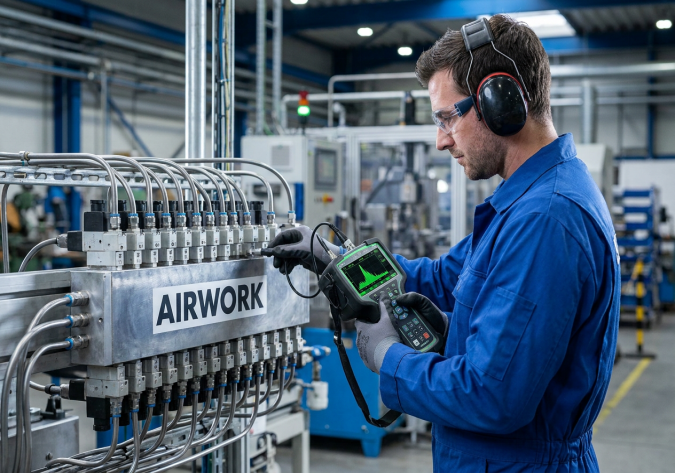
- How It Works: When compressed air escapes through a leak hole, it transitions from a high-pressure zone to a lower-pressure zone. This rapid transition creates a highly turbulent flow that generates high-frequency sound waves, specifically in the ultrasonic range between 38 kilohertz and 42 kilohertz. These high-frequency sound waves are completely silent to the human ear. An ultrasonic leak detector captures these high-frequency vibrations using a directional microphone, filters out low-frequency factory background noise (such as motors and exhaust fans), translates the signal into an audible tone in the technician's headphones, and displays the decibel strength on a digital screen. By sweeping the room with the detector, the technician can follow the sound peak to locate the leak.
- The Advantages: Ultrasonic scanning is incredibly fast and efficient. A single technician can scan a massive factory floor containing thousands of fittings in a few hours without touching the machinery. It works from a safe distance (up to 15 meters away), allowing the operator to scan overhead air lines, hazardous robotic cells, and moving machinery while the plant is in full operation. Since it filters out standard low-frequency industrial noise, the scan can be conducted during a busy production shift.
- The Disadvantages: The initial hardware cost is high; professional industrial ultrasonic leak detectors range from 1,000 USD to over 5,000 USD. It also requires some training for the technician to learn how to distinguish a real air leak from other ultrasonic noises, such as the natural friction of sliding metal or the electrical hum of high-voltage transformers.
3. Comprehensive Comparison: Soap-Bubble vs. Ultrasonic
To help maintenance managers select the right diagnostic tool, let us compare their primary operational characteristics:
- Feature: Soap-Bubble Method / Ultrasonic Detection Method
- Initial Capex: Negligible (under 10 USD) / High (1,000 to 5,000 USD)
- Sourced Range: Direct contact only / Long range (up to 15 meters)
- Detection Speed: Extremely slow and tedious / Rapid facility-wide scanning
- Operational Safety: Requires climbing ladders and touching hot parts / Safe non-contact scanning from ground level
- Factory Noise Interference: None / Filters background noise; highly effective
- Precision: Pinpoints exact leak point down to the millimeter / Identifies general area; requires close-range sweep to locate exact joint
4. The Ideal Hybrid Air-Leak Management Program
For optimal plant efficiency, maintenance leads should not rely on just one method. Instead, implement a highly structured hybrid leak management program consisting of three steps:
- Step 1: Broad Ultrasonic Auditing. Once every quarter, have a technician walk the entire facility during full production with an ultrasonic leak detector. Identify the locations of all leaks and mark them with high-visibility physical tags, noting the severity based on decibel readings.
- Step 2: Localized Soap-Bubble Verification. During scheduled weekend maintenance shutdowns, send a technician to the tagged areas. Use the soap-bubble spray to pinpoint the exact joint or fitting that is leaking (such as an unthreaded elbow or worn push-in claw).
- Step 3: Repair and Re-Verify. Replace the leaking component with a premium, leak-free fitting, and spray the connection again to confirm that the bubble formation has stopped completely.
5. Preventing Leaks at the Source: The JZPNU AIRWORK Solution
While finding leaks is critical, preventing them from occurring in the first place is the most cost-effective strategy. Zhejiang Jinzhi Pneumatic Technology Co., Ltd. (JZPNU) manufactures a premium line of leak-free pneumatic components under our AIRWORK brand, specifically engineered to eliminate leak paths:
- High-Tolerance Push-In Fittings: Our composite fittings feature high-grade stainless steel lock claws that hold tubing firmly, preventing the micro-vibrations that wear down internal seals and create micro-leaks.
- Pre-Applied Thread Sealants: All AIRWORK male threads feature pre-applied Teflon sealant coatings, eliminating the human error of applying tape unevenly on the assembly line.
- Dual-Seal Pneumatic Cylinders: Our DNC and MA series cylinders utilize premium NOK (Japan) seals with dual-lip profiles, ensuring a zero-leak piston rod seal over millions of cycles.
Conclusion: Strategic Sourcing Recommendations
Compressed air leaks are a silent drain on industrial profitability. Sourcing directors and plant managers can quickly reduce energy costs and improve machine reliability by establishing a regular leak detection program. By combining the speed of ultrasonic auditing with the precision of soap-bubble testing, and standardizing on premium, high-tolerance components from a world-class manufacturer like JZPNU, factories can eliminate air waste and achieve massive operational savings. Contact JZPNU's technical support department today to request leak-resistant AIRWORK fitting samples and technical specs.
Table of Contents
- Q: How do you detect 'Compressed Air Leaks' using ultrasonic vs. soap-bubble methods, and which is better for industrial plants?
- Introduction: The Massive Cost of Silent Leaks
- 1. The Soap-Bubble Method: The Classic Pinpoint Test
- 2. The Ultrasonic Leak Detection Method: High-Tech Acoustic Scanning
- 3. Comprehensive Comparison: Soap-Bubble vs. Ultrasonic
- 4. The Ideal Hybrid Air-Leak Management Program
- 5. Preventing Leaks at the Source: The JZPNU AIRWORK Solution
- Conclusion: Strategic Sourcing Recommendations