 EN
EN

Q: How do you select specialized Stainless Steel pneumatic components for FDA-compliant Food and Beverage environments?
Introduction: The Strict Standards of Food and Beverage Processing
In the food and beverage (F&B) industry, automation equipment faces some of the most punishing operational environments on Earth. Machines must operate with absolute precision while being subjected to daily high-pressure washdowns with aggressive caustic chemicals, extreme temperature swings, and constant exposure to organic acids and moisture. Standard pneumatic components made of anodized aluminum or standard plastics degrade rapidly in these conditions, risking mechanical failure and food contamination.
For B2B procurement managers and system engineers, sourcing pneumatics for F&B applications is not just about mechanical performance; it is about regulatory compliance and public safety. Sourcing components that carry FDA compliance and are constructed from high-grade stainless steel is essential to ensure long-term uptime and protect against product recalls.
This guide explains how to properly select and verify specialized stainless steel pneumatic components, with a focus on material science, sealing technologies, and sanitary design principles.
1. Material Science: Selecting the Correct Grade of Stainless Steel
Not all stainless steels are created equal. When selecting pneumatic actuators, fittings, and control valves, the choice of material depends on the operational zone within the facility.
- SUS304 (AISI 304) Stainless Steel: This grade offers excellent corrosion resistance and is highly cost-effective. It is ideal for the 'Non-Contact Zone' or 'Splash Zone'—areas where food or beverages may splash onto the equipment but will not return to the main product stream. SUS304 is commonly used for cylinder end caps, mounting brackets, and external structural panels.
- SUS316 and SUS316L (AISI 316/316L) Stainless Steel: This grade contains molybdenum, which dramatically improves resistance to chloride-induced pitting corrosion (caused by salt and sanitizing agents like chlorine and sodium hypochlorite). SUS316/316L is the absolute standard for the 'Food Contact Zone'—areas where components directly touch food products. It is highly recommended for pneumatic grippers, nozzle actuators, and process valves.
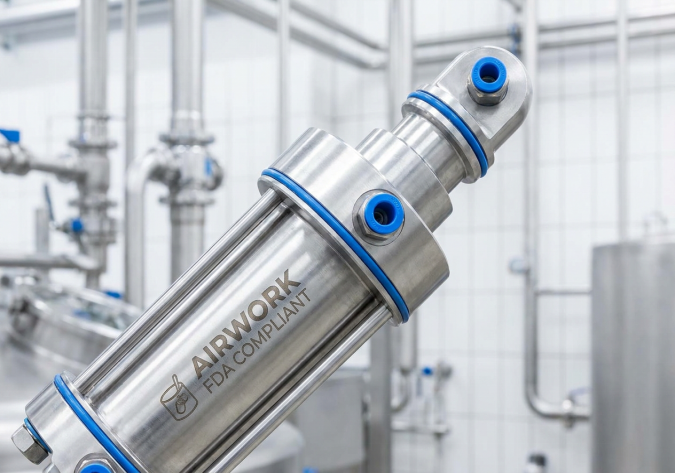
At JZPNU, our premium AIRWORK F&B line utilizes SUS316 for all critical fluid-contacting surfaces to guarantee maximum safety and durability.
2. Sanitary Design Principles: Eliminating Bacteria Traps
In food processing, bacteria growth is a major risk. Traditional pneumatic cylinders feature tie-rods, deep crevices, exposed screw threads, and sharp corners. These features act as physical traps where organic matter and bacteria can accumulate, defying standard washdown procedures.
When sourcing specialized pneumatic cylinders, look for sanitary design features:
- Smooth Profile Tubing: Round-body or smooth-profile cylinders (such as the JZPNU MA series mini cylinders) prevent water and food particles from pooling on the cylinder body.
- Crevice-Free Joints: Laser-welded or integrated end caps eliminate the micro-gaps where bacteria can hide.
- Laser-Marked Labeling: Traditional adhesive labels or plastic nameplates will peel under high-temperature washdowns, creating perfect bacterial breeding grounds. All AIRWORK stainless steel components feature laser-etched identification directly on the metal surface, which remains legible and sterile throughout the component's lifespan.
3. Advanced Sealing Technology: Withstanding Washdowns and Thermal Shock
Seals are the most vulnerable part of any pneumatic system. In F&B processing, seals must withstand clean-in-place (CIP) and sterilization-in-place (SIP) cycles, which involve steam temperatures up to 130 degrees Celsius and exposure to chemical sanitizers.
- Fluororubber (FKM / Viton): This high-performance elastomer is standard in AIRWORK F&B cylinders. It offers exceptional resistance to high temperatures, aggressive chemicals, and ozone, ensuring the cylinder maintains its sealing integrity under severe thermal shock.
- Food-Grade Nitrile (NBR): For applications with lower temperature requirements, food-grade NBR is used, providing excellent wear resistance and flexibility.
- FDA-Approved Polyurethane (PU): Used for heavy-duty wiping seals on piston rods to physically scrape sticky food residue (like syrup, dough, or fat) off the rod during the retraction stroke, protecting the internal primary seals from abrasion.
4. Food-Grade Lubricants (NSF H1 Registration)
Inside every pneumatic cylinder and solenoid valve is a layer of mechanical grease designed to minimize friction and extend seal life. In standard pneumatics, this grease contains petroleum-based compounds that are highly toxic. If a seal fails, there is a risk that this toxic lubricant can leak onto the food product.
For FDA compliance, all internal lubricants used in F&B pneumatic components must be NSF H1 registered. NSF H1 lubricants are non-toxic, odorless, tasteless, and certified for 'incidental food contact.' This means that in the rare event of a minor seal leak, the food product remains safe for consumption, preventing catastrophic product recalls.
JZPNU's factory assembly process for food-grade components uses strictly certified NSF H1 synthetic grease, ensuring full compliance with FDA 21 CFR regulations.
5. Ingress Protection (IP Ratings) for Electrical Components
Pneumatic systems do not operate in isolation; they are controlled by electrical solenoid valves. These electrical parts are highly sensitive to water penetration.
- IP67 Rating: Suitable for standard damp environments, protecting against temporary immersion in water.
- IP69K Rating: The gold standard for F&B processing. IP69K-rated solenoid valves and valve manifolds are designed to withstand close-range, high-pressure (up to 100 bar), and high-temperature (80 degrees Celsius) washdown jets. These valves feature robust stainless steel enclosures and specialized hygienic cable connectors, eliminating the need to house the valves in bulky, expensive external protective cabinets.
6. Sourcing From a Certified Manufacturer: The JZPNU Advantage
When sourcing stainless steel pneumatics from China, B2B buyers must partner with a manufacturer that understands international sanitary standards and implements strict quality control. Zhejiang Jinzhi Pneumatic Technology Co., Ltd. (JZPNU) offers specialized OEM and ODM services for the global food and beverage sector through our AIRWORK brand:
- Material Traceability: We provide material test certificates (MTRs) confirming the exact chemical composition of our SUS304 and SUS316 stainless steel components.
- FDA Compliance: Our food-grade seals, tubing, and lubricants are fully compliant with FDA guidelines, complete with third-party testing documentation.
- Customization: We can customize cylinder strokes, mounting styles, and sealing packages to match the precise requirements of your processing machinery, offering lead times that are significantly shorter than traditional Western brands.
Conclusion: Strategic Sourcing Recommendations
Sourcing pneumatic components for food and beverage automation requires a strict focus on FDA compliance, materials engineering, and sanitary design. By shifting from standard aluminum to JZPNU's specialized AIRWORK stainless steel components, food plants can extend component lifespans from months to years, dramatically reduce maintenance overhead, and ensure absolute safety for end-consumers. For your next automated F&B line, request a comprehensive technical quote from JZPNU's specialized hygienic engineering department.
Table of Contents
- Q: How do you select specialized Stainless Steel pneumatic components for FDA-compliant Food and Beverage environments?
- Introduction: The Strict Standards of Food and Beverage Processing
- 1. Material Science: Selecting the Correct Grade of Stainless Steel
- 2. Sanitary Design Principles: Eliminating Bacteria Traps
- 3. Advanced Sealing Technology: Withstanding Washdowns and Thermal Shock
- 4. Food-Grade Lubricants (NSF H1 Registration)
- 5. Ingress Protection (IP Ratings) for Electrical Components
- 6. Sourcing From a Certified Manufacturer: The JZPNU Advantage
- Conclusion: Strategic Sourcing Recommendations