 EN
EN


Basic knowledge of pneumatic air cylinders
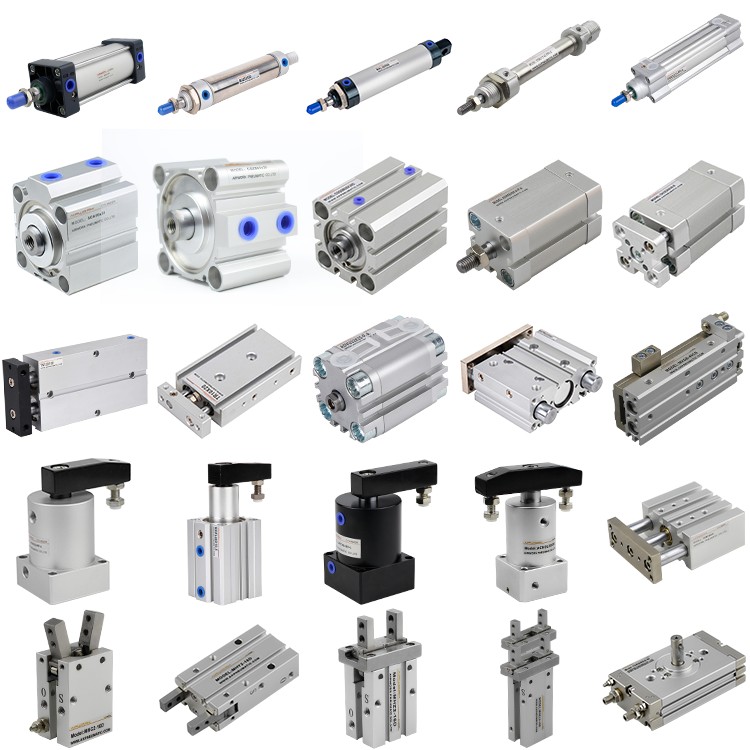
Pneumatic cylinders are pneumatic actuators that convert the pressure energy of compressed air into linear reciprocating motion, oscillating, or rotational mechanical energy. With advantages such as simple structure, low cost, convenient maintenance, safety, cleanliness, and fast response, they have become the most widely used power components in automated equipment, machinery, and tooling fixtures. Different cylinder structures and specifications are suited to vastly different working scenarios. This article systematically introduces the main types of cylinders and their precise selection and application in corresponding scenarios.
I. Main Types of Pneumatic Cylinders
Cylinders can be categorized into several types based on their structure, function, and installation method. The mainstream and commonly used types in industry are as follows:
1. Standard Cylinders (SC/SU/DNC Series)
The most common type of cylinder, available in single-acting and double-acting versions. The cylinder body is made of round aluminum alloy. They offer high output, a wide stroke range, and high cost-effectiveness, making them a basic type for automation equipment.
2. Mini Cylinders (MA/MAL Series)
With a small diameter and lightweight design, they are suitable for applications with limited space and low output requirements. They offer flexible installation and are often used in small mechanisms and lightly loaded equipment.
3. Thin-Type Cylinders (SDA/CQ2 Series)
With extremely short axial dimensions and a flat structure, they are suitable for equipment with extremely limited installation space and compact requirements, such as clamps, molds, and small pressing mechanisms.
4. Finger Cylinders (Pneumatic Grippers/MHZ/MHC Series)
Simulate human hand gripping motions. Available in parallel grippers, wide grippers, rotary grippers, and Y-grips, specifically designed for grasping, handling, and clamping workpieces.
5. Slide Cylinders (MXS/HLS Series)
Equipped with precision guide rails and slides, offering high motion accuracy and no lateral offset. Suitable for high-precision feeding, positioning, transfer, and cutting operations.
6. Rotary Cylinders (Oscillating Cylinders/MSQ/CRQ Series)
Output angular rotational motion, commonly 90°, 180°, 270°, and 360°. Used for flipping, turning, indexing, and opening/closing operations.
7. Rodless Cylinder (CY1L/CY3R Series)
Eliminates the traditional piston rod, saving installation length. Offers a long stroke and high speed, suitable for long-distance handling, transfer, and door opening/closing.
8. Blocking Cylinder (TTG/WS Series)
Specifically designed for blocking workpieces on production lines. Strongly withstands impact and provides stable cushioning. Widely used in assembly lines and double-speed chain conveyors.
9. Stainless Steel Waterproof Cylinder
Made of corrosion-resistant material, it is sealed and waterproof, suitable for harsh environments such as dampness, immersion, washing, and applications in food and pharmaceutical industries.
10. Multi-Position Cylinder Achieves multi-stage stroke positioning.
One cylinder completes multiple pauses, meeting the needs of complex step-by-step actions.
II. Typical Application Scenarios for Different Cylinders
1. Standard Cylinder
Application Scenarios: Automated equipment pushing, ejecting, pressing, lifting, and clamping; assembly line blocking; packaging machine sealing; injection molding machine part removal; general mechanical power actuation.
Features: High versatility, large load capacity, low cost, meeting the needs of most conventional linear power applications.
2. Mini Cylinder
Applications: Small equipment, electronic component press-fitting, toy machinery, 3C product clamps, small feeding mechanisms, desktop automation equipment.
Features: Small size, light weight, easy installation; preferred for light loads and short strokes.
3. Thin Cylinder
Applications: Mold clamping, fixture pressing, small flipping mechanisms, labeling machines, dispensing machines, mobile phone screen assembly equipment.
Features: Ultra-thin body, suitable for equipment with height constraints and compact layouts.
4. Finger Cylinder (Pneumatic Gripper)
Applications: Robotic gripping, parts handling, loading and unloading, packaging clamping, electronic component gripping, automatic machine tool loading and unloading.
Features: Stable gripping, fast response; a core component of automated gripping systems.
5. Slide Table Cylinder
Applications: Precision positioning, precision transfer, precision clamping, printing equipment, testing equipment, electronic component insertion, laser cutting positioning.
Features: High precision, no deviation, smooth operation, replacing the complex structure of ordinary cylinders + guide rails.
6. Rotary/Oscillating Cylinder
Application Scenarios: Workpiece flipping, hopper opening and closing, valve opening and closing, turntable indexing, packaging box opening, robotic arm joint steering.
Features: Directly outputs angular rotation, requiring no additional linkage mechanism.
7. Rodless Cylinder
Applications: Long-distance conveying, painting machine movement, automatic door opening and closing, large equipment translation, long-stroke feeding.
Features: Space-saving, long stroke, high speed, smooth movement.
8. Stopping Cylinder
Applications: High-speed chain production lines, roller conveyor lines, automotive parts production lines, logistics sorting lines, workpiece positioning and stopping.
Features: Impact resistant, load-bearing, with buffer protection to prevent workpiece impact damage.
9. Stainless Steel Waterproof Cylinder
Applications: Aquatic equipment, food machinery, pharmaceutical equipment, cleaning machines, underwater clamps, humid chemical environments, outdoor equipment.
Features: Waterproof and rustproof, washable, long service life.
10. Multi-position Cylinder Applications
Multi-stage positioning equipment, graded feeding, multi-station pressing, complex automated processes, step-by-step action execution. Features: One cylinder achieves multi-stage position control, simplifying system structure.
III. Key Precautions for Cylinder Use
1. The air source must be filtered, pressure regulated, and dried to prevent moisture and impurities from damaging the cylinder seals.
2. The load must match the cylinder diameter to avoid overload causing crawling, jamming, or damage.
3. Ensure proper alignment during installation and avoid lateral forces to prevent piston rod bending, seal wear, and air leakage.
4. Adjust the buffer appropriately to avoid high-speed impacts that could damage the cylinder and equipment.
5. Specialized cylinders must be used for waterproof, dustproof, high-temperature, and low-temperature environments; generic cylinders cannot be substituted.
6. Regularly check the seals, for leaks, and for lubrication to extend service life.
IV. Summary
Pneumatic cylinders are the "muscles and limbs" of automated equipment, ranging from standard general-purpose models to precision specialized models, covering almost all fields including industrial production, electronics manufacturing, food and pharmaceuticals, logistics and transportation, and automotive equipment. Choosing the right cylinder type is crucial for optimizing equipment efficiency and lifespan: choose mini cylinders for light loads, thin cylinders for limited space, slide tables for high precision, grippers for handling, rodless cylinders for long strokes, and stop cylinders for assembly lines.
Only by precisely matching the cylinder type to the load, space, precision requirements, and environment can equipment operate more stably, efficiently, and reliably.