 EN
EN

Q: The impact of 'Secondary Pressure' stability on the repeatability of pneumatic clamping tools.
In modern automated manufacturing, precision is not just about the accuracy of physical linear motions. It is equally dependent on the repeatability of the forces applied to the workpieces during critical operations like high-speed CNC milling, automated welding, robotic assembly, and precision gluing. On these highly automated assembly lines, pneumatic clamping tools are the industry-standard solution used to hold parts in place securely.
To ensure consistent quality, a clamping tool must exert the exact same force every single time it cycles. Under-clamping allows parts to slide or vibrate, causing machining defects, broken cutting tools, and massive safety hazards. Conversely, over-clamping can crush or permanently deform delicate components, leaving costly cosmetic marks on soft metal or plastic surfaces. Since the clamping force is a direct function of the supplied air pressure, the stability of the secondary pressure is the single most critical factor in achieving clamping repeatability. This technical analysis explores the physics of clamping force, the impact of pressure instability, and the engineering setup required to guarantee absolute repeatability.
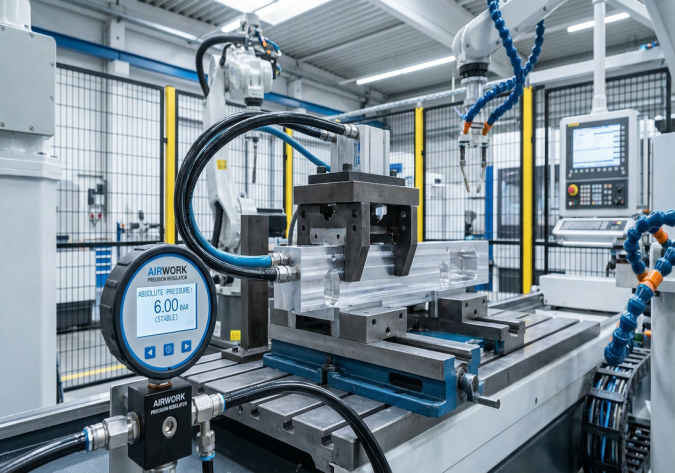
The Physics of Clamping Force and Secondary Pressure
To understand the impact of pressure fluctuations, we must examine the basic mechanical formula governing any pneumatic actuator:
- Force (F) = Pressure (P) x Area (A)
In this equation, the Area (A) is the surface area of the cylinder's internal piston, which is a physical constant. Therefore, the output Clamping Force (F) is directly proportional to the incoming air pressure (P).
In industrial pneumatics, we define two categories of pressure:
- Primary Pressure: The high-pressure air stored in the factory's main header lines, which is supplied directly by the central air compressor. This pressure fluctuates constantly (typically between 6 bar and 8.5 bar) as various heavy machines throughout the plant cycle on and off.
- Secondary Pressure: The regulated air pressure delivered from the outlet of the local FRL regulator to the downstream clamping tool (typically set at a constant 5 bar or 6 bar).
The core challenge for any manufacturing facility is that standard air regulators are not perfect. If the primary pressure fluctuates or if flow demand spikes, the regulator's outlet pressure—the secondary pressure—will fluctuate as well. This instability immediately alters the clamping force, directly compromising product repeatability.
The Technical Consequences of Secondary Pressure Instability
When the secondary pressure delivered to a pneumatic clamp is unstable, manufacturing facilities experience three severe operational issues:
1. Workpiece Slippage and Dimension Drift
If the secondary pressure drops by as little as 0.5 bar during a high-speed milling operation, the cylinder's clamping force can decrease by up to 10 percent. Under the massive forces of a CNC cutting spindle, this force reduction can allow the workpiece to slide or vibrate within the fixture. This results in dimensional drift, poor surface finish, scrapped parts, and potential cutting-tool breakage.
2. Micro-Deformations and Surface Damage
If the secondary pressure spikes, the clamp will over-tighten. For high-rigidity steel parts, this is rarely an issue. However, for modern lightweight materials—such as thin-walled aluminum castings, copper tubes, and plastic electronic housings—over-clamping causes localized micro-deformations. Once the clamp releases, the part may not spring back to its original shape, or it may exhibit permanent aesthetic indentations, leading to high reject rates.
3. Cycle-to-Cycle Quality Variance
In automated robotic welding, consistent clamp pressure is essential to maintain uniform electrical contact resistance between the parts. If the clamping force varies from cycle to cycle due to pressure instability, the weld quality will fluctuate, producing weak or porous joints that fail stress testing.
Root Causes of Secondary Pressure Instability
Maintenance teams must identify and troubleshoot the physical causes of secondary pressure drift:
- Pressure Droop: When a clamping cylinder extends rapidly, it demands a high volume of air. If the local regulator is under-sized, the pressure will drop dramatically during the stroke (droop), failing to reach full clamping force before the machining cycle begins.
- Regulator Hysteresis: Friction in the regulator's internal seals can cause it to lag. When the main header pressure fluctuates, a high-friction regulator cannot react quickly, leading to secondary pressure drift.
- Cross-Talk from Neighboring Actuators: If a clamping tool shares a small manifold with a large, heavy-duty air cylinder, the cylinder's rapid motion will starve the manifold of air volume, dropping the clamp's secondary pressure.
Engineering Strategies for Absolute Clamping Repeatability
To achieve absolute clamping repeatability, implement these three advanced design strategies:
1. Install Point-of-Use Precision Regulators
Never use a single large FRL unit to regulate a whole multi-station assembly line. Instead, install a dedicated, high-precision, point-of-use regulator (such as the AIRWORK series by JZPNU) immediately upstream of the clamping valve manifold. Precision regulators utilize a highly sensitive pilot-operated design and constant bleed orifices to respond instantly to dynamic pressure changes, maintaining secondary pressure stability to within 0.01 bar.
2. Integrate Local Surge Tanks (Accumulators)
To prevent dynamic pressure drops when a clamping tool cycles, install a small, local auxiliary volume tank (surge tank) between the FRL unit and the control valves. This tank acts as a localized buffer store of compressed air, providing the immediate high-volume flow required to extend the clamp without starving the line or causing a drop in secondary pressure.
3. Implement Pressure-Sensing Interlocks
To guarantee safety, never program a machine to begin cutting based solely on a timer. Instead, install an electronic pressure switch at the clamp's inlet port. Program the PLC to only initiate the machine cycle once the pressure switch confirms that the secondary pressure has reached and stabilized at the exact target value (e.g., 5.0 bar).
Conclusion: Achieving Perfect Force Consistency with AIRWORK
In B2B manufacturing, repeatability is the difference between a high-efficiency plant and a low-margin operation plagued by defects. Sourcing high-flow, high-precision regulators and specialized clamping control components from Zhejiang Jinzhi Pneumatic Technology Co., Ltd. (JZPNU) under the AIRWORK brand provides engineers with the hardware necessary to stabilize secondary pressures. By combining AIRWORK's ultra-sensitive regulators with dedicated surge volume design and digital pressure interlocks, maintenance managers can achieve flawless clamping repeatability, ensuring perfect part quality, zero tool breakage, and maximum factory safety.
Table of Contents
- Q: The impact of 'Secondary Pressure' stability on the repeatability of pneumatic clamping tools.
- The Physics of Clamping Force and Secondary Pressure
- The Technical Consequences of Secondary Pressure Instability
- Root Causes of Secondary Pressure Instability
- Engineering Strategies for Absolute Clamping Repeatability
- Conclusion: Achieving Perfect Force Consistency with AIRWORK