 EN
EN

Q: Why 'Pneumatic Silencers' are more than just noise reduction: Impact on back-pressure and valve life.
In any factory floor utilizing compressed air, the rapid, repetitive venting of exhaust air from solenoid valves creates a high-pitched, deafening hiss. To protect workers' hearing and comply with industrial noise level regulations, engineers install pneumatic silencers (often called mufflers) into the exhaust ports of directional control valves.
While most procurement teams view silencers as simple, low-cost safety commodities designed solely for noise reduction, this is a dangerous design oversight. In pneumatic engineering, the silencer is an active flow-control component. A poorly selected, incorrectly sized, or neglected silencer can severely compromise machine performance, generate destructive back-pressure, and cut the service life of expensive solenoid valves and cylinders in half. Below, the AIRWORK technical team explores the dual-role of pneumatic silencers, highlighting their impact on back-pressure, contaminants, and valve longevity.
1. The Physics of Noise and Exhaust Velocity
When a solenoid valve shifts, it opens a path for high-pressure air (typically 0.6 MPa) inside a cylinder chamber to escape into the atmosphere (0.1 MPa). This massive pressure differential causes the air to expand violently, exiting the exhaust port at supersonic velocities. This rapid expansion creates shear friction with the static ambient air, generating high-frequency noise levels that can easily exceed 100 decibels (dBA), well above the safe 85 dBA workplace limit.
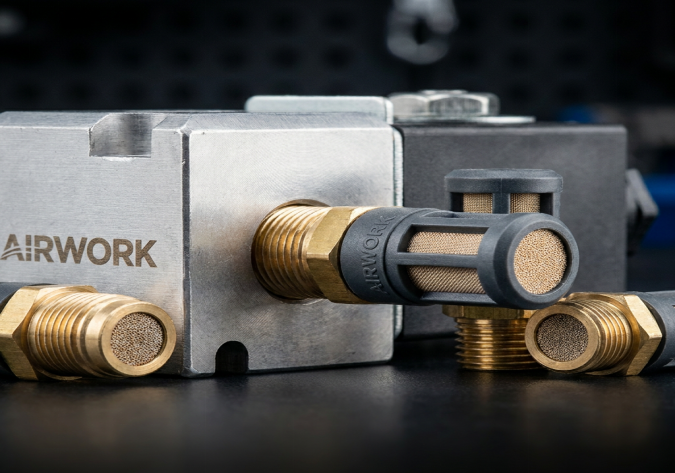
A pneumatic silencer works by diffusing this concentrated air stream. By routing the air through porous materials, such as sintered bronze or porous polyethylene, the silencer increases the surface area of the exhaust path. This slows down the air velocity, transforming a sharp, loud blast into a gentle, quiet hiss. However, this porous barrier also creates a restriction to air flow, which brings us to the core engineering challenge: back-pressure.
2. The Danger of Back-Pressure: Sluggishness and Seal Wear
Every silencer, by its very nature, introduces a minor restriction to the escaping air. This restriction creates a force known as back-pressure, which is the pressure that builds up inside the exhaust port and working lines of the valve.
- Impact on Actuator Speed: For a pneumatic cylinder to move, air must be fed into one side of the piston while the air on the opposite side is evacuated. If a silencer is clogged or undersized, the exhaust air cannot escape fast enough, building up back-pressure inside the exhausting cylinder chamber. This back-pressure resists the force of the incoming supply air, slowing down the cylinder's piston rod. Operators will observe a noticeable loss in machine speed and cycle efficiency.
- Destruction of Solenoid Valve Seals: Solenoid valve spools are designed to work within strict pressure differentials. When high back-pressure builds up in the exhaust gallery, it exerts unbalanced forces on the rubber spool seals (NBR/HNBR rings). This forces the seals to drag hard against the aluminum valve bore, leading to rapid frictional wear, tearing, and permanent internal leaks.
- Pilot System Failures: In pilot-operated valves, the pilot exhaust is often routed into the main exhaust gallery. If the main silencer is clogged, the resulting back-pressure can migrate into the pilot system, preventing the pilot plunger from seating properly. This leads to erratic valve shifting, failure to shift, or continuous air venting.
3. The Unsung Hero: Preventing Particulate Ingress
While silencers are famous for letting air out, their most critical role in valve longevity is keeping contaminants out. This is known as the vacuum-vortex effect.
- When a valve shifts high-velocity air out of the exhaust port, it creates a temporary, localized vacuum and low-pressure vortex at the port's exit as the air flow ceases.
- In a dusty factory environment (such as woodworking shops, cement plants, or dry packaging lines), this vortex draws surrounding airborne dust, metal shavings, and moisture directly into the exhaust port.
- Once inside the valve, these abrasive particulates score the precision-machined aluminum spool and tear the soft rubber seals, causing rapid valve failure.
Installing a high-quality silencer prevents this. The porous sintered metal or plastic acts as a dual-direction filter, venting exhaust clean air while physically blocking ambient particulates from entering the valve body during the low-pressure phase.
4. Selecting and Maintaining Silencers for Peak Performance
To optimize your pneumatic system, B2B buyers must select the correct silencer material and establish a regular maintenance schedule:
- Sintered Bronze Silencers: These are the industry standard. Made from microscopic brass beads fused together, they offer excellent mechanical strength, high flow rates, and moderate noise reduction. They are ideal for heavy-duty industrial settings.
- Porous Plastic Silencers: Constructed from high-density polyethylene (HDPE), these are lightweight, compact, and offer excellent noise attenuation. They are highly resistant to chemical vapors and moisture, making them the preferred choice for cleanrooms, laboratories, and washdown areas.
- Speed Control Silencers (Flow Control Mufflers): These specialized silencers feature an integrated adjustable needle screw. This allows engineers to regulate the exhaust flow rate directly at the valve exhaust port, enabling precise independent control of cylinder speed without needing inline flow valves.
- Cleaning and Replacement: Silencers must be treated as wear parts. Over time, they accumulate compressor oil mist and airborne dust, slowly clogging the micro-pores. If you notice a drop in cylinder speed or a rise in system noise, the silencer is likely clogged. Sintered bronze silencers can be removed and cleaned using an ultrasonic bath or a solvent degreaser. Plastic silencers should be discarded and replaced, as they are highly cost-effective.
The AIRWORK (JZPNU) Advantage
At Zhejiang Jinzhi Pneumatic Technology Co., Ltd. (JZPNU), we design our AIRWORK brand valves and accessories as a unified, high-performance system.
- High-Flow Silencer Geometry: Our sintered bronze and plastic silencers are manufactured with mathematically optimized pore sizes, ensuring maximum noise reduction while keeping back-pressure to an absolute minimum.
- Speed Control Silencers: We offer heavy-duty brass speed control silencers that allow fine-threaded needle adjustment, ensuring stable cylinder speeds and long-term positioning accuracy.
- Clean Assembly Standards: Every AIRWORK silencer is cleaned and tested to guarantee zero loose metal particles or plastic fibers can detach and migrate into your solenoid valve spools.
By selecting the correct AIRWORK silencer and treating it as a critical operational component rather than a simple afterthought, you can protect your workforce from noise pollution, maintain high machinery cycle speeds, and significantly prolong the operating life of your pneumatic control valves.
Table of Contents
- Q: Why 'Pneumatic Silencers' are more than just noise reduction: Impact on back-pressure and valve life.
- 1. The Physics of Noise and Exhaust Velocity
- 2. The Danger of Back-Pressure: Sluggishness and Seal Wear
- 3. The Unsung Hero: Preventing Particulate Ingress
- 4. Selecting and Maintaining Silencers for Peak Performance
- The AIRWORK (JZPNU) Advantage