 EN
EN

Q: How to prevent Water Condensation in pneumatic lines: Selecting the right auto-drain FRL unit.
Water condensation is one of the most persistent and costly challenges in modern pneumatic systems. For maintenance engineers and facility managers, the presence of liquid water in compressed air lines is a recipe for operational disaster. It washes away essential lubrication from air cylinders, corrodes delicate solenoid valves, clogs precision orifices, and causes premature failure of pneumatic tools. Ultimately, this leads to unscheduled downtime and expensive replacement cycles.
To prevent water condensation from ruining downstream equipment, selecting and installing the right auto-drain Filter, Regulator, and Lubricator (FRL) unit is the single most effective baseline strategy. This comprehensive technical guide analyzes why condensation occurs, how auto-drain mechanisms function, and how to select the ideal FRL setup to maintain dry, clean, and reliable air lines.
Understanding the Root Cause: Why Does Water Condense in Pneumatic Lines?
Before exploring filtration hardware, it is critical to understand the physics of compressed air. Ambient air drawn into an air compressor contains water vapor. When the compressor reduces the volume of the air, its pressure rises, and its temperature increases significantly. While hot compressed air can hold a substantial amount of water vapor, the air begins to cool as it travels downstream through the distribution piping.
As the compressed air temperature drops below its dew point, the water vapor can no longer remain in a gaseous state. It condenses into liquid water droplets. This condensation accumulates along the pipe walls and travels at high speeds toward your pneumatic actuators and control systems. High humidity climates, rapid temperature drops in factory environments, and long piping runs all accelerate this condensation process.
The Critical Role of the FRL Unit in Moisture Control
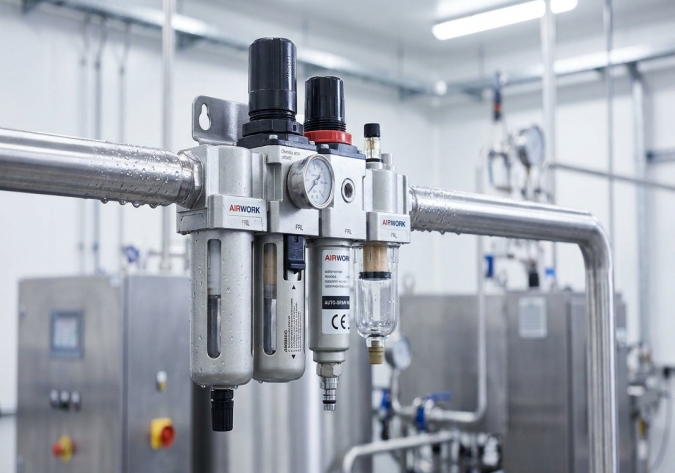
An FRL unit is the protective gateway for any pneumatic machine drop. The filter (F) stage is specifically engineered to remove solid particulates and separate liquid water from the air stream using centrifugal force.
As wet air enters the filter bowl, internal deflector vanes force the incoming air into a high-speed swirling motion. This rotational force flings heavy liquid water droplets outward against the inner walls of the filter bowl. The liquid then drains down past a baffle into the quiet zone at the bottom of the bowl, preventing the air flow from picking up the liquid again.
However, a filter is only useful if the collected water is removed from the bowl before it reaches maximum capacity. This is where the auto-drain mechanism becomes essential.
Why Manual Drains Fail in High-Uptime Factories
Many entry-level FRL units are equipped with manual drains, which require a maintenance technician to physically turn a valve to purge the collected liquid. While cost-effective upfront, manual drains are highly unreliable in busy B2B industrial environments:
- Neglect and Human Error: Technicians operating under tight schedules often forget to drain the bowls. Once the water level rises past the quiet zone baffle, the compressed air stream immediately atomizes and carries the accumulated water directly downstream into your machinery.
- Safety and Accessibility: FRL units are often installed in hard-to-reach locations, such as high overhead piping or deep inside machine enclosures, making manual servicing difficult and hazardous.
- Flooding Spikes: During high-humidity summer months, filter bowls can fill with water in a matter of hours, far exceeding the typical weekly maintenance schedule.
Transitioning to an auto-drain FRL unit removes human error from the equation, ensuring continuous, autonomous moisture removal.
Analyzing Auto-Drain Technologies: Float-Type vs. Electronic-Timer Drains
When sourcing an auto-drain FRL unit from direct manufacturers like Zhejiang Jinzhi Pneumatic Technology Co., Ltd. (JZPNU) under their premium AIRWORK brand, you will primarily choose between two main auto-drain mechanisms:
1. Mechanical Float-Type Auto-Drains
Mechanical float-type drains operate entirely on buoyancy and air pressure, requiring no electrical power supply. As liquid water accumulates in the filter bowl, an internal float rises. Once the water reaches a specific level, the buoyancy of the float overcomes the internal sealing force, opening a pilot valve. This shifts a piston, which unseats the main drain seal and allows the system pressure to force the water out through the drain port. As the water level drops, the float sinks, resealing the valve.
There are two main configurations of float drains:
- Normally Open (NO): The drain remains open when the system is depressurized. This is ideal for factories that shut down their compressors overnight, allowing any remaining condensation to drain out via gravity. When the system is pressurized, the drain closes automatically.
- Normally Closed (NC): The drain remains closed when depressurized, requiring a minimum operating pressure (usually around 1.5 bar) to function and seal. This is preferred for low-flow systems or small portable compressors to prevent air loss during start-up.
2. Electronic Solenoid Timer Drains
For heavy-duty applications with high water volumes or heavily contaminated air, electronic solenoid timer drains are highly effective. These units use a solid-state timer to open a robust brass solenoid valve at pre-set intervals (e.g., every 10 minutes for a duration of 3 seconds). While they require electrical wiring, they are less prone to clogging from sludge or pipe scale compared to mechanical floats.
How to Select the Right Auto-Drain FRL Unit: A B2B Checklist
To ensure your selected FRL unit successfully prevents water carryover, evaluate these engineering criteria:
1. Flow Rate and Port Sizing
Never size an FRL unit based solely on your pipe diameter. You must calculate the total flow rate of your downstream equipment in Standard Liters per Minute (L/min) or Standard Cubic Feet per Minute (SCFM). Under-sizing the FRL causes a massive pressure drop and high velocity, which pulls liquid water past the centrifugal deflector before it can settle.
2. Bowl Material and Chemical Exposure
- Polycarbonate Bowls: Offer excellent visibility of the water level but are vulnerable to synthetic compressor lubricants, solvents, and chemical vapors. Always specify protective metal bowls or metal bowl guards.
- Metal Bowls (Zinc-Alloy or Aluminum): Necessary for high-pressure systems, high temperatures, and environments with chemical exposure.
3. Filtration Rating
Standard FRL filters utilize a 40-micron or 5-micron element. While this is perfect for bulk water separation, you may need to pair it with a coalescing mist separator downstream if you require ultra-dry air for sensitive instrumentation.
Best Practices for System Installation
Even the best AIRWORK auto-drain FRL unit requires proper installation to maximize efficiency:
- Sloped Piping: Main header pipes should slope downward away from the compressor at a 1 in 100 angle.
- Top-Takeoff Drop Legs: Always run machine drops from the top of the main header line, not the bottom. This prevents gravity-fed water in the main line from immediately flooding down into the FRL.
- Location: Install the FRL as close as possible to the pneumatic application. This minimizes the distance over which the air can cool and form new condensation after passing through the filter.
Conclusion: The AIRWORK Advantage
Investing in a premium modular auto-drain FRL unit from AIRWORK by JZPNU is a strategic decision that pays dividends in reduced maintenance costs and zero water-related downtime. With precision-engineered mechanical floats, robust zinc-alloy or technopolymer housings, and high-flow efficiency, AIRWORK ensures your pneumatic lines remain dry and your factory uptime stays at its peak.
Table of Contents
- Q: How to prevent Water Condensation in pneumatic lines: Selecting the right auto-drain FRL unit.
- Understanding the Root Cause: Why Does Water Condense in Pneumatic Lines?
- The Critical Role of the FRL Unit in Moisture Control
- Why Manual Drains Fail in High-Uptime Factories
- Analyzing Auto-Drain Technologies: Float-Type vs. Electronic-Timer Drains
- How to Select the Right Auto-Drain FRL Unit: A B2B Checklist
- Best Practices for System Installation
- Conclusion: The AIRWORK Advantage