 EN
EN

Q: How are 'Smart Pneumatics' and integrated sensors transforming global factory efficiency?
Introduction: The Digital Evolution of Fluid Power
For decades, industrial pneumatic systems have been the reliable, cost-effective workhorses of manufacturing, converting compressed air into mechanical force with absolute simplicity. However, traditional pneumatics are inherently 'blind' and 'deaf.' A standard pneumatic cylinder operates back and forth without reporting its actual stroke speed, seal condition, or air consumption. When a component fails, it often does so unexpectedly, causing sudden production shutdowns and expensive emergency repairs.
Today, the manufacturing sector is undergoing a massive digital transformation driven by the Industrial Internet of Things (IIoT) and Industry 4.0. Pneumatics is no longer just mechanical; it has evolved into Smart Pneumatics. By integrating micro-sensors, digital controllers, and high-speed communication interfaces directly into valves, actuators, and FRL units, manufacturers can turn standard pneumatic components into intelligent, data-generating nodes on the factory network.
This guide explores how smart pneumatics and integrated sensors are transforming factory efficiency, energy management, and maintenance strategies.
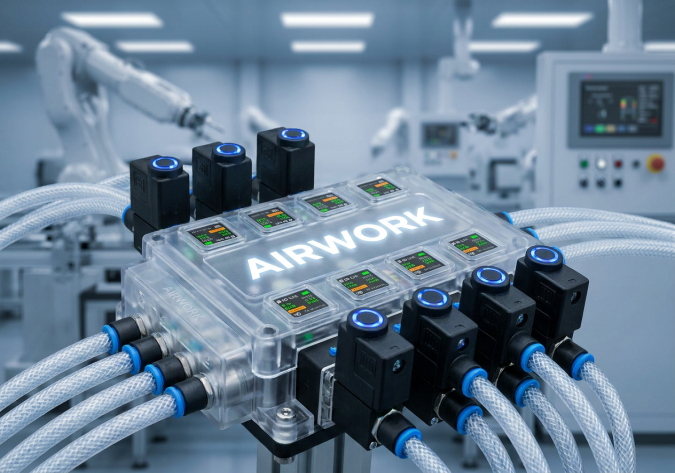
1. Real-Time Condition Monitoring: The Power of Data
Smart pneumatics replaces guesswork with real-time operational data. By embedding micro-sensors within pneumatic components, plant managers and PLC systems can track a wide range of operational parameters:
- Cylinder Position and Speed: Traditional reed switches only indicate when a cylinder is fully extended or retracted. Modern smart position sensors utilize continuous magnetic tracking to measure the piston's exact position, stroke speed, and acceleration profiles throughout the entire stroke. This allows for precise motion control, smoother deceleration, and immediate detection of mechanical binding.
- Operating Pressure and Flow: Smart FRL units and digital pressure switches continuously measure the incoming air pressure and flow rate. A sudden drop in pressure or an unexpected spike in flow rate indicates an upstream leak or a stuck valve spool, allowing for immediate corrective action.
- Core Temperature: Built-in temperature sensors monitor the temperature of solenoid valve coils and cylinder bodies. Overheating is a primary indicator of electrical overload or intense mechanical friction, warning maintenance teams before insulation fails.
2. Transitioning to Predictive Maintenance (PdM)
In traditional factory setups, maintenance is reactive (fixing components after they break) or preventative (replacing components based on a set calendar schedule, which often wastes perfectly good parts). Smart pneumatics enables Predictive Maintenance (PdM), which maximizes component life and eliminates unplanned downtime:
- How PdM Works: Embedded sensors feed real-time performance data to edge controllers or cloud-based analytics platforms. Predictive algorithms analyze these data streams to detect micro-deviations from baseline parameters. For example, if a pneumatic cylinder's stroke time increases by just 0.1 seconds over a week, or its breakaway pressure rises slightly, the algorithm identifies this as a sign of internal seal wear.
- The Operational Benefit: Instead of a sudden fitting blowout during a busy shift, the system automatically triggers a low-priority maintenance alert. Technicians can schedule a quick seal replacement during planned weekend downtime, avoiding expensive, unexpected line stoppages and maximizing plant labor efficiency.
3. Revolutionizing Industrial Energy Efficiency
Compressed air is highly energy-intensive, and electricity costs represent the largest expense over a compressor's lifecycle. Smart pneumatics provides factories with advanced tools to combat energy waste:
- Automated Leak Detection: Smart FRL units monitor air flow rates during factory idle periods (such as lunch breaks or shift changes). If the system detects a constant background flow of air when all machines are paused, it calculates the exact volume of air leaks and quantifies the financial loss in real time, helping maintenance teams locate and repair leaks quickly.
- Dynamic Pressure Adjustment: Traditional systems operate at a fixed maximum pressure (typically 6.0 to 7.0 bar) for both the extend and retract strokes. However, retracting an empty cylinder requires significantly less force than extending it under load. Smart valve manifolds equipped with proportional pressure regulators can dynamically lower the pressure on the return stroke (e.g., down to 3.0 bar), cutting overall air consumption by up to 30 percent.
4. The Critical Role of IO-Link Communication
The digital transformation of pneumatics depends on a standardized communication protocol. IO-Link has emerged as the global standard for field-level industrial communications:
- Simple Point-to-Point Cabling: IO-Link uses standard, unshielded 3-wire cables to connect sensors and valves to a centralized IO-Link master, eliminating expensive, bulky multi-core fieldbus wiring.
- Bidirectional Data Exchange: IO-Link is bidirectional, allowing the PLC to read detailed diagnostic data from the sensor while simultaneously writing operational parameters back to the device, facilitating rapid product changeovers on the fly.
- Plug-and-Play Device Replacement: If a smart sensor is damaged, a technician can plug in a new one. The IO-Link master automatically detects the new device and downloads the exact configuration parameters, eliminating manual calibration and reducing recovery times to seconds.
5. Sourcing Smart Pneumatic Solutions: The JZPNU AIRWORK Advantage
As a leading, forward-looking manufacturer of pneumatic components, Zhejiang Jinzhi Pneumatic Technology Co., Ltd. (JZPNU) is actively investing in smart technologies. Our AIRWORK line includes advanced components designed for modern smart factories:
- Digital Pressure Switches: Our high-accuracy digital pressure sensors feature bright LCD screens, adjustable hysteresis, and dual switching outputs with integrated IO-Link communication, ensuring precise, real-time pressure monitoring.
- Smart Cylinder Position Sensors: We offer continuous analog position transmitters that easily mount to our DNC and MA series cylinders, providing high-resolution position feedback for advanced automation setups.
- Intelligent Solenoid Valve Manifolds: Our custom OEM/ODM valve manifolds can be integrated with smart diagnostic modules, allowing B2B buyers to monitor coil status, cycle counts, and response times in real time.
- Agile Collaborative R&D: We work closely with our global OEM clients to design and manufacture customized smart pneumatic subsystems, helping them transition their machinery into fully compliant Industry 4.0 systems.
Conclusion: Strategic Sourcing Recommendations
The digital transformation of industrial pneumatics is no longer a future concept; it is an active competitive advantage. Plant managers and machinery designers who adopt smart pneumatics can significantly reduce unplanned downtime, slash energy bills, and improve product quality. Sourcing directors should look beyond short-term hardware costs and prioritize components that support integrated sensors and standard communication protocols. By partnering with a technologically advanced manufacturer like JZPNU and deploying smart AIRWORK systems, factories can unlock new levels of capital efficiency and future-proof their operations. Contact JZPNU's smart automation department today to begin your digital factory upgrade.
Table of Contents
- Q: How are 'Smart Pneumatics' and integrated sensors transforming global factory efficiency?
- Introduction: The Digital Evolution of Fluid Power
- 1. Real-Time Condition Monitoring: The Power of Data
- 2. Transitioning to Predictive Maintenance (PdM)
- 3. Revolutionizing Industrial Energy Efficiency
- 4. The Critical Role of IO-Link Communication
- 5. Sourcing Smart Pneumatic Solutions: The JZPNU AIRWORK Advantage
- Conclusion: Strategic Sourcing Recommendations